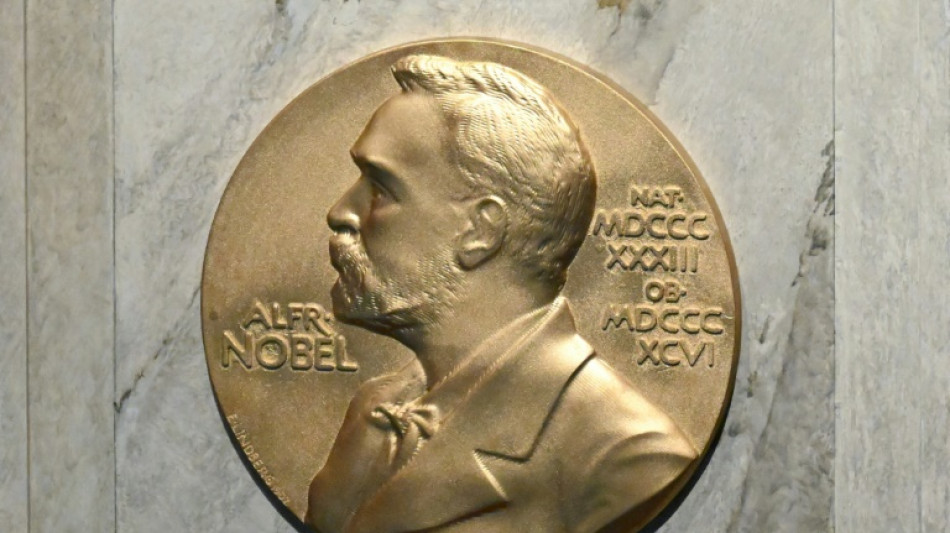
2024 Nobels offer glimmer of hope as global crises mount / Photo: Jonathan NACKSTRAND - AFP

 Warren Buffett steps down as Berkshire Hathaway chairman

 Isolated Syrian-Druze city blames Damascus for shortages

 Kerry James Marshall: American 'blackness' painter celebrated in Europe

 Infantino 'must go', says German FA vice-president

 Japan's busiest rail station tests robot bins

 Backpackers fret over Australian visa crackdown

 Bank of Japan hikes rates to 31-year high to battle inflation

 AI doomsday warnings unlikely to slow IPOs but questions linger

 In Brazil's Amazon, the hunt for oil fuels hopes and fears

 Baby orangutans in India expose 'frightening' scale of trafficking

 Oversight Board blasts 'inadequate' Meta safeguards for AI deepfakes

 Harry makes first public appearance since return to UK

 Princess Diana's brother makes new explosive claims against Charles

 Trump admin overhauls key protection for endangered species

 Mbappe draws political fire over Ceuta t-shirt controversy

 Third malaria death in Germany from outbreak tied to Frankfurt airport

 AtlasClear Holdings Reports Preliminary Fiscal 2026 Revenue of Approximately $20.1 Million, Up 85%; Revenue Plus Interest Income of Approximately $21.9 Million

 'Another arrow to the quiver': World Bank posts record private capital mobilization

 Ireland to boycott Eurovision 2027 over Gaza

 India's Tata Sons reappoints N. Chandrasekaran as chairman

 Germany urges EU action against China to defend carmakers

 Japan eyes changing prostitution law to punish sex buyers

 Modi pitches India as global chipmaking hub

 Ukraine plans record defence spending in 2027

 NASA scan discovers new, 'once in a century' Moon crater

Next week's Nobel Prize announcements will crown achievements that made the world a better place, a glimmer of optimism amid a spiralling Middle East conflict, war in Ukraine, famine in Sudan and a collapsing climate.
The prize winners will be announced between October 7 and 14.
For the Peace Prize, the most prestigious of the six Nobels, experts say it is harder than ever to predict the Norwegian Nobel Committee's pick, to be revealed on October 11.
Swedish philanthropist Alfred Nobel created the prizes in his 1895 will, stipulating that they go to those who have "conferred the greatest benefit on humankind".
But given the bleak state of world affairs, perhaps no one should get the Peace Prize this year, suggested Dan Smith, the head of the Stockholm International Peace Research Institute.
"Maybe this is the time to say, 'Yes, many people are working very hard, but it's not getting there and we need more people and world leaders to wake up and realise that we are in an extremely dangerous situation,'" he said.
"We have now over 50 armed conflicts around the world. The lethality of those armed conflicts has increased dramatically in the past two decades," he said.
- 'A worthy candidate' -
Not awarding a Peace Prize would be viewed as an acknowledgement of failure by the award committee, and is therefore deemed unlikely.
"I'm confident there will be a worthy candidate for the Peace Prize this year as well," the secretary of the committee, Olav Njolstad, told AFP.
Last year, the award went to jailed Iranian activist Narges Mohammadi for her fight against the oppression of women in Iran.
A total of 286 nominations are known to have been submitted for the Peace Prize this year, though the committee keeps the names sealed for 50 years.
Those entitled to nominate are however allowed to reveal their picks.
Among those known to be on the list are some actors involved in the Middle East, such as the UN agency for Palestinian refugees, UNRWA; Palestinian human rights group Al-Haq; its Israeli counterpart B'Tselem and the International Court of Justice.
Given the existential risks to humanity posed by weapons systems that can operate autonomously without human control, several Nobel-watchers have cited the Campaign to Stop Killer Robots as a possible laureate.
The Nobel Prize in Literature, to be announced on October 10, likewise generates frenzied speculation every year.
Several pundits believe Chinese author Can Xue will be the Swedish Academy's choice this year -- and she has the lowest odds on several betting sites.
An avant-garde fiction writer often likened to Kafka, her experimental style flips between utopia and dystopia and transforms the mundane into the surreal.
"I think it will be a woman from a language zone outside Europe," Bjorn Wiman, culture editor at Sweden's newspaper of record Dagens Nyheter, told AFP.
The last Chinese author to win was Mo Yan in 2012.
- Surprise name for literature? -
With no public shortlist, it is always difficult to predict which way the 18-member Swedish Academy is leaning.
Names making the rounds in Stockholm's literary circles include Australian novelist Gerald Murnane, Britain's Salman Rushdie, Antiguan-American writer Jamaica Kincaid, Canadian poet Anne Carson, Hungary's Laszlo Krasznahorkai, Mircea Cartarescu of Romania, Kenya's Ngugi wa Thiong'o and Japan's Haruki Murakami.
Last year, Norwegian playwright Jon Fosse took home the honour.
The Academy often shines a spotlight on relatively unknown writers.
"I think they've gone to great pains to find some writer that will catch the culture commentariat with their pants down," Wiman said.
The Nobel season kicks off on Monday with the Prize in Physiology or Medicine.
Analytics group Clarivate, which monitors potential science laureates, speculated that award could go to research on the genetics of lipid metabolism, which has led to new drugs to treat cardiovascular diseases.
Another candidate could be studies of the basal ganglia, which are parts of the brain associated with motor control and emotions.
Or the prize could go to the discovery of genomic imprinting, which has increased our understanding of epigenetics and mammalian development.
Last year, the Prize in Physiology or Medicine went to researchers Katalin Kariko and Drew Weissman for their work on messenger RNA technology that paved the way for groundbreaking Covid-19 vaccines.
The Prize in Physics follows on Tuesday ahead of Wednesday's Prize in Chemistry. The Nobel Memorial Prize in Economic Sciences then wraps up the 2024 Nobel season on Monday, October 14.
This year's laureates will take home the prized sum of 11 million kronor ($1 million) per discipline, to be shared if there is more than one winner.
H.Cho--CPN