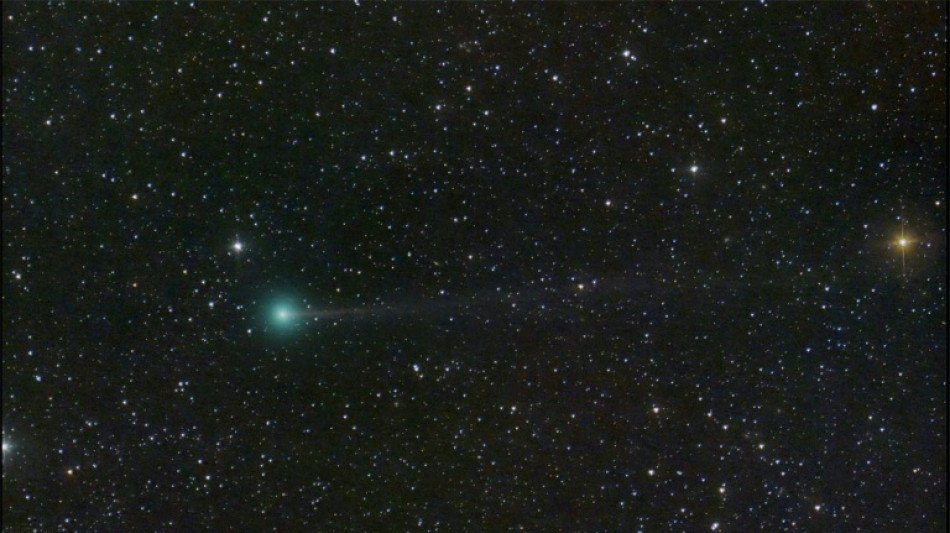
Fireworks forecast if comet survives risky Sun flypast / Photo: Dan Bartlett - NASA/AFP

 Warren Buffett steps down as Berkshire Hathaway chairman

 Isolated Syrian-Druze city blames Damascus for shortages

 Kerry James Marshall: American 'blackness' painter celebrated in Europe

 Infantino 'must go', says German FA vice-president

 Japan's busiest rail station tests robot bins

 Backpackers fret over Australian visa crackdown

 Bank of Japan hikes rates to 31-year high to battle inflation

 AI doomsday warnings unlikely to slow IPOs but questions linger

 In Brazil's Amazon, the hunt for oil fuels hopes and fears

 Baby orangutans in India expose 'frightening' scale of trafficking

 Oversight Board blasts 'inadequate' Meta safeguards for AI deepfakes

 Harry makes first public appearance since return to UK

 Princess Diana's brother makes new explosive claims against Charles

 Trump admin overhauls key protection for endangered species

 Mbappe draws political fire over Ceuta t-shirt controversy

 Third malaria death in Germany from outbreak tied to Frankfurt airport

 AtlasClear Holdings Reports Preliminary Fiscal 2026 Revenue of Approximately $20.1 Million, Up 85%; Revenue Plus Interest Income of Approximately $21.9 Million

 'Another arrow to the quiver': World Bank posts record private capital mobilization

 Ireland to boycott Eurovision 2027 over Gaza

 India's Tata Sons reappoints N. Chandrasekaran as chairman

 Germany urges EU action against China to defend carmakers

 Japan eyes changing prostitution law to punish sex buyers

 Modi pitches India as global chipmaking hub

 Ukraine plans record defence spending in 2027

 NASA scan discovers new, 'once in a century' Moon crater

A comet is expected to risk having its tail clipped on Friday by flying perilously close to the Sun, promising fireworks next month should it survive the fraught flypast.
Astronomers believe the Tsuchinshan-ATLAS comet has been hurtling headfirst through the void of space towards the centre of the Solar System for millions of years.
Named for the Chinese observatory and South African programme which detected and confirmed its existence in 2023, the ball of rock and ice may have formed at a distance up to 400,000 times that between Earth and the Sun, models suggest.
Up till now, you had to be in the southern hemisphere to hope to see it with the naked eye.
But on Friday evening it is projected to cross as close to the Sun as it will get, before returning towards Earth.
From October 13 the comet will be visible in the northern hemisphere.
If the weather is right "it will jump to the eye" every night "in the direction of the setting sun", astronomer Lucie Maquet at the Paris Observatory told AFP.
- 'A brilliant comet' -
But that forecast assumes the comet does not fly too close to the Sun.
When comets approach our star, the melting ice contained at their core lets out a long trail of dust which reflects sunlight.
This characteristic tail is also the sign the comet is degassing. If the Sun affects the comet too much, it risks disintegrating.
As the cluster of frozen water and rock "may not resist the force of the Sun's gravity", a catastrophe "is always possible", Maquet said.
The good news is that the comet, officially named "C/2023 A3" by scientists, seems to have a rather massive core.
So "there's a good chance it will survive" its sunny pass-by, the astronomer said.
Initial forecasts predicting the comet would be especially bright as it visited our skies have since been revised down.
"But it will certainly be a brilliant comet," Maquet said.
- Unpredictable future -
The comet's future course is unpredictable.
Its solar sojourn will not be without consequences on its voyage, disturbed by the gravitational pull of the celestial objects it has crossed and by the weightloss inflicted by the Sun's harsh rays.
According to the models of The Paris Observatory's Institute of Celestial Mechanics, it could be "ejected from the solar system and lost among the stars".
All depends on the encounters the comet makes on its journey through the Oort cloud -- a frigid belt of tiny objects theorised to exist at the far end of the Solar System up to 3.2 light-years away -- in a few thousand years' time.
It would be enough, Maquet said, for the comet to pass by an object "that deflects it enough for a return trip to the Solar System".
P.Kolisnyk--CPN