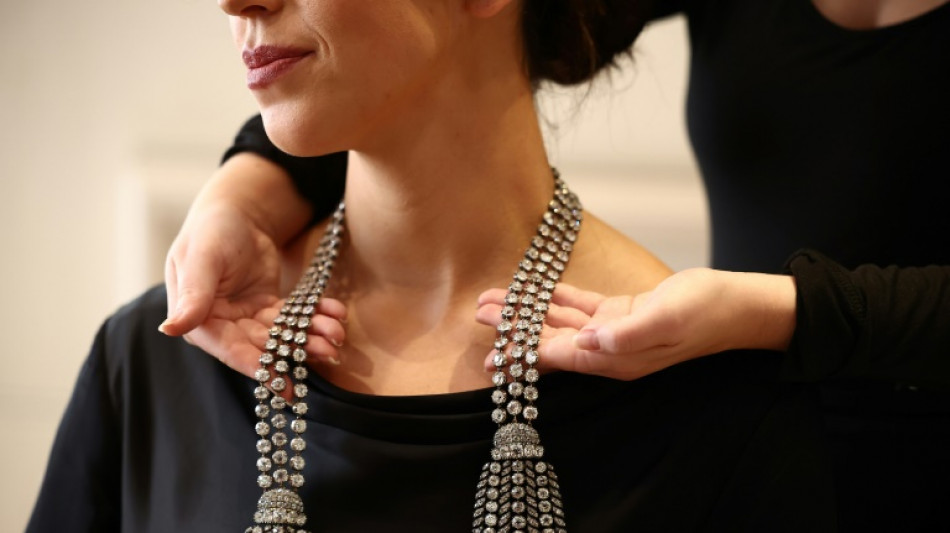
Mysterious 18th century diamond necklace set for auction / Photo: HENRY NICHOLLS - AFP

 Warren Buffett steps down as Berkshire Hathaway chairman

 Isolated Syrian-Druze city blames Damascus for shortages

 Kerry James Marshall: American 'blackness' painter celebrated in Europe

 Infantino 'must go', says German FA vice-president

 Japan's busiest rail station tests robot bins

 Backpackers fret over Australian visa crackdown

 Bank of Japan hikes rates to 31-year high to battle inflation

 AI doomsday warnings unlikely to slow IPOs but questions linger

 In Brazil's Amazon, the hunt for oil fuels hopes and fears

 Baby orangutans in India expose 'frightening' scale of trafficking

 Oversight Board blasts 'inadequate' Meta safeguards for AI deepfakes

 Harry makes first public appearance since return to UK

 Princess Diana's brother makes new explosive claims against Charles

 Trump admin overhauls key protection for endangered species

 Mbappe draws political fire over Ceuta t-shirt controversy

 Third malaria death in Germany from outbreak tied to Frankfurt airport

 AtlasClear Holdings Reports Preliminary Fiscal 2026 Revenue of Approximately $20.1 Million, Up 85%; Revenue Plus Interest Income of Approximately $21.9 Million

 'Another arrow to the quiver': World Bank posts record private capital mobilization

 Ireland to boycott Eurovision 2027 over Gaza

 India's Tata Sons reappoints N. Chandrasekaran as chairman

 Germany urges EU action against China to defend carmakers

 Japan eyes changing prostitution law to punish sex buyers

 Modi pitches India as global chipmaking hub

 Ukraine plans record defence spending in 2027

 NASA scan discovers new, 'once in a century' Moon crater

A mysterious 18th century necklace made from around 500 diamonds, some of which are believed to have been taken from a piece that contributed to Marie Antoinette's demise, will go on sale in November, Sotheby's said on Monday.
The piece, from a private Asian collection, will go under the hammer in Geneva on November 11, with online bidding opening on the auction house's website on October 25.
The necklace, which is composed of three rows of diamonds finished with a diamond tassel at each end, will make its first public appearance in 50 years on Monday, and is expected to fetch between $1.8 and $2.8 million.
"It's a wonderful find because, normally, jewellery in the 18th century was broken up in order to be repurposed... so to have an intact piece of the Georgian period of this importance, this amount of carats... is absolutely fabulous," Andres White Correal, chairman of the Sotheby's jewelry department, told AFP.
"The jewel has passed from families to families. We can start at the early 20th century when it was part of the collection of the Marquesses of Anglesey," he added.
Members of this aristocratic family are believed to have worn the jewel twice in public: once at the 1937 coronation of King George VI and once at his daughter Queen Elizabeth II's coronation in 1953.
Beyond that, little is known of the necklace, including who designed it and for whom it was commissioned, although the auction house believes that such an impressive antique jewel could only have been created for a royal family.
It probably would have been made during the decade preceding the French Revolution, it added.
It is thought that some of the diamonds may have come from the famous necklace linked to what became the scandal of the "Affair of the Necklace", which contributed to the advent of the French Revolution and eventually Marie-Antoinette's death, said Sotheby's.
The auction house said the diamonds are likely to have been sourced "from the legendary Golconda mines in India".
The diamonds from Golconda are still considered to be the purest and most dazzling ever mined.
The necklace will be on public display in London until Wednesday before beginning a tour that will take it to Hong Kong, New York and Taiwan.
Y.Ponomarenko--CPN