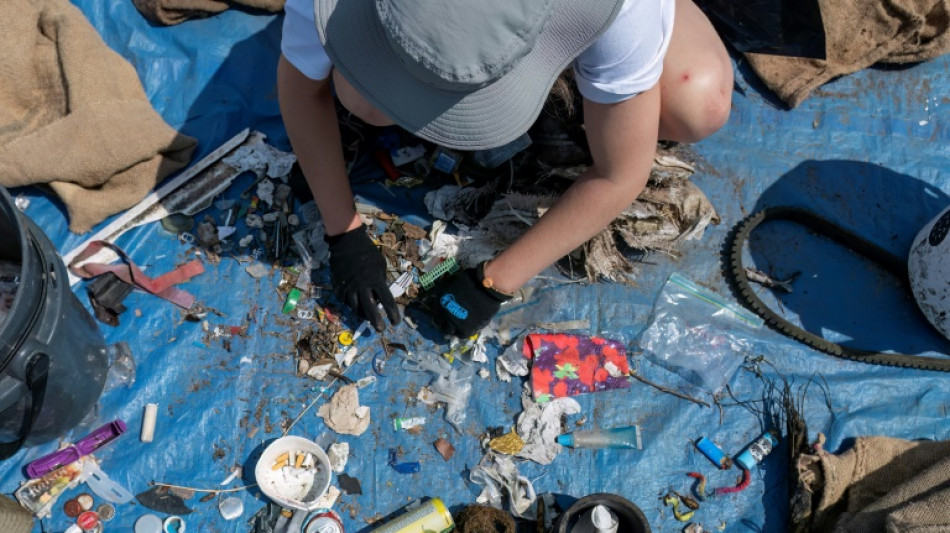
How plastic pollution poses challenge for Canada marine conservation / Photo: Sebastien ST-JEAN - AFP

 Warren Buffett steps down as Berkshire Hathaway chairman

 Isolated Syrian-Druze city blames Damascus for shortages

 Kerry James Marshall: American 'blackness' painter celebrated in Europe

 Infantino 'must go', says German FA vice-president

 Japan's busiest rail station tests robot bins

 Backpackers fret over Australian visa crackdown

 Bank of Japan hikes rates to 31-year high to battle inflation

 AI doomsday warnings unlikely to slow IPOs but questions linger

 In Brazil's Amazon, the hunt for oil fuels hopes and fears

 Baby orangutans in India expose 'frightening' scale of trafficking

 Oversight Board blasts 'inadequate' Meta safeguards for AI deepfakes

 Harry makes first public appearance since return to UK

 Princess Diana's brother makes new explosive claims against Charles

 Trump admin overhauls key protection for endangered species

 Mbappe draws political fire over Ceuta t-shirt controversy

 Third malaria death in Germany from outbreak tied to Frankfurt airport

 AtlasClear Holdings Reports Preliminary Fiscal 2026 Revenue of Approximately $20.1 Million, Up 85%; Revenue Plus Interest Income of Approximately $21.9 Million

 'Another arrow to the quiver': World Bank posts record private capital mobilization

 Ireland to boycott Eurovision 2027 over Gaza

 India's Tata Sons reappoints N. Chandrasekaran as chairman

 Germany urges EU action against China to defend carmakers

 Japan eyes changing prostitution law to punish sex buyers

 Modi pitches India as global chipmaking hub

 Ukraine plans record defence spending in 2027

 NASA scan discovers new, 'once in a century' Moon crater

One of the largest producers of plastic waste per capita, Canada is struggling to protect its designated marine protected areas from this pollution, experts warn.
Here are some key points about the issue facing the North American country.
- Significant plastic pollution -
With more than four million tonnes produced each year, Canada generates "two to four times more" plastic pollution per person than the global average, said Anthony Merante of the NGO Oceana.
In 2020, more than 90 percent of plastic waste ended up in landfills or was incinerated, and only seven percent was recycled, according to the Canadian environment ministry.
The remaining roughly two percent, or 90,000 tonnes, ended up in the environment.
"Plastic pollution is so ubiquitous at this point, we can't protect marine protected areas from plastic pollution unless we stop plastic pollution at the source," said Merante, head of Oceana Canada's plastics campaign.
Globally, annual plastic production has more than doubled in 20 years to reach 460 million tonnes.
Only nine percent is recycled, according to the Organization for Economic Co-operation and Development (OECD).
And more than half of it is single-use packaging -- "things that we use for a few moments and that end up lasting hundreds of years," said Merante.
- New regulations -
In June 2022, Prime Minister Justin Trudeau's federal government banned six types of single-use plastics with the goal of achieving zero plastic waste by 2030.
The regulation is being challenged in court by Canadian and American plastics manufacturers, as well as petrochemical firms.
Several municipalities, including Montreal, Vancouver and Edmonton, have already banned certain single-use plastics.
More biodegradable utensils are being found on the banks near the island city of Montreal, said Anne-Marie Asselin, a marine biologist who has been carrying out collection campaigns along the Saint Lawrence River for five years.
This shows that people's "behaviors have not changed," but the kind of waste now generated has "much less impact on the environment," she noted.
Ottawa is also working on creating a federal plastics registry.
The goal is to hold manufacturers accountable by requiring them to report on the life cycle of the plastics they put into circulation.
In the case of federal marine protected areas, few measures have been put in place against plastic pollution.
The Department of Fisheries and Oceans maintains that it is, however, "taken into account" when creating new marine protected areas and that since 2019, it has been prohibited to dump waste in protected areas.
Y.Ibrahim--CPN