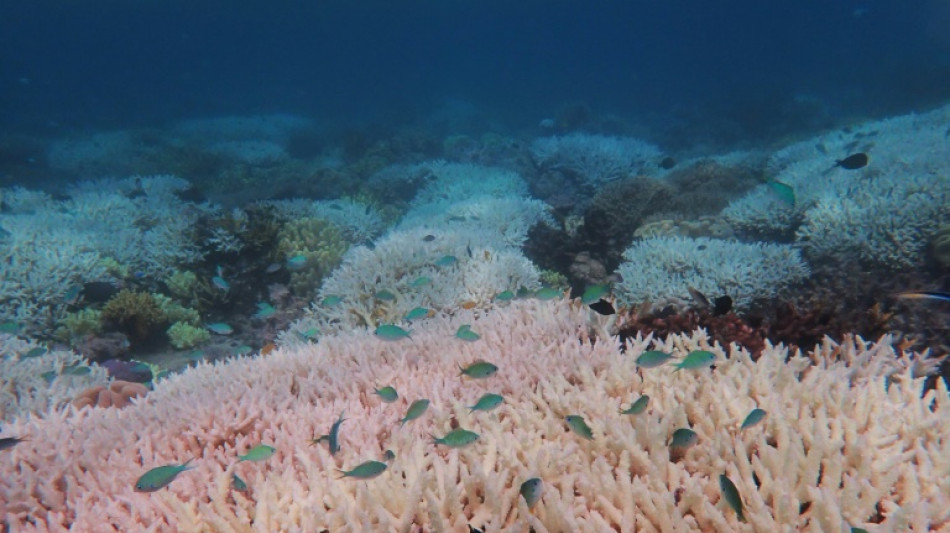
Summer heatwave bleaches 91% of Great Barrier Reef: report / Photo: MORGAN PRATCHETT, Handout - ARC Centre of Excellence for Coral Reef Studies/AFP

 Wildfires push endangered Sumatran elephants to brink: Indonesian NGO

 Bank of Japan set to raise rates under pressure from inflation, US

 EU chief to unveil social media, gaming curbs for under-15s

 'Resident Evil' film brings video game's ethos to the big screen

 i-payout Expands U.S. Money Transmitter Licensing Footprint and Advances European EMI Strategy

 US Senate crypto bill collapses amid partisan deadlock

 OpenAI, Anthropic and Google are working to create an AI standards body

 Protesting shepherds, farmers clash with Romanian police

 Foundation Lets Ledger Users Switch to Open Source Without Starting Over

 EU to propose curbing social media, online games for under 15s

 FX Junction Reaches 40,600 Members and 26 Million Trades

 'We unleashed the beast': the world's fears and hopes about AI

 Hospitality leaders ask Burnham to halve VAT amid rising costs

 Worcestershire invited to nominate groups for 2027 King’s volunteer award

 Berlin's run-down public spaces at heart of election campaign

 'Widow's Bay' and 'The Pitt' win big at Emmy Awards

 Most markets drop as oil extends gains ahead of expected US rate hike

 Sri Lanka's famed beach shack battles demolition

 Vserv targets ₹1,000 crore revenue by 2030 through AI expansion

 India prohibits bank fees on UPI payments up to ₹2,000

 Brazil's Amazon defender Raoni has cancer

 Trump rejects AI slowdown concerns as UN urges coordinated controls

 Higher wages draw migrant workers to Kashmir despite attacks

 Oil supply concerns and AI warnings weigh on global markets

 'I am the hoax buster': Trump rejects AI danger warnings

A prolonged summer heatwave in Australia left 91 percent of the Great Barrier Reef's coral damaged by bleaching, according to a new government monitoring report.
It was the first time on record the reef had suffered bleaching during a La Nina weather cycle, when temperatures would normally be expected to be cooler.
The Reef Snapshot report offered new detail on the damage caused by the fourth "mass bleaching" the world's largest coral reef system has experienced since 2016, which was first revealed in March.
"Climate change is escalating, and the Reef is already experiencing the consequences of this," the report warned.
The Great Barrier Reef Marine Park Authority, which published the report late Tuesday, conducted extensive surveys of the World Heritage-listed reef between September 2021 and March 2022.
It found that after waters began to warm last December, all three major regions of the reef experienced bleaching -- a phenomenon that occurs when coral is stressed and expels brightly coloured algae living in it.
Although bleached corals are still alive, and moderately affected sections of the reef may recover, "severely bleached corals have higher mortality rates", the report said.
Of the 719 reefs surveyed, the report said 654 -- or 91 percent -- showed some level of coral bleaching.
The report was published 10 days before Australia's May 21 federal election, in which climate change policy has emerged as a key issue for voters.
Next month, the United Nations' World Heritage Committee will decide whether to list the reef as "in danger".
When the UN previously threatened to downgrade the reef's World Heritage listing in 2015, Australia created a "Reef 2050" plan and poured billions of dollars into protection.
A.Agostinelli--CPN