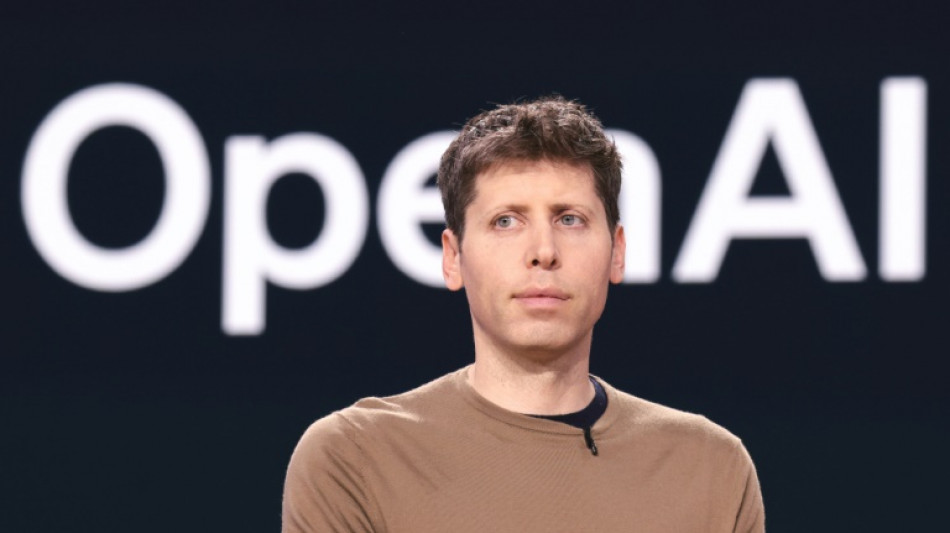
OpenAI releases reasoning AI with eye on safety, accuracy / Photo: Jason Redmond - AFP/File

 Crisis-wracked Volkswagen warns of 10-bn-euro hit to profits

 Shakira to cap off world tour with Madrid 12-gig run

 Isolated Syrian-Druze city shortages

 UNESCO can be 'moderator' in AI debate: chief to AFP

 Russia seizes assets of Nestle, French firms

 Anthropic says AI systems moving towards building themselves

 Asian stocks boosted by falling oil, yen weakens after BoJ rate hike

 Afghan medical students in Pakistan hope court stops college expulsions

 Australia to detain tourists who overstay visa, minister says

 Asian stocks track Wall St rally as oil prices drop

 Prized Mexican relic returns on loan, two centuries on

 'In our lane': Fed's Warsh defies Trump but still fighting for credibility

 Trump admin makes major cut to endangered species protections

 GM delivers first components for US interceptor missiles

 Travis Scott and Keith Richards feature on GTA VI soundtrack

 King Charles warns tech bosses of 'existential dangers' of AI

 French fishermen block ports over petrol prices

 Micron's Taiwan workers say 68 months' bonus not enough

 Canada's Carney pushes 'new alliance' with EU despite Trump threats

 Beyond Investment Returns: Families Are Measuring Wealth by Freedom, Continuity, and Legacy, According to Nour Private Wealth

 King Charles disputes claims in book by Princess Diana's brother

 Nepal floods among 'most challenging' disasters: WFP

 Kids and social media: what would change under new EU law

 King Charles to call on tech giants for 'reassurances' over AI

 STARPRIME Responds to Diverging Gold Market Demand with AM/PM Fixing and XAU24/7

ChatGPT creator OpenAI on Thursday released a new series of artificial intelligence models designed to spend more time thinking -- in hopes that generative AI chatbots provide more accurate and beneficial responses.
The new models, known as OpenAI o1-Preview, are designed to tackle complex tasks and solve more challenging problems in science, coding and mathematics -- something that earlier models have been criticized for failing to provide consistently.
Unlike their predecessors, these models have been trained to refine their thinking processes, try different methods and recognize mistakes before they deploy a final answer.
The new release comes as OpenAI is raising funds that could see it valued around $150 billion, which would make it one of the world's most valuable private companies, according to US media.
Investors include Microsoft and Nvidia, and could also include a $7 billion investment from MGX, a United Arab Emirates-backed investment fund, The Information reported.
OpenAI CEO Sam Altman hailed the models as "a new paradigm: AI that can do general-purpose complex reasoning."
However, he cautioned that the technology "is still flawed, still limited, and it still seems more impressive on first use than it does after you spend more time with it."
OpenAI's push to improve "thinking" in its model is a response to the persistent problem of "hallucinations" in AI chatbots.
This refers to their tendency to generate persuasive but incorrect content that has somewhat cooled the excitement over ChatGPT-style AI features among business customers
"We have noticed that this model hallucinates less," OpenAI researcher Jerry Tworek told The Verge.
But "we can't say we solved hallucinations," he added.
The Microsoft-backed company said that in tests, the models performed comparably to PhD students on difficult tasks in physics, chemistry and biology.
They also excelled in mathematics and coding, achieving an 83 percent success rate on a qualifying exam for the International Mathematics Olympiad, compared to 13 percent for GPT-4o, its most advanced general use model.
OpenAI said that the new reasoning capabilities could be used for healthcare researchers to annotate cell sequencing data, physicists to generate complex formulas, or computer developers to build and execute multistep designs.
The company also said that the models survived rigorous jailbreaking tests and could better withstand attempts to circumvent its guardrails.
OpenAI said its strengthened safety measures also included recent agreements with the US and UK AI Safety Institutes, which were granted early access to the models for evaluation and testing.
X.Cheung--CPN