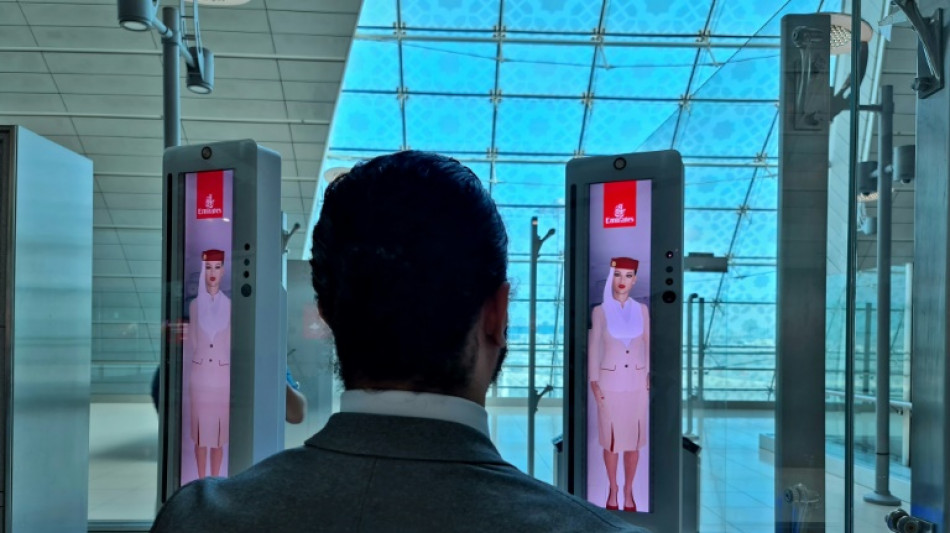
Settlement curbs firm's facial recognition database in US / Photo: Mohamad Ali Harissi - AFP

 Wildfires push endangered Sumatran elephants to brink: Indonesian NGO

 Bank of Japan set to raise rates under pressure from inflation, US

 EU chief to unveil social media, gaming curbs for under-15s

 'Resident Evil' film brings video game's ethos to the big screen

 i-payout Expands U.S. Money Transmitter Licensing Footprint and Advances European EMI Strategy

 US Senate crypto bill collapses amid partisan deadlock

 OpenAI, Anthropic and Google are working to create an AI standards body

 Protesting shepherds, farmers clash with Romanian police

 Foundation Lets Ledger Users Switch to Open Source Without Starting Over

 EU to propose curbing social media, online games for under 15s

 FX Junction Reaches 40,600 Members and 26 Million Trades

 'We unleashed the beast': the world's fears and hopes about AI

 Hospitality leaders ask Burnham to halve VAT amid rising costs

 Worcestershire invited to nominate groups for 2027 King’s volunteer award

 Berlin's run-down public spaces at heart of election campaign

 'Widow's Bay' and 'The Pitt' win big at Emmy Awards

 Most markets drop as oil extends gains ahead of expected US rate hike

 Sri Lanka's famed beach shack battles demolition

 Vserv targets ₹1,000 crore revenue by 2030 through AI expansion

 India prohibits bank fees on UPI payments up to ₹2,000

 Brazil's Amazon defender Raoni has cancer

 Trump rejects AI slowdown concerns as UN urges coordinated controls

 Higher wages draw migrant workers to Kashmir despite attacks

 Oil supply concerns and AI warnings weigh on global markets

 'I am the hoax buster': Trump rejects AI danger warnings

Startup Clearview AI has agreed to limit access to its controversial facial recognition database in the United States, settling a lawsuit filed by privacy advocates, a court filing showed Monday.
The deal, which needs approval by the court to become final, would resolve litigation filed two years ago by the American Civil Liberties Union (ACLU) and rights groups accusing Clearview of violating a strict biometric privacy law in the state of Illinois.
A main provision of the settlement permanently bans Clearview from making its "faceprint" database available to most businesses or other private entities in the country, according the ACLU.
"Clearview can no longer treat people's unique biometric identifiers as an unrestricted source of profit," said ACLU speech, privacy and technology director Nathan Freed Wessler.
"Before this agreement, Clearview ignored the fact that biometric information can be misused to create dangerous situations and threats" to lives, said Linda Xochitl Tortolero, chief executive of Chicago-based nonprofit Mujeres Latinas en Accion.
"Today that's no longer the case."
Clearview will also stop its practice of offering free trial accounts to police officers without the knowledge or approval of their employers, the ACLU said.
The ban does not limit Clearview from working with federal or state agencies other than those in Illinois, the lawsuit said.
Clearview admits no wrongdoing in the settlement.
Clearview AI says it has built up a database of more than 10 billion facial images taken from public websites, ranging from social media to news portals, which it touts as a tool for law enforcement.
- Still checking faces -
Clearview chief executive Hoan Ton-That said the company has told the court that it intends to make its facial recognition software available to commercial customers, without the database of images.
"Clearview AI's posture regarding sales to private entities remains unchanged," the chief executive said in response to an AFP inquiry.
Facial recognition is used to unlock smartphones, verify identities, board aircraft and more, he noted.
The settlement does not require any "material change" in the Clearview business model," said Cahill Gordon, an attorney representing the company.
Campaigners have condemned Clearview's use of images for being open to abuse, and a number of groups including Privacy International last year filed complaints with data regulators in France, Austria, Italy, Greece and Britain.
Italy's data privacy watchdog in March fined Clearview 20 million euros (almost $22 million) over its facial recognition software.
The watchdog ordered the company to delete data relating to people in Italy and banned it from further collection and processing of information there.
France's privacy watchdog as well in December ordered Clearview to delete data on its citizens and cease further collection.
Meanwhile in June last year, Canada's independent parliamentary watchdog ruled that both Clearview's database and the use of it by federal police were illegal.
X.Cheung--CPN