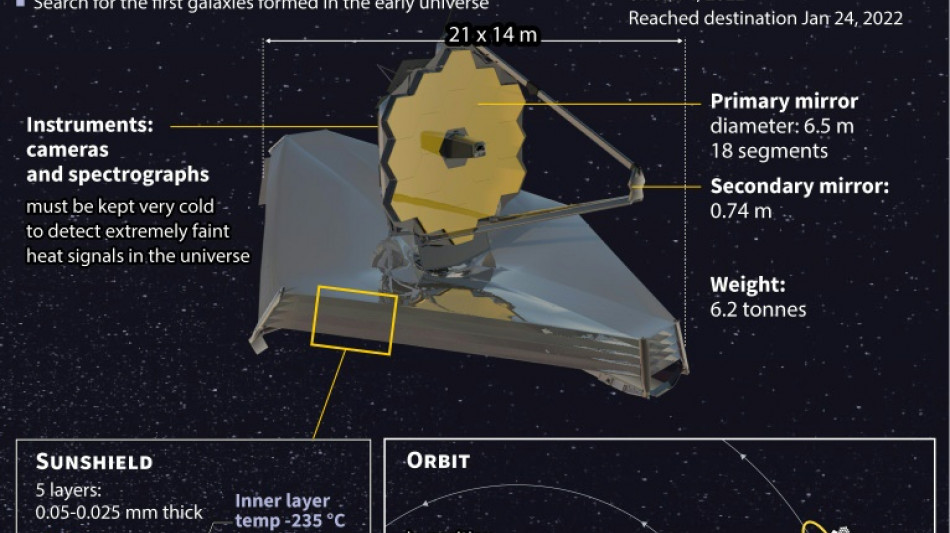
Webb telescope's first full color, scientific images coming in July / Photo: Jonathan WALTER - AFP

 Wildfires push endangered Sumatran elephants to brink: Indonesian NGO

 Bank of Japan set to raise rates under pressure from inflation, US

 EU chief to unveil social media, gaming curbs for under-15s

 'Resident Evil' film brings video game's ethos to the big screen

 i-payout Expands U.S. Money Transmitter Licensing Footprint and Advances European EMI Strategy

 US Senate crypto bill collapses amid partisan deadlock

 OpenAI, Anthropic and Google are working to create an AI standards body

 Protesting shepherds, farmers clash with Romanian police

 Foundation Lets Ledger Users Switch to Open Source Without Starting Over

 EU to propose curbing social media, online games for under 15s

 FX Junction Reaches 40,600 Members and 26 Million Trades

 'We unleashed the beast': the world's fears and hopes about AI

 Hospitality leaders ask Burnham to halve VAT amid rising costs

 Worcestershire invited to nominate groups for 2027 King’s volunteer award

 Berlin's run-down public spaces at heart of election campaign
 'Widow's Bay' and 'The Pitt' win big at Emmy Awards

 Most markets drop as oil extends gains ahead of expected US rate hike

 Sri Lanka's famed beach shack battles demolition

 Vserv targets ₹1,000 crore revenue by 2030 through AI expansion
 India prohibits bank fees on UPI payments up to ₹2,000

 Brazil's Amazon defender Raoni has cancer

 Trump rejects AI slowdown concerns as UN urges coordinated controls

 Higher wages draw migrant workers to Kashmir despite attacks

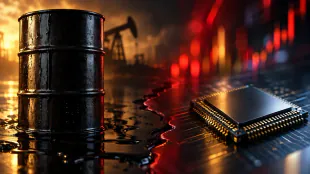 Oil supply concerns and AI warnings weigh on global markets

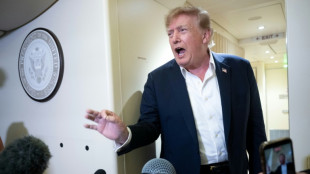 'I am the hoax buster': Trump rejects AI danger warnings

Get ready for a summer blockbuster.
The James Webb Space Telescope will produce "spectacular color images" of the cosmos in mid-July -- its first observations dedicated to its mission of scientific discovery, an astronomer overseeing the project said Monday.
The successor to Hubble has spent the last five months aligning its instruments in preparation for the big reveal, with scientists deliberately remaining coy about where the cameras will be pointed.
"We'd really like it to be a surprise," Klaus Pontoppidan, a scientist at the Space Telescope Science Institute in Baltimore told reporters, adding that the secrecy was partly due to the first targets not yet being finalized.
NASA and its partners the European Space Agency (ESA) and Canadian Space Agency (CSA) formed a committee to create a ranked list of objects, which they now intend to work through.
Webb's team has already released a series of star field images taken for calibration purposes, but the new photographs will be of astrophysics targets, key to deepening humankind's understanding of the universe, said Pontoppidan.
These images will actually be shot in infrared, and then colorized for public consumption.
Visible and ultraviolet light emitted by the very first luminous objects has been stretched by the universe's expansion, and arrives today in the form of infrared, which Webb is equipped to detect with unprecedented clarity -- giving it an unprecedented view of the first stars and galaxies that formed 13.5 billion years ago.
Webb, which is expected to cost NASA nearly $10 billion, is among the most expensive scientific platforms ever built, comparable to the Large Hadron Collider at CERN, and its predecessor telescope, Hubble.
Its mission also includes the study of distant planets, known as exoplanets, to determine their origin, evolution and habitability.
X.Cheung--CPN