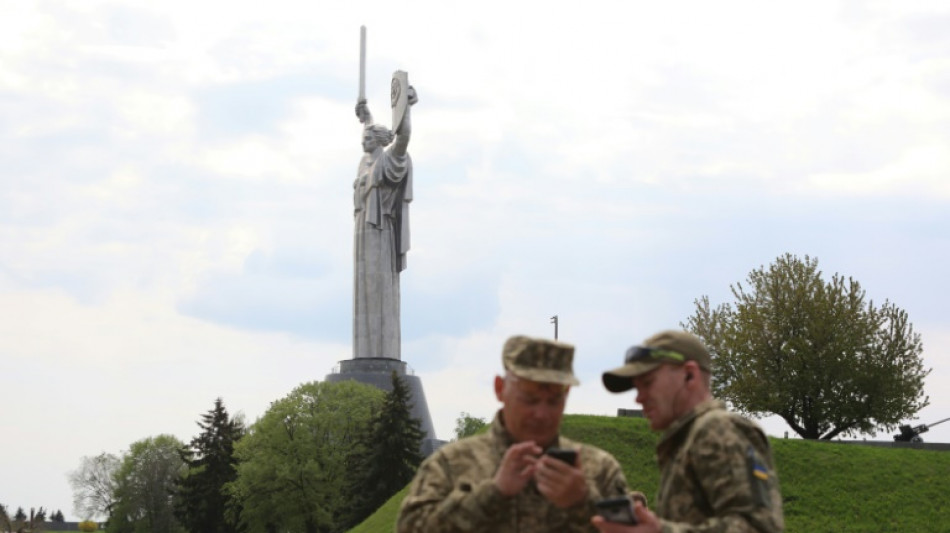
'Our real Victory Day': Ukrainians shun Soviet WWII anniversary / Photo: Aleksey Filippov - AFP

 Wildfires push endangered Sumatran elephants to brink: Indonesian NGO

 Bank of Japan set to raise rates under pressure from inflation, US

 EU chief to unveil social media, gaming curbs for under-15s

 'Resident Evil' film brings video game's ethos to the big screen

 i-payout Expands U.S. Money Transmitter Licensing Footprint and Advances European EMI Strategy

 US Senate crypto bill collapses amid partisan deadlock

 OpenAI, Anthropic and Google are working to create an AI standards body

 Protesting shepherds, farmers clash with Romanian police

 Foundation Lets Ledger Users Switch to Open Source Without Starting Over

 EU to propose curbing social media, online games for under 15s

 FX Junction Reaches 40,600 Members and 26 Million Trades

 'We unleashed the beast': the world's fears and hopes about AI

 Hospitality leaders ask Burnham to halve VAT amid rising costs

 Worcestershire invited to nominate groups for 2027 King’s volunteer award

 Berlin's run-down public spaces at heart of election campaign

 'Widow's Bay' and 'The Pitt' win big at Emmy Awards

 Most markets drop as oil extends gains ahead of expected US rate hike
 Sri Lanka's famed beach shack battles demolition
 Vserv targets ₹1,000 crore revenue by 2030 through AI expansion
 India prohibits bank fees on UPI payments up to ₹2,000

 Brazil's Amazon defender Raoni has cancer

 Trump rejects AI slowdown concerns as UN urges coordinated controls

 Higher wages draw migrant workers to Kashmir despite attacks

 Oil supply concerns and AI warnings weigh on global markets
 'I am the hoax buster': Trump rejects AI danger warnings
The solemn rhetoric and formal gatherings in Ukraine marking the Soviet Union's victory over Nazi Germany on May 9 every year always had deep personal resonance for 62-year-old Volodymyr Kostiuk.
His father was a soldier in the Moscow's Red Army, fought in Europe during World War II and was held captive in a Nazi prisoner of war camp.
But this year, his pride has turned to indignation and anger, with the anniversary blackened by Russia's full-scale invasion of his country.
"We were fighting together against the Nazis. It was our joint victory. Today the Russians are killing and torturing us. This shared history no longer means anything," Kostiuk told AFP, after fleeing from his home as Russian troops into Ukraine.
"Did we win then for them to annihilate us now?"
The Soviet Union's victory over Nazi Germany has traditionally been a holiday of national pride in the countries of the former Soviet Union, which with up to 27 million people killed, suffered the highest toll of any nation in World War II.
Since Russian President Vladimir Putin came to power, the holiday has taken on increasingly militaristic overtones, with a bombastic military parade through Moscow's Red Square in showing off its latest military hardware.
But this year, to shore up Western support and distance the country from Soviet-era rituals, Ukraine is drawing parallels between the horrors brought on Europe by the Nazis and Russia's invasion.
- 'Evil has returned' -
"Decades after World War II, darkness has returned to Ukraine. Evil has returned -- in a different uniform, under different slogans, but for the same purpose," Ukraine President Volodymyr Zelensky said in an address on May 8.
He compared bombings of European cities in World War II to Russian shelling on Ukraine this year and said Russia, like Nazi Germany, was attempting to justify this "give this evil a sacred purpose."
The Ukrainian Institute of National Memory summarised the trend in blunter terms, proposing a new slogan for remembrance day.
"We defeated the Nazis -- we will defeat the russhisty," it put forward, using a play on words in Ukrainian that combines the words Russian and fascist.
Ukraine was among the ex-Soviet nations most devastated by World War II.
Its cities were attacked in the first hours of the Nazi invasion; it spent several years under occupation; was the scene of such atrocities as the Babyn Yar massacre of Jews outside Kyiv; saw more than two million of its citizens sent as slave labour to Germany; and is believed to have lost eight million civilians and soldiers in all.
But this year commemorative events marking victory of the Nazis have been cancelled with barrages of Russian fire rocking frontline towns.
Even before Russia invaded Ukraine on February 24, the country was cooling to the Kremlin's approach to commemoration.
Ukraine began distancing itself from Victory Day's Soviet traditions more than a decade ago, first by dropping Moscow's preferred title of "The Great Patriotic War" opting instead for World War II in official discourse and history books.
The ousting of a Kremlin-friendly president and Russia's annexation of the Crimean peninsula from Ukraine in 2014 saw the gap widen.
As well as Moscow's support for pro-Russian separatists, these historic moments saw Kyiv embark on its ongoing project of "de-Sovietisation," tearing down monuments and symbols from its Soviet past.
After the separatist conflict broke out in the east, Ukraine adopted the poppy used by some Western countries as its symbol of remembrance.
It also banned displays of the black-and-orange Saint George ribbon, which has been omnipresent at Victory Day celebrations in Russia as a symbol of Moscow's military prowess since its annexation of Crimea in 2014.
- 'No one will be celebrating -
And since 2015, remembrance events are held not only on May 9 as in Soviet times, but also on May 8 dubbed "Day of Memory and Reconciliation," mirroring European traditions.
Russia's invasion has only quickened this trend. Recent polls show just over 30 percent of Ukrainians see Victory Day as important, down from 80 percent in previous years.
The pollster, Rating, described the shift as a "key change in historical memory," within society, noting that one in four respondents said the event was a "relic of the past".
Some Ukrainian politicians are calling for May 9 events to be scrapped entirely.
Meanwhile on the streets of Kyiv, Ukrainians had a different win on their minds.
Leonid Kotlarevsky, a soldier told APF near a huge World War II monument in Kyiv that May 9 was a celebration "for our grandfathers who fought against fascism."
"But these Russian are fascists too, and we should destroy them," he said.
Rodion, a 51-year-old pensioner nearby said "no one will be celebrating May 9 now," after Russia's invasion.
"We will have our own Victory Day, when Ukraine and the whole global community will win against Russia. And that's going to be our real Victory Day."
Ch.Lefebvre--CPN