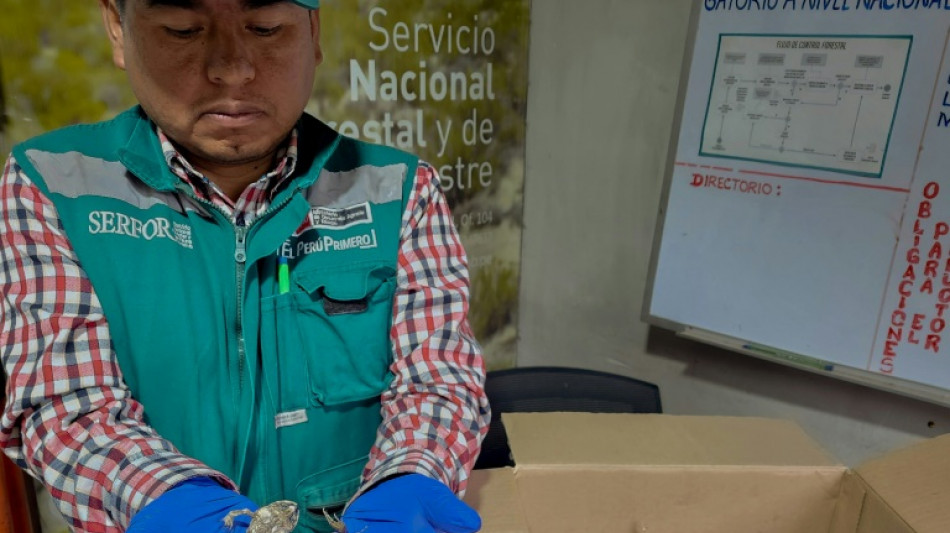
Andean 'Viagra': Peru seizes hundreds of frogs used as aphrodisiacs / Photo: HANDOUT - SERFOR/AFP

 Crisis-wracked Volkswagen warns of 10-bn-euro hit to profits

 Shakira to cap off world tour with Madrid 12-gig run

 Isolated Syrian-Druze city shortages

 UNESCO can be 'moderator' in AI debate: chief to AFP

 Russia seizes assets of Nestle, French firms

 Anthropic says AI systems moving towards building themselves

 Asian stocks boosted by falling oil, yen weakens after BoJ rate hike

 Afghan medical students in Pakistan hope court stops college expulsions

 Australia to detain tourists who overstay visa, minister says

 Asian stocks track Wall St rally as oil prices drop

 Prized Mexican relic returns on loan, two centuries on

 'In our lane': Fed's Warsh defies Trump but still fighting for credibility

 Trump admin makes major cut to endangered species protections

 GM delivers first components for US interceptor missiles

 Travis Scott and Keith Richards feature on GTA VI soundtrack

 King Charles warns tech bosses of 'existential dangers' of AI

 French fishermen block ports over petrol prices

 Micron's Taiwan workers say 68 months' bonus not enough

 Canada's Carney pushes 'new alliance' with EU despite Trump threats

 Beyond Investment Returns: Families Are Measuring Wealth by Freedom, Continuity, and Legacy, According to Nour Private Wealth

 King Charles disputes claims in book by Princess Diana's brother

 Nepal floods among 'most challenging' disasters: WFP

 Kids and social media: what would change under new EU law

 King Charles to call on tech giants for 'reassurances' over AI

 STARPRIME Responds to Diverging Gold Market Demand with AM/PM Fixing and XAU24/7

Peruvian authorities said Thursday they had seized hundreds of endangered frogs from Lake Titicaca that were illegally captured to be used for their purported aphrodisiac properties.
The national forestry and wildlife service said it found 390 frogs in a cardboard box inside a truck in the Puno region on the shores of the huge lake, which lies at 3,810 meters (12,500 feet) above sea level in the Andes, on Peru's border with Bolivia.
The shipment was bound for the Peruvian capital Lima, where the frogs are widely used in traditional medicine as well as in dishes flagged as boosting customer's sex drive.
Some traditional healers make a brew with frog extract that they call the "Viagra of the Incas," after the civilization that ruled over a vast South American empire in the 15th and 16th centuries.
The potion is also touted as having a wide array of medicinal properties.
The Lake Titicaca frog (Telmatobius culeus), one of the largest species of aquatic frogs in the world, is native to Peru and part of Bolivia.
In the last 15 years, the population of the frog, which is on Peru's list of endangered species, has shrunk by an estimated 80 percent due to trafficking, climate change and pollution.
Wildlife trafficking is a crime punishable by fines of over $14,500 in Peru, over 50 times the minimum monthly wage.
H.Meyer--CPN