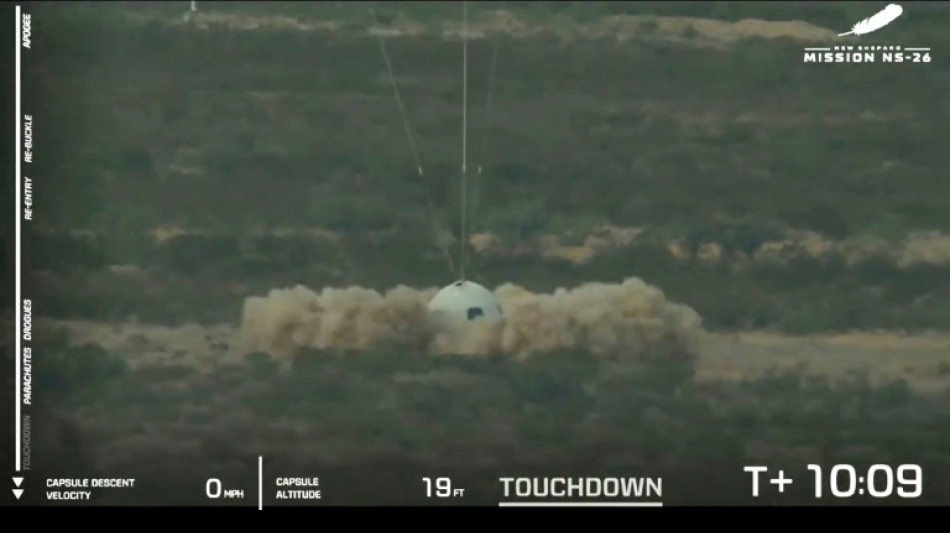
Blue Origin completes latest space tourism flight successfully / Photo: Handout - BLUE ORIGIN/AFP

 Crisis-wracked Volkswagen warns of 10-bn-euro hit to profits

 Shakira to cap off world tour with Madrid 12-gig run

 Isolated Syrian-Druze city shortages

 UNESCO can be 'moderator' in AI debate: chief to AFP

 Russia seizes assets of Nestle, French firms

 Anthropic says AI systems moving towards building themselves

 Asian stocks boosted by falling oil, yen weakens after BoJ rate hike

 Afghan medical students in Pakistan hope court stops college expulsions

 Australia to detain tourists who overstay visa, minister says

 Asian stocks track Wall St rally as oil prices drop

 Prized Mexican relic returns on loan, two centuries on

 'In our lane': Fed's Warsh defies Trump but still fighting for credibility

 Trump admin makes major cut to endangered species protections

 GM delivers first components for US interceptor missiles

 Travis Scott and Keith Richards feature on GTA VI soundtrack

 King Charles warns tech bosses of 'existential dangers' of AI

 French fishermen block ports over petrol prices

 Micron's Taiwan workers say 68 months' bonus not enough

 Canada's Carney pushes 'new alliance' with EU despite Trump threats

 Beyond Investment Returns: Families Are Measuring Wealth by Freedom, Continuity, and Legacy, According to Nour Private Wealth

 King Charles disputes claims in book by Princess Diana's brother

 Nepal floods among 'most challenging' disasters: WFP

 Kids and social media: what would change under new EU law

 King Charles to call on tech giants for 'reassurances' over AI

 STARPRIME Responds to Diverging Gold Market Demand with AM/PM Fixing and XAU24/7

Blue Origin flew its latest group of six thrill-seekers to the edge of space and back again Thursday, including the youngest-ever woman to complete the feat.
Mission NS-26 marked the eighth human spaceflight for the company, founded by Jeff Bezos, as it presses ahead in the emerging suborbital tourism market.
Karsen Kitchen, a 21-year-old senior at the University of North Carolina at Chapel Hill, became the youngest woman ever to cross the Karman Line, the internationally recognized boundary marking the edge of space, 100 kilometers (62 miles) above the Earth's surface.
Blue Origin's small New Shepard rocket blasted off at 8:00 am local time (1300 GMT) from the company's Launch Site One base in west Texas.
After liftoff, the sleek and spacious capsule separated from its booster, which boasts zero carbon emissions, before the rocket performed a precise vertical landing.
As the spaceship soared beyond the Karman Line, passengers had the chance to marvel at the Earth's curvature and unbuckle their seatbelts to float during a few minutes of weightlessness.
"Being there in the darkness of space... there's no way to talk about how impressive that is," said Rob Ferl, a NASA-funded researcher who conducted an experiment during the flight.
The capsule then reentered the atmosphere, deploying its parachutes for a desert landing near the launch site. The total flight time is typically around 10 to 11 minutes.
Blue Origin does not publicly disclose the cost of its tickets, but prices are believed to vary significantly based on the individual selected, their net worth, and the social capital they bring to the company.
The first seat sold in a 2021 charity auction went for $28 million, but notable guests like Star Trek actor William Shatner have flown on Blue Origin flights for free. Others have reported paying several hundred thousand dollars.
Blue Origin's main competitor in the suborbital space market, Virgin Galactic, is currently on a two-year pause from commercial operations as it upgrades its fleet.
T.Morelli--CPN