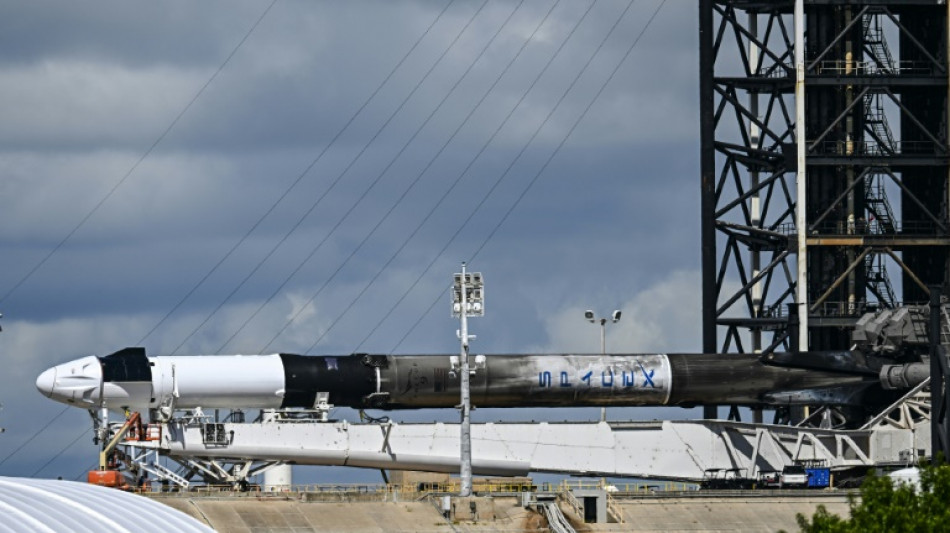
SpaceX postpones historic mission featuring first private spacewalk / Photo: CHANDAN KHANNA - AFP/File

 Crisis-wracked Volkswagen warns of 10-bn-euro hit to profits

 Shakira to cap off world tour with Madrid 12-gig run

 Isolated Syrian-Druze city shortages

 UNESCO can be 'moderator' in AI debate: chief to AFP

 Russia seizes assets of Nestle, French firms

 Anthropic says AI systems moving towards building themselves

 Asian stocks boosted by falling oil, yen weakens after BoJ rate hike

 Afghan medical students in Pakistan hope court stops college expulsions

 Australia to detain tourists who overstay visa, minister says

 Asian stocks track Wall St rally as oil prices drop

 Prized Mexican relic returns on loan, two centuries on

 'In our lane': Fed's Warsh defies Trump but still fighting for credibility

 Trump admin makes major cut to endangered species protections

 GM delivers first components for US interceptor missiles

 Travis Scott and Keith Richards feature on GTA VI soundtrack

 King Charles warns tech bosses of 'existential dangers' of AI

 French fishermen block ports over petrol prices

 Micron's Taiwan workers say 68 months' bonus not enough

 Canada's Carney pushes 'new alliance' with EU despite Trump threats

 Beyond Investment Returns: Families Are Measuring Wealth by Freedom, Continuity, and Legacy, According to Nour Private Wealth

 King Charles disputes claims in book by Princess Diana's brother

 Nepal floods among 'most challenging' disasters: WFP

 Kids and social media: what would change under new EU law

 King Charles to call on tech giants for 'reassurances' over AI

 STARPRIME Responds to Diverging Gold Market Demand with AM/PM Fixing and XAU24/7

SpaceX on Tuesday postponed once more its attempt at launching a daring orbital expedition featuring an all-civilian crew that is aiming to carry out the first-ever spacewalk by private citizens.
The Polaris Dawn mission, organized by billionaire entrepreneur Jared Isaacman, had been set to lift off from NASA's Kennedy Space Center in Florida during a four-hour window early Wednesday.
But SpaceX announced Tuesday it was pushing back the launch plans "due to unfavorable weather forecasted in Dragon's splashdown areas off the coast of Florida," in a message on X.
An earlier attempt on Tuesday was scrapped due to a helium leak on a line connecting the tower to the rocket.
Riding atop a Falcon 9 rocket, the SpaceX Dragon capsule is set to reach a peak altitude of 870 miles (1,400 kilometers) -- higher than any crewed mission in more than half a century, since the Apollo era.
Mission commander Isaacman will guide his four-member team through the mission's centerpiece: the first-ever spacewalk carried out by non-professional astronauts, equipped with sleek, newly developed SpaceX extravehicular activity (EVA) suits.
Rounding out the team are mission pilot Scott Poteet, a retired US Air Force lieutenant colonel; mission specialist Sarah Gillis, a lead space operations engineer at SpaceX; and mission specialist and medical officer Anna Menon, also a lead space operations engineer at SpaceX.
The quartet underwent more than two years of training in preparation for the landmark mission, logging hundreds of hours on simulators as well as skydiving, centrifuge training, scuba diving, and summiting an Ecuadoran volcano.
Polaris Dawn is set to be the first of three missions under the Polaris program, a collaboration between Isaacman, the founder of tech company Shift4 Payments, and SpaceX.
Isaacman declined to reveal his total investment in the project, though reports suggest he paid around $200 million for the SpaceX Inspiration4 mission in September 2021, the first all-civilian orbital mission.
Polaris Dawn will reach its highest altitude on its first day, venturing briefly into the Van Allen radiation belt, a region teeming with high-energy charged particles that can pose health risks to humans over extended periods.
On day three, the crew will don their state-of-the-art EVA spacesuits -- outfitted with heads-up displays, helmet cameras, and advanced joint mobility systems -- and take turns to venture outside their spacecraft in twos.
Each will spend 15 to 20 minutes in space, 435 miles above Earth's surface.
Also on their to-do list are testing laser-based satellite communication between the spacecraft and Starlink, SpaceX's more than 6,000-strong constellation of internet satellites, in a bid to boost space communication speeds, and conducting nearly 40 scientific experiments.
These include tests with contact lenses embedded with microelectronics to continuously monitor changes in eye pressure and shape.
After six days in space, the mission will conclude with the splashdown off the coast of Florida.
Y.Jeong--CPN