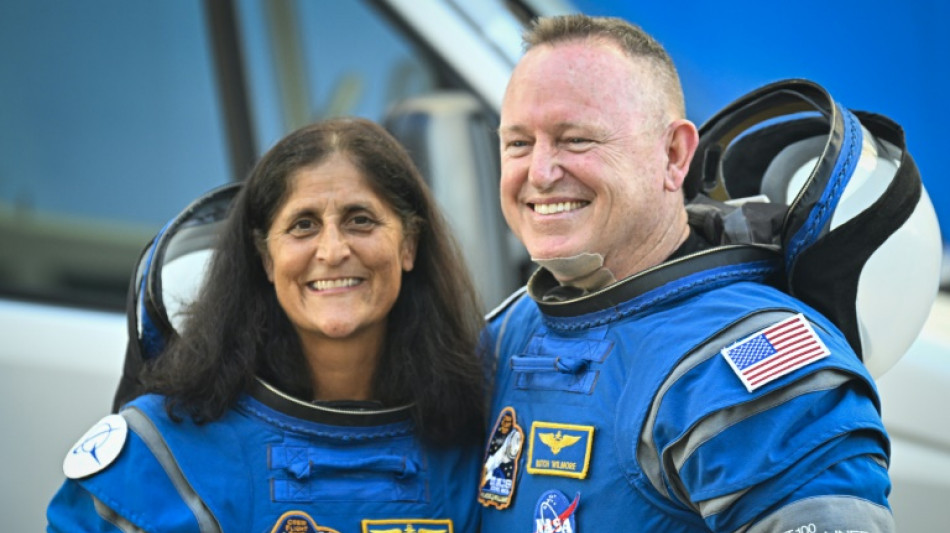
NASA to decide Saturday on return of stranded astronauts / Photo: Miguel J. Rodriguez Carrillo - AFP/File

 Crisis-wracked Volkswagen warns of 10-bn-euro hit to profits

 Shakira to cap off world tour with Madrid 12-gig run

 Isolated Syrian-Druze city shortages

 UNESCO can be 'moderator' in AI debate: chief to AFP

 Russia seizes assets of Nestle, French firms

 Anthropic says AI systems moving towards building themselves

 Asian stocks boosted by falling oil, yen weakens after BoJ rate hike

 Afghan medical students in Pakistan hope court stops college expulsions

 Australia to detain tourists who overstay visa, minister says

 Asian stocks track Wall St rally as oil prices drop

 Prized Mexican relic returns on loan, two centuries on

 'In our lane': Fed's Warsh defies Trump but still fighting for credibility

 Trump admin makes major cut to endangered species protections

 GM delivers first components for US interceptor missiles

 Travis Scott and Keith Richards feature on GTA VI soundtrack

 King Charles warns tech bosses of 'existential dangers' of AI

 French fishermen block ports over petrol prices

 Micron's Taiwan workers say 68 months' bonus not enough

 Canada's Carney pushes 'new alliance' with EU despite Trump threats

 Beyond Investment Returns: Families Are Measuring Wealth by Freedom, Continuity, and Legacy, According to Nour Private Wealth

 King Charles disputes claims in book by Princess Diana's brother

 Nepal floods among 'most challenging' disasters: WFP

 Kids and social media: what would change under new EU law

 King Charles to call on tech giants for 'reassurances' over AI

 STARPRIME Responds to Diverging Gold Market Demand with AM/PM Fixing and XAU24/7

NASA is expected to decide Saturday whether two astronauts who arrived at the International Space Station aboard Boeing's Starliner should return on that craft -- or brace for a longer wait to fly home with rival SpaceX.
The latter solution would not only create a fresh public relations headache for Boeing, but possibly result in astronauts Butch Wilmore and Suni Williams spending a total of eight months in orbit, not the eight days as originally planned.
A decision-making committee, with NASA chief Bill Nelson sitting in, will meet Saturday to weigh the tough issue.
The US space agency has tentatively scheduled a news conference for 1:00 pm (1700 GMT), presumably to announce its verdict.
After years of Starliner development delays, the spacecraft finally lifted off in early June carrying Wilmore and Williams, both veteran astronauts, to the ISS.
The capsule was originally set to bring them to Earth after eight days in space, but NASA put their return on indefinite hold as it studied problems with the craft's propulsion system.
NASA officials are weighing the highly unusual option of bringing the two astronauts back from the flying laboratory not on their own craft, but aboard a previously scheduled SpaceX vehicle in February.
Engineers at Boeing and NASA have spent weeks conducting intensive tests on the Starliner's systems, trying to get to the root of the problem.
Their worry is that the craft might not have the propulsive power to wrest itself out of orbit and begin the descent toward Earth.
If NASA experts decide the Starliner is not safe, the craft would return without any passengers.
The SpaceX Crew-9 mission would then take off in late September, but carrying only two passengers instead of the originally planned four.
It would remain moored to the ISS until its scheduled return in February, bringing back its own crew members plus their two stranded colleagues.
Such an approach would be a stinging blow to the already tarnished image of US giant Boeing, whose airplane arm has been beset in recent years with concerns about safety and quality control.
Ten years ago, following the retirement of the Space Shuttle, NASA ordered new vessels from both Boeing and SpaceX that could ferry astronauts to and from the ISS.
With two such vehicles available, NASA reasoned, there would always be a backup in case one of the two experienced problems.
But Elon Musk's SpaceX beat Boeing to the punch and has been the lone vehicle used to taxi astronauts for the past four years.
This year's crewed Starliner flight, which followed years of delays and disappointments during the craft's development, was meant to be a last test of the vehicle before it enters regular operations.
NASA has said the astronauts on the ISS have plenty of supplies, are trained for extended stays and have plenty of experiments to conduct.
L.Peeters--CPN