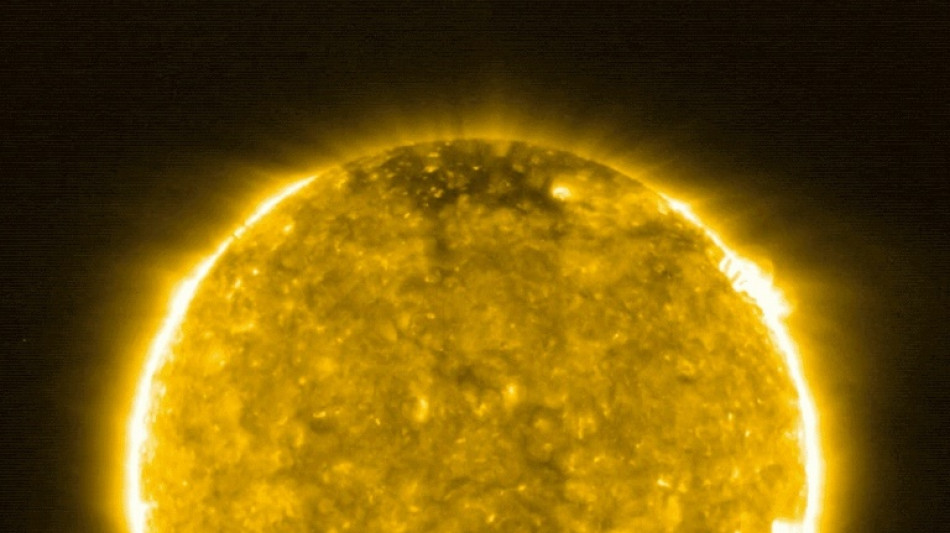
Earth hit by 'severe' solar storm / Photo: - - Solar Orbiter/EUI/ESA/NASA/AFP

 Crisis-wracked Volkswagen warns of 10-bn-euro hit to profits

 Shakira to cap off world tour with Madrid 12-gig run

 Isolated Syrian-Druze city shortages

 UNESCO can be 'moderator' in AI debate: chief to AFP

 Russia seizes assets of Nestle, French firms

 Anthropic says AI systems moving towards building themselves

 Asian stocks boosted by falling oil, yen weakens after BoJ rate hike

 Afghan medical students in Pakistan hope court stops college expulsions

 Australia to detain tourists who overstay visa, minister says

 Asian stocks track Wall St rally as oil prices drop

 Prized Mexican relic returns on loan, two centuries on

 'In our lane': Fed's Warsh defies Trump but still fighting for credibility

 Trump admin makes major cut to endangered species protections

 GM delivers first components for US interceptor missiles

 Travis Scott and Keith Richards feature on GTA VI soundtrack

 King Charles warns tech bosses of 'existential dangers' of AI

 French fishermen block ports over petrol prices

 Micron's Taiwan workers say 68 months' bonus not enough

 Canada's Carney pushes 'new alliance' with EU despite Trump threats

 Beyond Investment Returns: Families Are Measuring Wealth by Freedom, Continuity, and Legacy, According to Nour Private Wealth

 King Charles disputes claims in book by Princess Diana's brother

 Nepal floods among 'most challenging' disasters: WFP

 Kids and social media: what would change under new EU law

 King Charles to call on tech giants for 'reassurances' over AI

 STARPRIME Responds to Diverging Gold Market Demand with AM/PM Fixing and XAU24/7

The Earth was hit Monday by an intense solar storm that could bring the northern lights to night skies further south than normal, a US agency announced.
Conditions of a level-four geomagnetic storm -- on a scale of five -- were observed Monday from 1500 GMT, according to a specialized center at the US National Oceanic and Atmospheric Administration (NOAA).
These conditions may persist for several hours, but were not expected to increase further in intensity, NOAA added in a statement.
"A severe geomagnetic storm includes the potential for aurora to be seen faintly as far south as Alabama and northern California," NOAA said in a statement, referring to US states.
The new solar storm is caused by coronal mass ejections (CMEs), which are explosions of particles leaving the Sun. When these particles arrive on Earth, they disrupt its magnetic field.
"There are a lot of auroras now... If it lasts until nightfall here, we might be able to see some," Eric Lagadec, an astrophysicist at the Cote d'Azur Observatory in France, said on X.
On Sunday, NASA astronaut Matthew Dominick published on X a superb photo of the aurora borealis -- or Northern Lights -- taken from the International Space Station, where he is currently stationed.
But solar or geomagnetic storms can also trigger undesirable effects.
For example, they can degrade high-frequency communications, disrupt satellites, and cause overloads on the electricity grid. Operators of sensitive infrastructure have been notified to put in place measures to limit these effects, NOAA said.
In May, the planet went through the most powerful geomagnetic storms recorded in 20 years. They caused auroras to light up the night sky in the United States, Europe, and Australia, at much lower latitudes than usual.
This type of event has increased recently because the Sun is currently close to its peak activity, as per its 11-year cycle.
D.Philippon--CPN