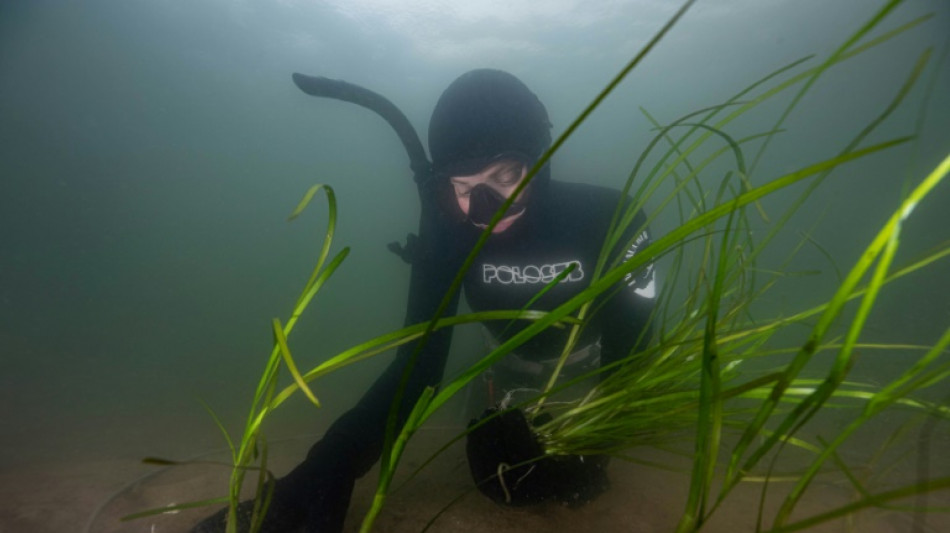
Researchers discover 1,400-year-old seagrass in Finland / Photo: Helene-Julie Zofia PAAMAND - Underwater Ambassador/AFP

 Crisis-wracked Volkswagen warns of 10-bn-euro hit to profits

 Shakira to cap off world tour with Madrid 12-gig run

 Isolated Syrian-Druze city shortages

 UNESCO can be 'moderator' in AI debate: chief to AFP

 Russia seizes assets of Nestle, French firms

 Anthropic says AI systems moving towards building themselves

 Asian stocks boosted by falling oil, yen weakens after BoJ rate hike

 Afghan medical students in Pakistan hope court stops college expulsions

 Australia to detain tourists who overstay visa, minister says

 Asian stocks track Wall St rally as oil prices drop

 Prized Mexican relic returns on loan, two centuries on

 'In our lane': Fed's Warsh defies Trump but still fighting for credibility

 Trump admin makes major cut to endangered species protections

 GM delivers first components for US interceptor missiles

 Travis Scott and Keith Richards feature on GTA VI soundtrack

 King Charles warns tech bosses of 'existential dangers' of AI

 French fishermen block ports over petrol prices

 Micron's Taiwan workers say 68 months' bonus not enough

 Canada's Carney pushes 'new alliance' with EU despite Trump threats

 Beyond Investment Returns: Families Are Measuring Wealth by Freedom, Continuity, and Legacy, According to Nour Private Wealth

 King Charles disputes claims in book by Princess Diana's brother

 Nepal floods among 'most challenging' disasters: WFP

 Kids and social media: what would change under new EU law

 King Charles to call on tech giants for 'reassurances' over AI

 STARPRIME Responds to Diverging Gold Market Demand with AM/PM Fixing and XAU24/7

Scientists have discovered the world's oldest known seagrass in Finland, using a new method to determine the age of aquatic plants that put it at 1,403 years old, they said this week.
By measuring the number of genetic mutations occurring over time in seagrass -- which reproduces by cloning itself over and over again, the scientists were able to determine the age of the original ancestor plant with groundbreaking precision.
"This is the first really reliable clone age estimate", study co-author Thorsten Reusch told AFP on Thursday.
The study was published in the scientific journal Nature Ecology and Evolution in June.
Researchers used the new method, dubbed a "genetic clock", at 20 sites across the world and found that a lush underwater meadow of eelgrass -- a species of seagrass -- in the Finnish coastal waters of the Baltic Sea was 1,403 years old, the most ancient marine plant currently known.
"In a way, we now have a clock that can determine to which seed and eventually which seedling a plant dates back to", Reusch said.
The ability to determine the age of plants unravels eye-opening information about how ecosystems function and about ageing processes in the natural world, he explained.
"It is interesting to understand how they avoid ageing symptoms over thousands of years.
"Ultimately it may even give us some clues on how to deal with ageing in humans", he continued.
- Valuable ecosystem -
"I am very positive that we will find clones that are 10,000 years or older".
Reproducing through flowers, seeds and rhizomes in the sediment, eelgrass populations provide important marine environments for other organisms and store carbon dioxide in stems and roots.
"Eelgrass is the most valuable ecosystem in the Baltic Sea," Reusch said.
Despite the staggering age and resilience demonstrated by the ancient plant, eelgrass is a threatened species in the Baltic Sea -- characterised by shallow, brackish waters and encircled by eight countries.
Nutrient pollution from industries like agriculture and forestry, coupled with rising sea temperatures due to climate change, have exacerbated the plight of the eelgrass populations.
"In the western Baltic Sea where I work, about 60 percent of the eelgrass has been lost in the last 100 years", Reusch said.
The sea is bordered by the three Baltic states, Finland, Germany, Poland, Russia and Sweden.
Y.Ibrahim--CPN