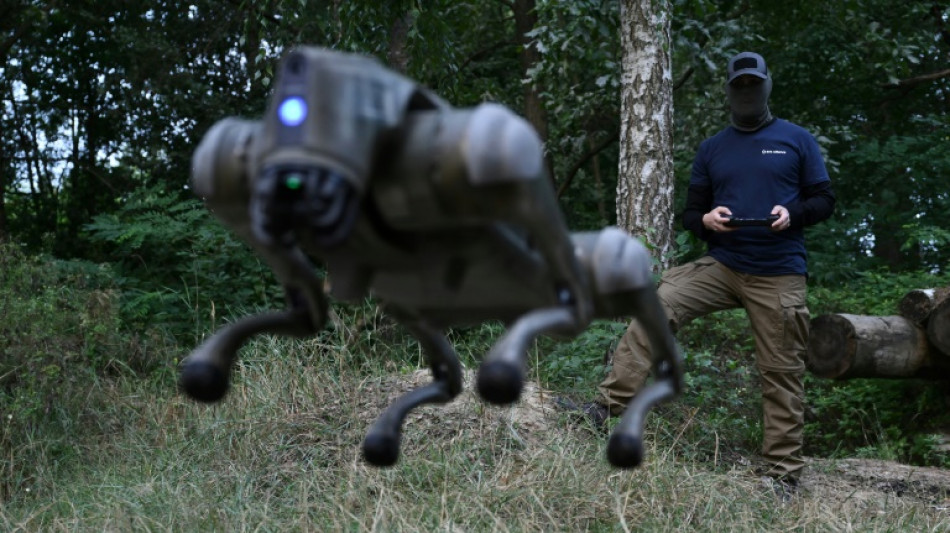
Ukraine to unleash robot dogs on its front lines / Photo: GENYA SAVILOV - AFP

 Crisis-wracked Volkswagen warns of 10-bn-euro hit to profits

 Shakira to cap off world tour with Madrid 12-gig run

 Isolated Syrian-Druze city shortages

 UNESCO can be 'moderator' in AI debate: chief to AFP

 Russia seizes assets of Nestle, French firms

 Anthropic says AI systems moving towards building themselves

 Asian stocks boosted by falling oil, yen weakens after BoJ rate hike

 Afghan medical students in Pakistan hope court stops college expulsions

 Australia to detain tourists who overstay visa, minister says

 Asian stocks track Wall St rally as oil prices drop

 Prized Mexican relic returns on loan, two centuries on

 'In our lane': Fed's Warsh defies Trump but still fighting for credibility

 Trump admin makes major cut to endangered species protections

 GM delivers first components for US interceptor missiles

 Travis Scott and Keith Richards feature on GTA VI soundtrack

 King Charles warns tech bosses of 'existential dangers' of AI

 French fishermen block ports over petrol prices

 Micron's Taiwan workers say 68 months' bonus not enough

 Canada's Carney pushes 'new alliance' with EU despite Trump threats

 Beyond Investment Returns: Families Are Measuring Wealth by Freedom, Continuity, and Legacy, According to Nour Private Wealth

 King Charles disputes claims in book by Princess Diana's brother

 Nepal floods among 'most challenging' disasters: WFP

 Kids and social media: what would change under new EU law

 King Charles to call on tech giants for 'reassurances' over AI

 STARPRIME Responds to Diverging Gold Market Demand with AM/PM Fixing and XAU24/7

Ukraine could soon unleash robot dogs on its front lines, replacing soldiers for perilous missions like spying on Russian trenches or detecting mines.
At a demonstration in an undisclosed part of Ukraine, the metallic dog known as model "BAD One" stood up, crouched, ran and jumped according to commands transmitted by its operator.
Stealthy and agile, they could soon become an invaluable ally on the front line for an Ukrainian army that is short on manpower to repel the Russian invasion, its makers said.
Low on the ground and therefore difficult to detect, the robot dogs can use thermal imaging to inspect enemy trenches or the inside of buildings in combat zones.
"We have surveillance soldiers who get sent on reconnaissance missions (who) are most of the time very highly trained people, very experienced people (and) always exposed to risks," said the operator who called himself "Yuri", as he showed it off to AFP journalists.
"This dog limits the risk for soldiers and increases operational capabilities. This is the core function of the dog," said the operator, who works for a British company providing military equipment.
A more advanced model, known as "BAD Two" could not be shown for security reasons.
The device used in the demonstration has a battery that powers it for around two hours.
Useful for detecting mines or improvised explosive devices, the robot dog can also be used to carry up to seven kilos (15 pounds) of ammunition or medicines to hot spots on the battlefield.
"I can't say how many we deployed" in Ukraine, Yuri said, adding: "But it will have a significant impact on the operations and increase the safety of soldiers."
And if the robot dogs were ever to fall into Russian hands, he said, an emergency switch allows the operator to erase all its data.
A.Mykhailo--CPN