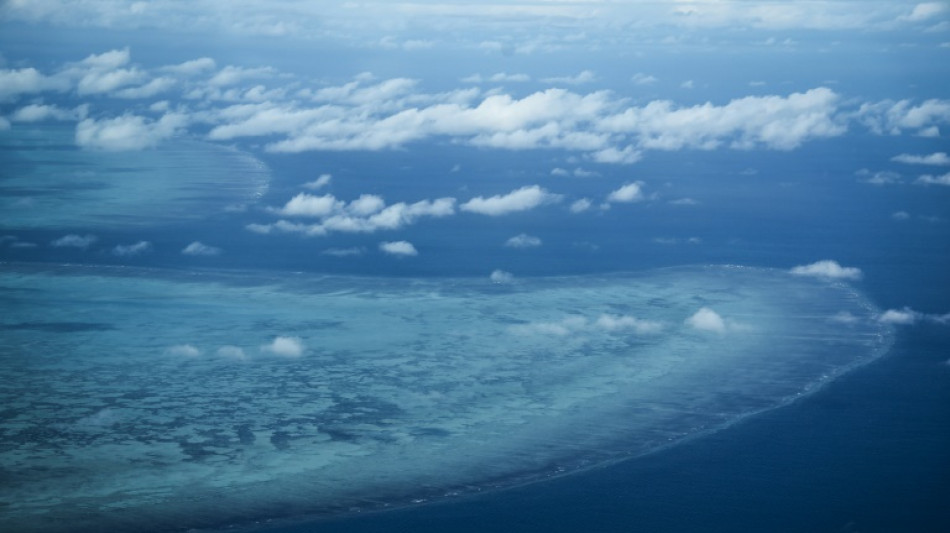
Great Barrier Reef ocean temperatures hit 400-year record: study / Photo: DAVID GRAY - AFP

 Nigeria miners struggled to breathe in cell before 37 died: survivors

 Warren Buffett steps down as Berkshire Hathaway chairman

 Isolated Syrian-Druze city blames Damascus for shortages

 Kerry James Marshall: American 'blackness' painter celebrated in Europe

 Infantino 'must go', says German FA vice-president

 Japan's busiest rail station tests robot bins

 Backpackers fret over Australian visa crackdown

 Bank of Japan hikes rates to 31-year high to battle inflation

 AI doomsday warnings unlikely to slow IPOs but questions linger

 In Brazil's Amazon, the hunt for oil fuels hopes and fears

 Baby orangutans in India expose 'frightening' scale of trafficking

 Oversight Board blasts 'inadequate' Meta safeguards for AI deepfakes

 Harry makes first public appearance since return to UK

 Princess Diana's brother makes new explosive claims against Charles

 Trump admin overhauls key protection for endangered species

 Mbappe draws political fire over Ceuta t-shirt controversy

 Third malaria death in Germany from outbreak tied to Frankfurt airport

 AtlasClear Holdings Reports Preliminary Fiscal 2026 Revenue of Approximately $20.1 Million, Up 85%; Revenue Plus Interest Income of Approximately $21.9 Million

 'Another arrow to the quiver': World Bank posts record private capital mobilization

 Ireland to boycott Eurovision 2027 over Gaza

 India's Tata Sons reappoints N. Chandrasekaran as chairman

 Germany urges EU action against China to defend carmakers

 Japan eyes changing prostitution law to punish sex buyers

 Modi pitches India as global chipmaking hub

 Ukraine plans record defence spending in 2027

For the past decade, water temperatures along Australia's famed Great Barrier Reef have been the warmest in 400 years, a major study said on Thursday.
Ocean temperatures around the spectacular coral system have increased yearly since 1960 but were particularly hotter during recent mass coral bleaching events, according to a study in the science journal Nature.
The warmer waters are most likely down to human-induced climate change, the report said.
Co-author Helen McGregor said she was "extremely concerned" about the reef, describing the temperature increases as "unprecedented".
"These are corals that have lived for 400 years and this is the warmest temperatures they're experiencing. These are the Redwood trees of the reef," she told AFP.
Often dubbed the world's largest living structure, the Great Barrier Reef is a 2,300-kilometre (1,400-mile) long expanse, home to a stunning array of biodiversity that includes more than 600 types of coral and 1,625 fish species.
But repeated mass bleaching events -- when extreme heat saps the coral of nutrients and colour -- threaten the reef's fragile ecosystem.
Coral bleaching occurs when water temperatures rise more than one degree Celsius (1.8 degrees Fahrenheit).
- 'Changes happening too quickly' -
The Australian researchers examined sea surface temperatures in the Coral Sea –- a 2,000-kilometre (1,200-mile) stretch of ocean that extends down the northeast coast and includes the Great Barrier Reef.
Scientists used coral skeleton samples to reconstruct sea surface temperatures from 1618 to 1995, as well as more recent data.
They found temperatures before 1900 had been relatively stable but the sea had warmed 0.12C (0.2F) on average since 1960 until the present.
Those temperatures were even higher during the past five mass bleaching events in 2016, 2017, 2020, 2022 and 2024, the report found.
McGregor said that although corals could recover, increasing high temperatures and repeated bleaching events were straining that ability.
"These changes -- from what we're seeing so far -- appear to be happening too rapidly for the corals to adapt to so it really threatens the reef as we know it," said McGregor, a climate researcher at the University of Wollongong.
This year's bleaching event has left 81 percent of the reef with extreme or high levels of damage -- one of the most severe and widespread on record, the latest government data shows.
It will take scientists a few more months to determine how much of the reef is beyond recovery.
- 'Existentially threatened' -
Richard Leck, World Wide Fund Australia's head of oceans, said the future of the reef was "increasingly vulnerable".
"At the moment, we can see the reef is resilient. It's bounced back from previous coral bleaching events but at some point that elastic band will snap," he told AFP.
"Coral reefs, as an ecosystem, are the first ecosystem on the planet to be existentially threatened by climate change."
"I think we have to be hopeful that the world is not going to stand by and let that happen. But it is a fraction of a second to midnight," he said.
Governments around the globe are ramping up efforts to help curb greenhouse gases or invest in reef adaptation and mitigation efforts.
Australia has invested about Aus$5 billion ($3.2 billion) in improving water quality, reducing the effects of climate change, and protecting threatened species.
But Australia, one of the world's largest gas and coal exporters, has only recently set targets to become carbon neutral.
H.Müller--CPN