Inbred, gibberish or just MAD? Warnings rise about AI models / Photo: Fabrice COFFRINI - AFP/File

 Nigeria miners struggled to breathe in cell before 37 died: survivors

 Warren Buffett steps down as Berkshire Hathaway chairman

 Isolated Syrian-Druze city blames Damascus for shortages

 Kerry James Marshall: American 'blackness' painter celebrated in Europe

 Infantino 'must go', says German FA vice-president

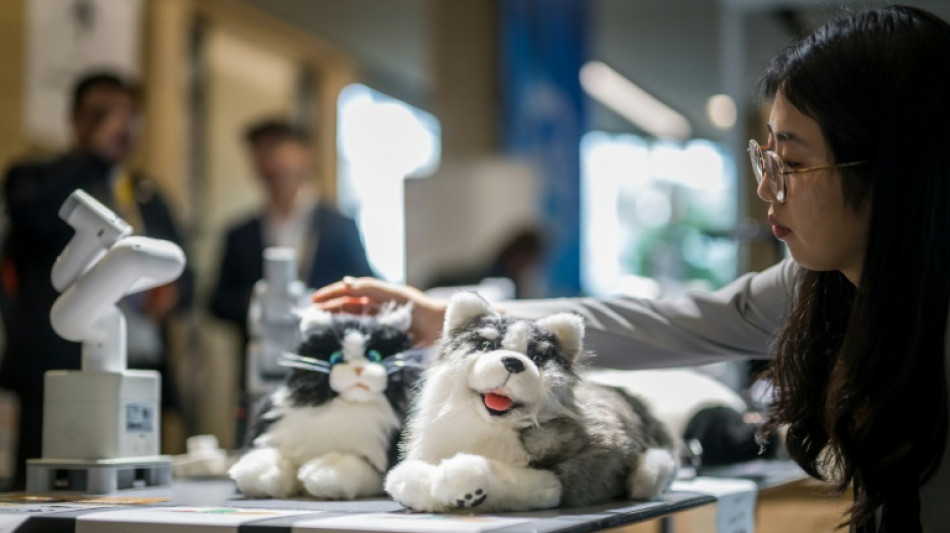
 Japan's busiest rail station tests robot bins

 Backpackers fret over Australian visa crackdown

 Bank of Japan hikes rates to 31-year high to battle inflation

 AI doomsday warnings unlikely to slow IPOs but questions linger

 In Brazil's Amazon, the hunt for oil fuels hopes and fears

 Baby orangutans in India expose 'frightening' scale of trafficking

 Oversight Board blasts 'inadequate' Meta safeguards for AI deepfakes

 Harry makes first public appearance since return to UK

 Princess Diana's brother makes new explosive claims against Charles

 Trump admin overhauls key protection for endangered species

 Mbappe draws political fire over Ceuta t-shirt controversy

 Third malaria death in Germany from outbreak tied to Frankfurt airport

 AtlasClear Holdings Reports Preliminary Fiscal 2026 Revenue of Approximately $20.1 Million, Up 85%; Revenue Plus Interest Income of Approximately $21.9 Million

 'Another arrow to the quiver': World Bank posts record private capital mobilization

 Ireland to boycott Eurovision 2027 over Gaza

 India's Tata Sons reappoints N. Chandrasekaran as chairman

 Germany urges EU action against China to defend carmakers

 Japan eyes changing prostitution law to punish sex buyers

 Modi pitches India as global chipmaking hub

 Ukraine plans record defence spending in 2027

When academic Jathan Sadowski reached for an analogy last year to describe how AI programs decay, he landed on the term "Habsburg AI".
The Habsburgs were one of Europe's most powerful royal houses, but entire sections of their family line collapsed after centuries of inbreeding.
Recent studies have shown how AI programs underpinning products like ChatGPT go through a similar collapse when they are repeatedly fed their own data.
"I think the term Habsburg AI has aged very well," Sadowski told AFP, saying his coinage had "only become more relevant for how we think about AI systems".
The ultimate concern is that AI-generated content could take over the web, which could in turn render chatbots and image generators useless and throw a trillion-dollar industry into a tailspin.
But other experts argue that the problem is overstated, or can be fixed.
And many companies are enthusiastic about using what they call synthetic data to train AI programs. This artificially generated data is used to augment or replace real-world data. It is cheaper than human-created content but more predictable.
"The open question for researchers and companies building AI systems is: how much synthetic data is too much," said Sadowski, lecturer in emerging technologies at Australia's Monash University.
- 'Mad cow disease' -
Training AI programs, known in the industry as large language models (LLMs), involves scraping vast quantities of text or images from the internet.
This information is broken into trillions of tiny machine-readable chunks, known as tokens.
When asked a question, a program like ChatGPT selects and assembles tokens in a way that its training data tells it is the most likely sequence to fit with the query.
But even the best AI tools generate falsehoods and nonsense, and critics have long expressed concern about what would happen if a model was fed on its own outputs.
In late July, a paper in the journal Nature titled "AI models collapse when trained on recursively generated data" proved a lightning rod for discussion.
The authors described how models quickly discarded rarer elements in their original dataset and, as Nature reported, outputs degenerated into "gibberish".
A week later, researchers from Rice and Stanford universities published a paper titled "Self-consuming generative models go MAD" that reached a similar conclusion.
They tested image-generating AI programs and showed that outputs become more generic and strafed with undesirable elements as they added AI-generated data to the underlying model.
They labelled model collapse "Model Autophagy Disorder" (MAD) and compared it to mad cow disease, a fatal illness caused by feeding the remnants of dead cows to other cows.
- 'Doomsday scenario' -
These researchers worry that AI-generated text, images and video are clearing the web of usable human-made data.
"One doomsday scenario is that if left uncontrolled for many generations, MAD could poison the data quality and diversity of the entire internet," one of the Rice University authors, Richard Baraniuk, said in a statement.
However, industry figures are unfazed.
Anthropic and Hugging Face, two leaders in the field who pride themselves on taking an ethical approach to the technology, both told AFP they used AI-generated data to fine-tune or filter their datasets.
Anton Lozhkov, machine learning engineer at Hugging Face, said the Nature paper gave an interesting theoretical perspective but its disaster scenario was not realistic.
"Training on multiple rounds of synthetic data is simply not done in reality," he said.
However, he said researchers were just as frustrated as everyone else with the state of the internet.
"A large part of the internet is trash," he said, adding that Hugging Face already made huge efforts to clean data -- sometimes jettisoning as much as 90 percent.
He hoped that web users would help clear up the internet by simply not engaging with generated content.
"I strongly believe that humans will see the effects and catch generated data way before models will," he said.
M.Anderson--CPN