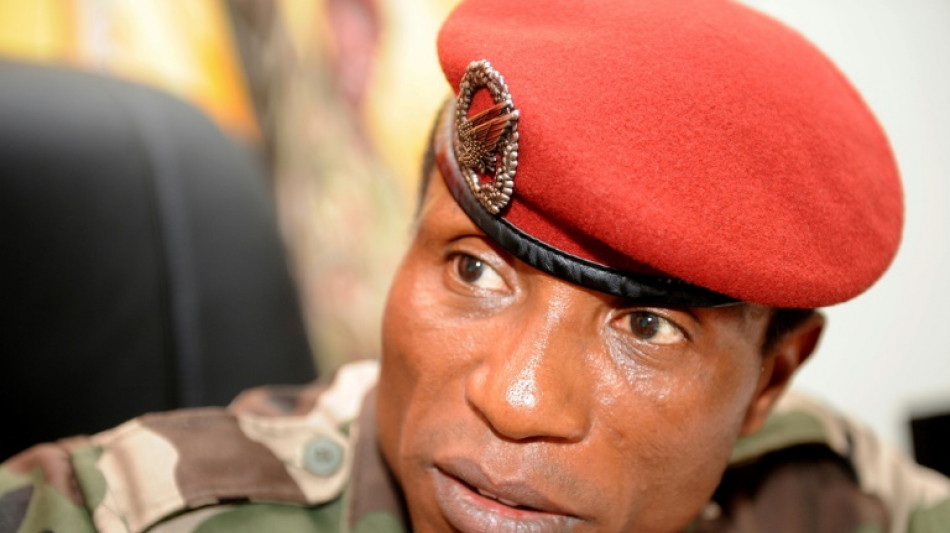
The bloodied trajectory of Guinean ex-dictator Dadis Camara / Photo: SEYLLOU DIALLO - AFP/File

 Nigeria miners struggled to breathe in cell before 37 died: survivors

 Warren Buffett steps down as Berkshire Hathaway chairman

 Isolated Syrian-Druze city blames Damascus for shortages

 Kerry James Marshall: American 'blackness' painter celebrated in Europe

 Infantino 'must go', says German FA vice-president

 Japan's busiest rail station tests robot bins

 Backpackers fret over Australian visa crackdown

 Bank of Japan hikes rates to 31-year high to battle inflation

 AI doomsday warnings unlikely to slow IPOs but questions linger

 In Brazil's Amazon, the hunt for oil fuels hopes and fears

 Baby orangutans in India expose 'frightening' scale of trafficking

 Oversight Board blasts 'inadequate' Meta safeguards for AI deepfakes

 Harry makes first public appearance since return to UK

 Princess Diana's brother makes new explosive claims against Charles

 Trump admin overhauls key protection for endangered species

 Mbappe draws political fire over Ceuta t-shirt controversy

 Third malaria death in Germany from outbreak tied to Frankfurt airport

 AtlasClear Holdings Reports Preliminary Fiscal 2026 Revenue of Approximately $20.1 Million, Up 85%; Revenue Plus Interest Income of Approximately $21.9 Million

 'Another arrow to the quiver': World Bank posts record private capital mobilization

 Ireland to boycott Eurovision 2027 over Gaza

 India's Tata Sons reappoints N. Chandrasekaran as chairman

 Germany urges EU action against China to defend carmakers

 Japan eyes changing prostitution law to punish sex buyers

 Modi pitches India as global chipmaking hub

 Ukraine plans record defence spending in 2027

Moussa Dadis Camara once described himself as the "little captain who became president by destiny" but is associated with one of the darkest periods in Guinea's history.
Known during his rule for his absurd television performances in which he would humiliate stooges, the once-obscure officer who became an incongruous head of state is now a convicted criminal, 59, and faces 20 years in jail.
On September 28, 2009 and in the following days, the Red Berets of his presidential guard as well as soldiers, police and militiamen assassinated 156 people who had gathered in and around a stadium for an opposition rally ahead of an upcoming presidential election.
At least 109 women were raped.
Dadis Camara, then a military captain, had seized power with a group of officers in December 2008 immediately after the death of Lansana Conte, Guinea's second post-independence president who had ruled autocratically for 24 years.
He described the takeover as bloodless and emerged as head of a ruling junta, justifying his power grab by claiming no civilian could manage a country marked by corruption and instability since independence from France in 1958.
"I am the father of the nation," he declared in 2009, asserting on several occasions that he had been "chosen by God, who confers power on whomever He wishes".
The ex-dictator remained motionless as the verdict was read out on Wednesday at the Conakry Court, where he was sentenced for crimes against humanity, after the landmark trial. Seven other defendants were handed sentences of up to life imprisonment.
- The 'Dadis Show' -
Dadis Camara's rollercoaster life journey saw him rise from humble beginnings as a low-ranking officer born in a remote corner of southeastern Guinea, far from the centre of political power in Conakry.
He said his illiterate father was a simple peasant.
"I'm a man of the people... I was born in a hut," he once said.
He is known to have joined the armed forces in 1990 and to have served mainly in the army's fuel supply department.
In 2007 he was among army officers who took part in a wave of unrest against the regime of veteran president Conte, aimed notably at gaining payment of salary arrears.
His popular rhetoric earned him the support of many Guineans at the start of his presidency as he often highlighted his modest origins.
Then-Senegalese president Abdoulaye Wade said Dadis Camara gave him the impression of being a "pure young person who wants to do well".
In his frequent appearances on national television, which became known as the "Dadis Show", he would rail against fellow officers, accusing them of systematic corruption.
But he soon showed signs of letting his power go to his head, becoming increasingly erratic and reneging on a promise not to run in a presidential election the junta promised to hold in 2010.
- 'Napoleon' -
That led to the fateful day in Conakry's sports stadium in September 2009, where a large crowd of opposition supporters were attending a rally against Dadis Camara as a potential election candidate.
After the event, which turned most Guineans against him, Dadis Camara expressed little remorse, stating that his army was "uncontrollable", but that it also had "feelings and respect" for him.
He was unceremoniously ousted from power after suffering a head wound in an attempted assassination by his aide de camp in December 2009, formally giving up power in January 2010.
He received treatment in Morocco before fleeing into exile in Burkina Faso, where he converted to Christianity.
After announcing his intention to run for president in 2015, he was indicted in July 2015 by Guinean magistrates for his role in the stadium massacre.
He finally returned to his homeland in September 2022 for his trial, the once mighty head of state humbled by the experience of imprisonment.
In his winding testimony referencing philosophers Heraclitus and Immanuel Kant, Egyptian pharaohs, Napoleon and the memory of his father, Dadis Camara denied any responsibility.
"Many may think, 'Ah, Dadis Camara is crazy'", he said.
"Dadis Camara is not crazy -- Dadis Camara is generous because Dadis Camara recognises his ancestors."
M.Davis--CPN