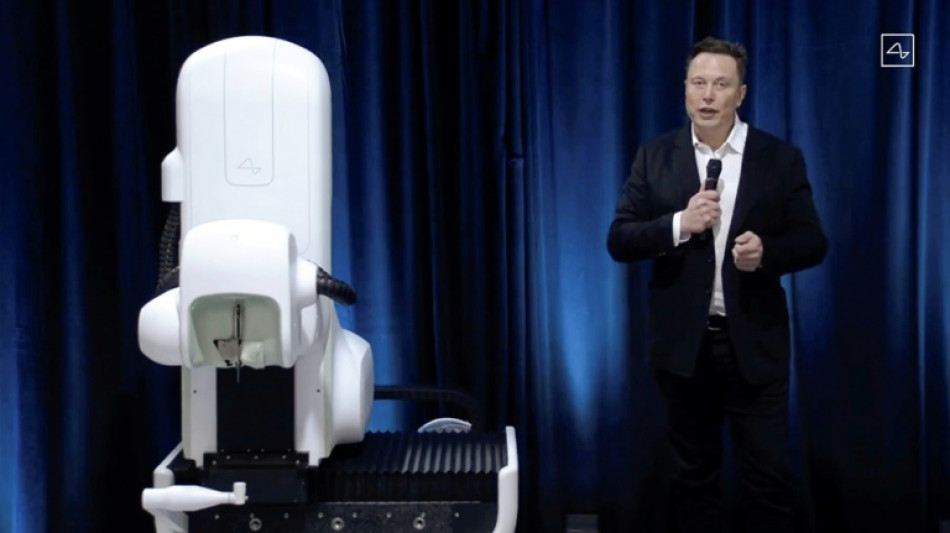
Musk's superhuman vision promise is dangerous: researchers / Photo: - - Neuralink/AFP/File

 Nigeria miners struggled to breathe in cell before 37 died: survivors

 Warren Buffett steps down as Berkshire Hathaway chairman

 Isolated Syrian-Druze city blames Damascus for shortages

 Kerry James Marshall: American 'blackness' painter celebrated in Europe

 Infantino 'must go', says German FA vice-president

 Japan's busiest rail station tests robot bins

 Backpackers fret over Australian visa crackdown

 Bank of Japan hikes rates to 31-year high to battle inflation

 AI doomsday warnings unlikely to slow IPOs but questions linger

 In Brazil's Amazon, the hunt for oil fuels hopes and fears

 Baby orangutans in India expose 'frightening' scale of trafficking

 Oversight Board blasts 'inadequate' Meta safeguards for AI deepfakes

 Harry makes first public appearance since return to UK

 Princess Diana's brother makes new explosive claims against Charles

 Trump admin overhauls key protection for endangered species

 Mbappe draws political fire over Ceuta t-shirt controversy

 Third malaria death in Germany from outbreak tied to Frankfurt airport

 AtlasClear Holdings Reports Preliminary Fiscal 2026 Revenue of Approximately $20.1 Million, Up 85%; Revenue Plus Interest Income of Approximately $21.9 Million

 'Another arrow to the quiver': World Bank posts record private capital mobilization

 Ireland to boycott Eurovision 2027 over Gaza

 India's Tata Sons reappoints N. Chandrasekaran as chairman

 Germany urges EU action against China to defend carmakers

 Japan eyes changing prostitution law to punish sex buyers

 Modi pitches India as global chipmaking hub

 Ukraine plans record defence spending in 2027

Researchers have criticised billionaire Elon Musk for promising that his brain implant technology could eventually provide patients with vision superior to normal human sight.
Musk has long promised that his Neuralink company was working on implants that could restore sight to blind people, telling his 190 million followers on X in March that the product would be called "Blindsight".
He said the product was already working in monkeys, adding: "Resolution will be low at first, like early Nintendo graphics, but ultimately may exceed normal human vision."
But Ione Fine, psychology professor at the University of Washington, said it was "a dangerous thing to say".
Fine co-authored a paper published Monday in the journal Scientific Reports that used models known as "virtual patients" to simulate how such implants could work.
The article argues that the impact of novel implants including Musk's are likely to be limited by human biology.
Fine said Musk's idea rested on a flawed premise that high-resolution vision could be created by implanting millions of tiny electrodes into the visual cortex, the region of the brain that processes information received from the eye.
"Engineers often think of electrodes as producing pixels, but that is simply not how biology works," she said in a statement.
Creating an image in the brain involves not only stimulating individual cells in the way an implant can do, but also then generating a "neural code" that fires across thousands of cells.
She said scientists were not even close to finding the correct neural code in a blind person -- meaning the impact of implants would be limited.
"Blindness doesn't make people vulnerable, but becoming blind late in life can make some people vulnerable," she said.
"So, when Elon Musk says things like 'this is going to better than human vision', that is a dangerous thing to say."
A.Levy--CPN