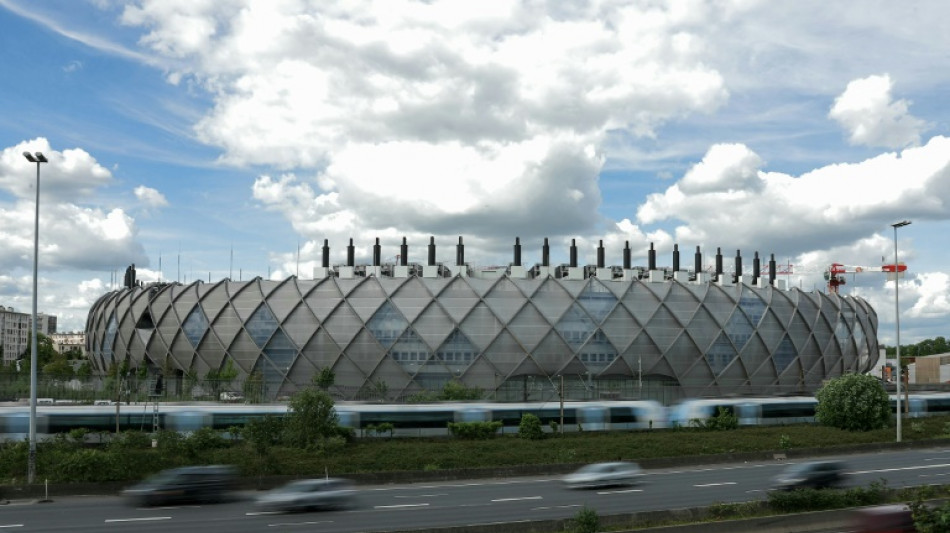
France quietly catches rivals in battle for data centre supremacy / Photo: Thomas SAMSON - AFP/File

 Nigeria miners struggled to breathe in cell before 37 died: survivors

 Warren Buffett steps down as Berkshire Hathaway chairman

 Isolated Syrian-Druze city blames Damascus for shortages

 Kerry James Marshall: American 'blackness' painter celebrated in Europe

 Infantino 'must go', says German FA vice-president

 Japan's busiest rail station tests robot bins

 Backpackers fret over Australian visa crackdown

 Bank of Japan hikes rates to 31-year high to battle inflation

 AI doomsday warnings unlikely to slow IPOs but questions linger

 In Brazil's Amazon, the hunt for oil fuels hopes and fears

 Baby orangutans in India expose 'frightening' scale of trafficking

 Oversight Board blasts 'inadequate' Meta safeguards for AI deepfakes

 Harry makes first public appearance since return to UK

 Princess Diana's brother makes new explosive claims against Charles

 Trump admin overhauls key protection for endangered species

 Mbappe draws political fire over Ceuta t-shirt controversy

 Third malaria death in Germany from outbreak tied to Frankfurt airport

 AtlasClear Holdings Reports Preliminary Fiscal 2026 Revenue of Approximately $20.1 Million, Up 85%; Revenue Plus Interest Income of Approximately $21.9 Million

 'Another arrow to the quiver': World Bank posts record private capital mobilization

 Ireland to boycott Eurovision 2027 over Gaza

 India's Tata Sons reappoints N. Chandrasekaran as chairman

 Germany urges EU action against China to defend carmakers

 Japan eyes changing prostitution law to punish sex buyers

 Modi pitches India as global chipmaking hub

 Ukraine plans record defence spending in 2027

At the end of a narrow suburban street north of Paris, a giant structure shrouded in a skin of mesh and steel looks like a football stadium, but is in fact a vast data centre.
Paris Digital Park, which towers over four-storey apartment blocks and is owned by US firm Digital Realty, is one of more than 70 centres that ring the French capital -- more than a third of the country's total.
The government is pushing hard to expand an industry seen as the backbone of the digital economy, playing catch-up with established hubs like London and Frankfurt, and is so far avoiding the backlash that has slowed development elsewhere.
"The Paris region is the fourth largest hub in the world for content exchanges," Fabrice Coquio, President of Digital Realty France, told AFP on a recent tour of his firm's campus.
The capital region's data centre industry is already worth 1.2 billion euros ($1.3 billion), according to specialist consultancy Structure Research.
And Coquio, like everyone else in the industry, believes artificial intelligence is about to supercharge it.
He said the massive computing needs of AI would power a "second wave" of expansion for data centres, after the shift to cloud computing fuelled the first wave.
Jerome Totel of French firm Data4 said there were virtually no AI-ready data centres in France right now. But by 2030 data capacity would double in France, with between 30 and 40 percent of it dedicated to the technology, according to a recent report by trade group Datacenter.
That expansion will suck up power and land on a dramatic scale -- Coquio sees electricity usage at data centres doubling in the next four years.
But unlike in other parts of the world, there are few dissenting voices in France.
- 'Isolated' protests -
Concerns over energy and land use pushed Amsterdam and Dublin to restrict licences for new data centres -- helping Paris overtake the Dutch capital in the race for market share.
Frankfurt has clamped down on data centre sprawl with new zoning and energy rules.
And public protests have been seen recently from the Netherlands to the heart of the global industry in the US state of Virginia.
Yet in France, one of the few concerted efforts to block a centre was back in 2015 when Coquio's firm -- then known as Interxion -- had to overcome local protests and legal challenges to an earlier building.
Amazon's data centre arm, AWS, also backed off from a planned centre in 2021 after facing pushback in Bretigny-sur-Orge, in the south of Paris.
"Protests have existed and still exist, but they are very ad hoc and isolated," said Clement Marquet, a researcher at Paris-based engineering school Mines.
He said the objections had not gone beyond NIMBY, or "not in my backyard".
Those who had tried to widen the issue to the broader climate costs of digital developments "failed to bring people together over time and eventually gave up", said Marquet.
- Faster planning -
France already has some advantages that explain why data centre developments are not as divisive as in other countries.
It is much bigger than the Netherlands or Ireland, with much more free land and a less strained power grid.
Added to this, national laws largely restrict data centre companies to building on land already in industrial use.
Coquio stresses that his new Paris campus is built on a former Airbus helicopter plant.
Keeping developments mostly out of the public eye, tucked away next to motorways, in former factories, and on wasteland, has helped keep the public neutral about the centres.
However, this balance could be about to shift.
Before President Emmanuel Macron called snap elections in June that his centrist party lost, resulting in a hung parliament, his government had been trying to push through a law that would allow large data centres to be classified as projects of major national interest.
The idea would be to speed up planning processes and connection to the power grid.
Marquet said France should be moving in the opposite direction and putting more thought into planning.
"In the long term, we all need to think hard about the ecological consequences of digital growth in general," he said, labelling the current habit of ignoring climate concerns as "absurd".
But with the ramped-up computing needs of AI combining with looser regulation, the transformation of France's post-industrial suburbs looks set to continue apace.
D.Goldberg--CPN