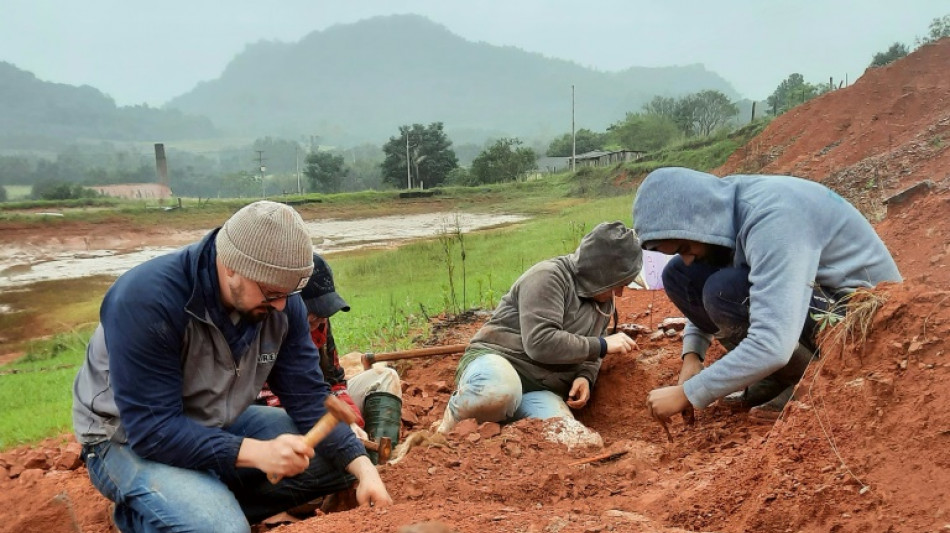
'Well-preserved' dinosaur fossil revealed by Brazilian flood / Photo: Handout - Federal University of Santa Maria/AFP

 Nigeria miners struggled to breathe in cell before 37 died: survivors

 Warren Buffett steps down as Berkshire Hathaway chairman

 Isolated Syrian-Druze city blames Damascus for shortages

 Kerry James Marshall: American 'blackness' painter celebrated in Europe

 Infantino 'must go', says German FA vice-president

 Japan's busiest rail station tests robot bins

 Backpackers fret over Australian visa crackdown

 Bank of Japan hikes rates to 31-year high to battle inflation

 AI doomsday warnings unlikely to slow IPOs but questions linger

 In Brazil's Amazon, the hunt for oil fuels hopes and fears

 Baby orangutans in India expose 'frightening' scale of trafficking

 Oversight Board blasts 'inadequate' Meta safeguards for AI deepfakes

 Harry makes first public appearance since return to UK

 Princess Diana's brother makes new explosive claims against Charles

 Trump admin overhauls key protection for endangered species

 Mbappe draws political fire over Ceuta t-shirt controversy

 Third malaria death in Germany from outbreak tied to Frankfurt airport

 AtlasClear Holdings Reports Preliminary Fiscal 2026 Revenue of Approximately $20.1 Million, Up 85%; Revenue Plus Interest Income of Approximately $21.9 Million

 'Another arrow to the quiver': World Bank posts record private capital mobilization

 Ireland to boycott Eurovision 2027 over Gaza

 India's Tata Sons reappoints N. Chandrasekaran as chairman

 Germany urges EU action against China to defend carmakers

 Japan eyes changing prostitution law to punish sex buyers

 Modi pitches India as global chipmaking hub

 Ukraine plans record defence spending in 2027

Torrential rains causing historic flooding in southern Brazil have revealed a "very well-preserved" dinosaur fossil dating back some 200 million years, according to the research team who discovered it.
The fossil was first identified in May near the city of Sao Joao do Polesine, some 280 kilometres (170 miles) west of Porto Alegre, in a part of the Brazilian pampas dubbed the country's 'El Dorado' of palaeontology.
A team of palaeontologists from the Federal University of Santa Maria spent four days excavating the fossil to remove the block of rock containing a "near complete" dinosaur fossil to take back to their research centre for study.
Initial findings have determined the fossil was a specimen of the Herrerasauridae family, which were bipedal carnivores with long tails found in the area of modern-day Brazil and Argentina.
The fossil dates to the Triassic period, between 250 to 200 million years ago.
Rodrigo Temp Muller, who's leading the research effort, told AFP that the fossil is possibly the second most complete fossil of a Herrerasauridae specimen to date.
The most complete was found in the same part of Brazil in 2014, leading to the identification of a new species with hooked claws, dubbed gnathovorax cabreirai.
The fossil will undergo several rounds of analysis before researchers can determine whether the specimen is a member of the same species.
"We have to be very careful with this work, it's very meticulous, almost surgical," Muller said, adding the process could take "several months."
"Every little part that we might damage will be a bit of information that we might not be able to recover."
Once the analysis is done, Muller's team will publish the results in a scientific journal.
- Erosion acceleration -
The heavy rains that affected the pampas in May killed more than 180 people in Brazil and caused major damage to infrastructure.
The floods revealed the fossil much earlier by "accelerating erosion," a silver lining to researchers, who would not have discovered it until much later, according to Muller.
The downpour is not without its drawbacks, however, as heavy rainfall "also destroys a lot of the material" from the fossils, especially small fragments.
Palaeontologists maintain a close watch on the fossil deposits as a result, especially any fragments that may be exposed, and focus their efforts during excavations to recover these fossils in the best possible condition.
M.P.Jacobs--CPN