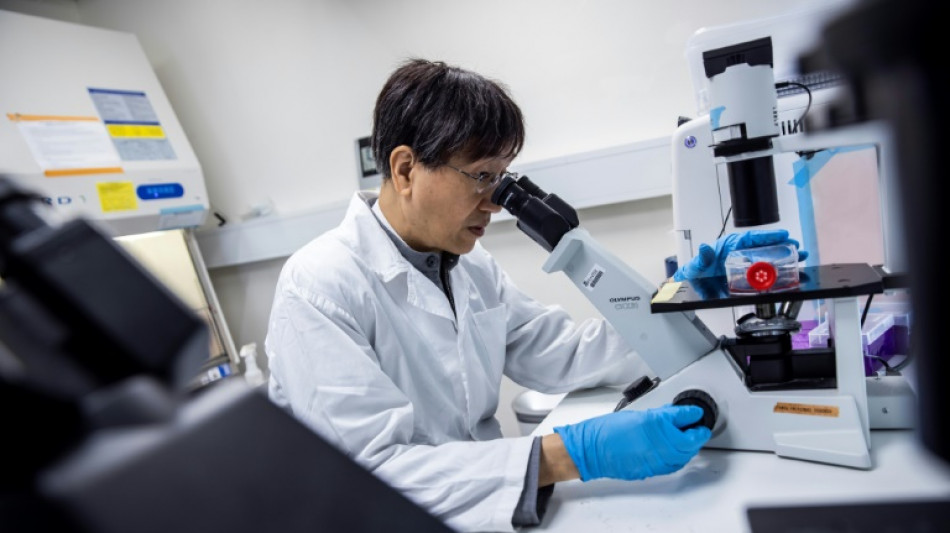
'Hong Kong's Dr Fauci' sounds alarm on next pandemic / Photo: ISAAC LAWRENCE - AFP

 Nigeria miners struggled to breathe in cell before 37 died: survivors

 Warren Buffett steps down as Berkshire Hathaway chairman

 Isolated Syrian-Druze city blames Damascus for shortages

 Kerry James Marshall: American 'blackness' painter celebrated in Europe

 Infantino 'must go', says German FA vice-president

 Japan's busiest rail station tests robot bins

 Backpackers fret over Australian visa crackdown

 Bank of Japan hikes rates to 31-year high to battle inflation

 AI doomsday warnings unlikely to slow IPOs but questions linger

 In Brazil's Amazon, the hunt for oil fuels hopes and fears

 Baby orangutans in India expose 'frightening' scale of trafficking

 Oversight Board blasts 'inadequate' Meta safeguards for AI deepfakes

 Harry makes first public appearance since return to UK

 Princess Diana's brother makes new explosive claims against Charles

 Trump admin overhauls key protection for endangered species

 Mbappe draws political fire over Ceuta t-shirt controversy

 Third malaria death in Germany from outbreak tied to Frankfurt airport

 AtlasClear Holdings Reports Preliminary Fiscal 2026 Revenue of Approximately $20.1 Million, Up 85%; Revenue Plus Interest Income of Approximately $21.9 Million

 'Another arrow to the quiver': World Bank posts record private capital mobilization

 Ireland to boycott Eurovision 2027 over Gaza

 India's Tata Sons reappoints N. Chandrasekaran as chairman

 Germany urges EU action against China to defend carmakers

 Japan eyes changing prostitution law to punish sex buyers

 Modi pitches India as global chipmaking hub

 Ukraine plans record defence spending in 2027

Hong Kong microbiologist Yuen Kwok-yung has done battle with some of the world's worst threats, including the SARS virus he helped isolate and identify. And he has a warning.
Another pandemic is inevitable and could exact damage far worse than Covid-19, according to the soft-spoken scientist sometimes thought of as Hong Kong's answer to top US health expert Anthony Fauci.
"Both the public and (world) leaders must admit that another pandemic will come, and probably sooner than you anticipate," he told AFP at the city's Queen Mary Hospital, where he works and teaches.
"Why I make such a horrifying prediction is because you can see clearly that the geopolitical, economic, and climatic changes are changing so rapidly," he told AFP.
Politicians must "come to their senses" and solve "global existential threats," he warns in his new autobiography "My Life in Medicine: A Hong Kong Journey".
While world leaders are more focused on "national or regional interests", Yuen said a rapidly changing climate coupled with emerging infectious diseases should be a top priority.
"This is something so important that we should not ignore."
- Humble background -
Yuen is a globally recognised authority on coronaviruses and infectious diseases, but he came from humble beginnings.
Born in Hong Kong in the late 1950s, he grew up in a 60-square-foot subdivided flat with his parents and three brothers.
Since graduating from medical school in 1981, he has worked in the city's public hospitals, where doctors are paid far less than in the private sector.
It was in 2003 when he leapt into the public consciousness, after he and his team successfully isolated and identified severe acute respiratory syndrome, better known as SARS.
It was a vital step towards testing, diagnosing and treating the disease, which emerged in southern China and Hong Kong before spreading globally.
The virus killed nearly 300 people in the city in just two months, a toll second only to mainland China.
That experience informed Yuen's approach to the Covid-19 pandemic, which ripped through Hong Kong due to lax vaccination, particularly among the elderly.
"We benefited from the 20 years of study that followed the SARS outbreak," he wrote in his book.
"Until factors beyond our ability to stop or overcome -- fear, ignorance, poor messaging, and deliberate misinformation -- the measures were effective" in buying Hong Kong time until the vaccines were developed.
In the end, despite tough lockdown measures and lengthy quarantines, Hong Kong recorded some three million infections -- about half its population -- and more than 13,800 deaths from Covid-19.
It was a frenetic time for Yuen, who became a familiar face as the government's go-to expert and penned more than 100 peer-reviewed studies on the virus.
It also put him in a delicate position on several occasions, including when his call to lift restrictions in 2022 was rejected when the city stayed aligned with China's zero-Covid doctrine of closed borders and quarantines.
The self-described medical "detective" also faced complaints that put his license at risk after he described the seafood market in China's Wuhan -- where the first cluster of coronavirus cases was detected -- as a "crime scene".
- 'Transparent investigation' -
Today, Yuen chooses his words carefully and avoids political subjects, but he maintains that understanding the origins of Covid-19 is key.
It is "important to properly do an investigation in a very open, transparent manner" so lessons can be learned for future pandemic prevention, he said.
The World Health Organization has called on China to be more transparent about the pandemic's origins, without making any firm conclusions on the source.
Last year, Yuen set up the Pandemic Research Alliance with peers in mainland China and the United States to share information and research on future threats.
"It is a bad idea to stop or inhibit these exchanges because it protects everyone," he said.
"If we do not talk about it... then another pandemic comes, we have to pay a huge price again."
Y.Ibrahim--CPN