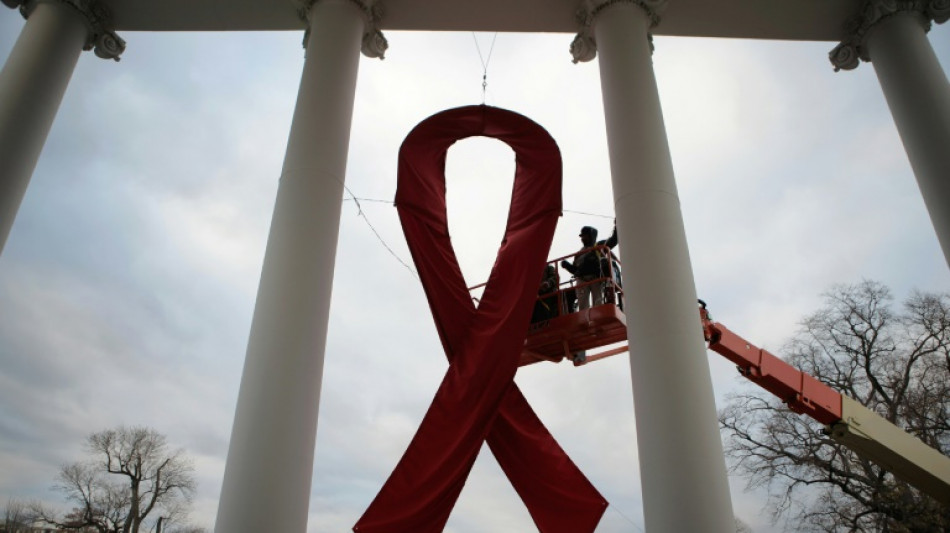
Seventh person likely 'cured' of HIV, doctors announce / Photo: CHIP SOMODEVILLA - GETTY IMAGES NORTH AMERICA/AFP/File

 Nigeria miners struggled to breathe in cell before 37 died: survivors

 Warren Buffett steps down as Berkshire Hathaway chairman

 Isolated Syrian-Druze city blames Damascus for shortages

 Kerry James Marshall: American 'blackness' painter celebrated in Europe

 Infantino 'must go', says German FA vice-president

 Japan's busiest rail station tests robot bins

 Backpackers fret over Australian visa crackdown

 Bank of Japan hikes rates to 31-year high to battle inflation

 AI doomsday warnings unlikely to slow IPOs but questions linger

 In Brazil's Amazon, the hunt for oil fuels hopes and fears

 Baby orangutans in India expose 'frightening' scale of trafficking

 Oversight Board blasts 'inadequate' Meta safeguards for AI deepfakes

 Harry makes first public appearance since return to UK

 Princess Diana's brother makes new explosive claims against Charles

 Trump admin overhauls key protection for endangered species

 Mbappe draws political fire over Ceuta t-shirt controversy

 Third malaria death in Germany from outbreak tied to Frankfurt airport

 AtlasClear Holdings Reports Preliminary Fiscal 2026 Revenue of Approximately $20.1 Million, Up 85%; Revenue Plus Interest Income of Approximately $21.9 Million

 'Another arrow to the quiver': World Bank posts record private capital mobilization

 Ireland to boycott Eurovision 2027 over Gaza

 India's Tata Sons reappoints N. Chandrasekaran as chairman

 Germany urges EU action against China to defend carmakers

 Japan eyes changing prostitution law to punish sex buyers

 Modi pitches India as global chipmaking hub

 Ukraine plans record defence spending in 2027

A 60-year-old German man is likely the seventh person to be effectively cured from HIV after receiving a stem cell transplant, doctors announced on Thursday.
The painful and risky procedure is for people who have both HIV and aggressive leukaemia, so is not an option for almost all of the nearly 40 million people living with the deadly virus across the world.
The German man, whose wished to remain anonymous, was dubbed the "next Berlin patient".
The original Berlin patient, Timothy Ray Brown, was the first person declared cured of HIV back in 2008. Brown died from cancer in 2020.
The second man from Berlin to achieve long-term HIV remission was announced ahead of the 25th International AIDS Conference being held in the German city of Munich next week.
He was first diagnosed with HIV in 2009, according to the research abstract being presented at the conference.
The man received a bone marrow transplant for his leukaemia in 2015. The procedure, which has a 10 percent risk of death, essentially replaces a person's immune system.
Then he stopped taking anti-retroviral drugs -- which reduce the amount of HIV in the blood -- in late 2018.
Nearly six years later, he appears to be both HIV and cancer free, the medical researchers said.
Christian Gaebler, a doctor-researcher at Berlin's Charite university hospital treating the patient, told AFP that the team cannot be "absolutely certain" every last trace of HIV has been eradicated.
But "the patient's case is highly suggestive of an HIV cure," Gaebler added. "He feels well and is enthusiastic about contributing to our research efforts."
- 'Promising' for wider cure -
International AIDS Society President Sharon Lewin said researchers hesitate to use the word "cure" because it is not clear how long they need to follow up such cases.
But more than five years in remission means the man "would be close" to being considered cured, she told a press conference.
There is an important difference between the man's case and the other HIV patients who have reached long-term remission, she said.
All but one of the other patients received stem cells from donors with a rare mutation in which part of their CCR5 gene was missing, blocking HIV from entering their body's cells.
Those donors had inherited two copies of the mutated CCR5 gene -- one from each parent -- making them "essentially immune" to HIV, Lewin said.
But the new Berlin patient is the first to have received stem cells from a donor who had inherited only one copy of the mutated gene.
Around 15 percent of people from European origin have one mutated copy, compared to one percent for both.
Researchers hope the latest success means there will be a much larger potential donor pool in the future.
The new case is also "promising" for the wider search for an HIV cure that works for all patients, Lewin said.
This is "because it suggests that you don't actually have to get rid of every single piece of CCR5 for gene therapy to work," she added.
The Geneva patient, whose case was announced at last year's AIDS conference, is the other exception among the seven. He received a transplant from a donor without any CCR5 mutations -- yet still achieved long-term remission.
This showed that the effectiveness of the procedure was not just down to the CCR5 gene, Lewin said.
X.Wong--CPN