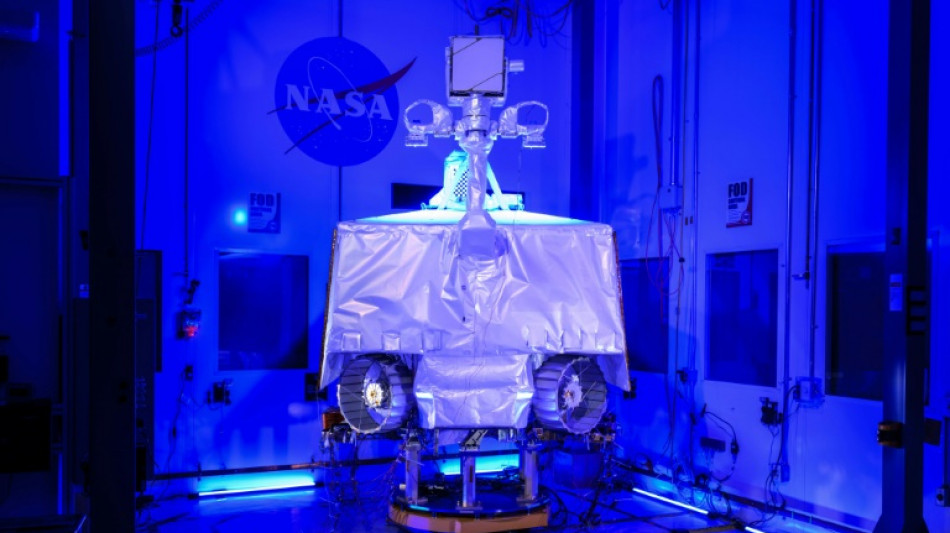
NASA cans lunar rover after spending $450 million building it / Photo: Handout - NASA/AFP

 Nigeria miners struggled to breathe in cell before 37 died: survivors

 Warren Buffett steps down as Berkshire Hathaway chairman

 Isolated Syrian-Druze city blames Damascus for shortages

 Kerry James Marshall: American 'blackness' painter celebrated in Europe

 Infantino 'must go', says German FA vice-president

 Japan's busiest rail station tests robot bins

 Backpackers fret over Australian visa crackdown

 Bank of Japan hikes rates to 31-year high to battle inflation

 AI doomsday warnings unlikely to slow IPOs but questions linger

 In Brazil's Amazon, the hunt for oil fuels hopes and fears

 Baby orangutans in India expose 'frightening' scale of trafficking

 Oversight Board blasts 'inadequate' Meta safeguards for AI deepfakes

 Harry makes first public appearance since return to UK

 Princess Diana's brother makes new explosive claims against Charles

 Trump admin overhauls key protection for endangered species

 Mbappe draws political fire over Ceuta t-shirt controversy

 Third malaria death in Germany from outbreak tied to Frankfurt airport

 AtlasClear Holdings Reports Preliminary Fiscal 2026 Revenue of Approximately $20.1 Million, Up 85%; Revenue Plus Interest Income of Approximately $21.9 Million

 'Another arrow to the quiver': World Bank posts record private capital mobilization

 Ireland to boycott Eurovision 2027 over Gaza

 India's Tata Sons reappoints N. Chandrasekaran as chairman

 Germany urges EU action against China to defend carmakers

 Japan eyes changing prostitution law to punish sex buyers

 Modi pitches India as global chipmaking hub

 Ukraine plans record defence spending in 2027

NASA announced Wednesday that cost overruns and delays have forced it to cancel a planned Moon rover it already spent $450 million to develop, marking a significant setback for the agency's lunar exploration program.
The Volatiles Investigating Polar Exploration Rover (VIPER) was intended to explore the lunar south pole in search of ice and other resources, paving the way for planned crewed missions by American astronauts under the Artemis program later this decade.
"Decisions like this are never easy," said Nicky Fox, NASA's associate administrator of the science mission directorate.
"But in this case, the projected remaining expenses for VIPER would have resulted in having to either cancel or disrupt many other missions."
The mobile robot, which NASA had hoped would venture into the Moon's permanently shadowed craters, where ice reserves have endured for billions of years, was originally planned to launch in 2023.
But in 2022, the US space agency requested a launch delay to late 2024 to allow more time for preflight testing of the Griffin lander vehicle, supplied by the Pittsburgh-based company Astrobotic under the new Commercial Lunar Payload Services (CLPS) program, a public-private venture.
The launch readiness date of the rover then slipped back further to September 2025, while the cost was projected to rise to $609.6 million.
Joel Kearns, deputy associate administrator for exploration in NASA's science mission directorate, added that Congress had been notified of the agency's decision.
The rover was "completely assembled" but had not yet undergone certain tests that would certify it could withstand launch, flying through the vacuum of space, and experiencing extreme temperatures, said Kearns.
But it was still possible the rover could be re-used in future missions, either in whole or in component parts, if NASA could reach a suitable agreement with industry partners who might be interested, he said.
Astrobotic, which in January launched the Peregrine lander that failed to reach the Moon, is still on track to launch in late 2025, but it will now carry a "mass simulator" or heavy weight in place of a NASA rover.
Kearns insisted that despite the setback, the United States was not falling behind in its space rivalry with China, which in June succeeded in returning the first ever samples from the far side of the Moon.
"We congratulate China's national space agency for the seemingly very successful Chang'e-6 mission," he said.
But he added that, by partnering with the space industry under the CLPS program, "we think that we're going to have a more robust science program and a more robust lunar landing capability in the United States."
Y.Ponomarenko--CPN