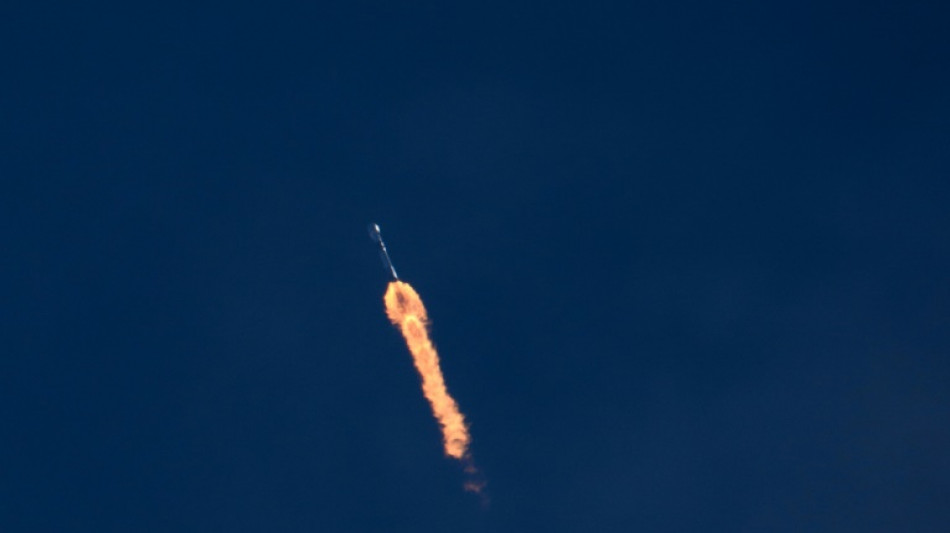
SpaceX Falcon 9 rocket experiences rare failure / Photo: Patrick T. Fallon - AFP

 Nigeria miners struggled to breathe in cell before 37 died: survivors

 Warren Buffett steps down as Berkshire Hathaway chairman

 Isolated Syrian-Druze city blames Damascus for shortages

 Kerry James Marshall: American 'blackness' painter celebrated in Europe

 Infantino 'must go', says German FA vice-president

 Japan's busiest rail station tests robot bins

 Backpackers fret over Australian visa crackdown

 Bank of Japan hikes rates to 31-year high to battle inflation

 AI doomsday warnings unlikely to slow IPOs but questions linger

 In Brazil's Amazon, the hunt for oil fuels hopes and fears

 Baby orangutans in India expose 'frightening' scale of trafficking

 Oversight Board blasts 'inadequate' Meta safeguards for AI deepfakes

 Harry makes first public appearance since return to UK

 Princess Diana's brother makes new explosive claims against Charles

 Trump admin overhauls key protection for endangered species

 Mbappe draws political fire over Ceuta t-shirt controversy

 Third malaria death in Germany from outbreak tied to Frankfurt airport

 AtlasClear Holdings Reports Preliminary Fiscal 2026 Revenue of Approximately $20.1 Million, Up 85%; Revenue Plus Interest Income of Approximately $21.9 Million

 'Another arrow to the quiver': World Bank posts record private capital mobilization

 Ireland to boycott Eurovision 2027 over Gaza

 India's Tata Sons reappoints N. Chandrasekaran as chairman

 Germany urges EU action against China to defend carmakers

 Japan eyes changing prostitution law to punish sex buyers

 Modi pitches India as global chipmaking hub

 Ukraine plans record defence spending in 2027

SpaceX's highly reliable Falcon 9 rocket has experienced a rare failure that means the latest batch of the company's Starlink satellites won't make it into orbit, the company said Friday, as regulators opened an investigation.
The rocket, a prolific launch vehicle that propels both satellites and astronauts into orbit, blasted off from Vandenberg Space Force Base in California on Thursday night, with the first stage performing well and executing its impressive yet now routine droneship landing.
But the second stage developed a liquid oxygen leak, SpaceX said in a statement, leaving it unable to complete a planned second burn.
Though it deployed the 20 Starlink internet satellites it was carrying, they entered an eccentric orbit with a low point of 135 km (83 miles), roughly half of what it needed to be.
The team worked overnight to send commands to the satellites to try to lift their orbit, but were ultimately unsuccessful.
"As such, the satellites will re-enter Earth’s atmosphere and fully demise," SpaceX said. "They do not pose a threat to other satellites in orbit or to public safety."
The mishap marks a rare failure for a rocket that has launched successfully 364 times, carrying astronauts, payloads for SpaceX's commercial clients and thousands of Starlink satellites to orbit.
The last time a Falcon 9 experienced a serious incident was when one blew up on the launchpad in September 2016.
And in June 2015, the second stage of a Falcon 9 disintegrated two minutes after lift-off, resulting in the loss of important equipment bound for the International Space Station.
The Federal Aviation Administration said in a statement it was "requiring an investigation" to determine the root cause of the latest event, identify corrective actions and prevent it from happening again.
SpaceX must submit a report before it can be issued a "return to flight," meaning the next scheduled resupply of the International Space Station on July 19 is likely to be delayed, as is the next crewed launch on July 31 for the private Polaris Dawn mission.
"SpaceX has an incredible track record with Falcon 9. I can say from personal experience they are very transparent when issues arise," Jared Isaacman, the billionaire businessman behind Polaris Dawn tweeted.
"As for Polaris Dawn, we will fly whenever SpaceX is ready."
The mishap notably comes as the first crew of Boeing's problem-plagued Starliner spaceship are stuck waiting for ground teams to give a green light for them to return from the ISS.
Ng.A.Adebayo--CPN