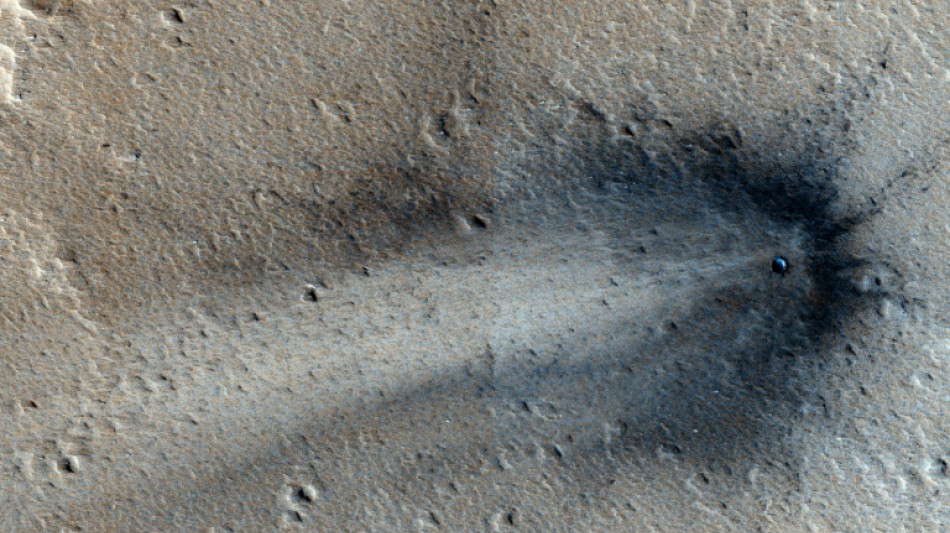
Meteorites strike Mars far more often than thought, probe finds / Photo: Handout - NASA/JPL-Caltech/Univ. of Arizona/AFP/File

 Nigeria miners struggled to breathe in cell before 37 died: survivors

 Warren Buffett steps down as Berkshire Hathaway chairman

 Isolated Syrian-Druze city blames Damascus for shortages

 Kerry James Marshall: American 'blackness' painter celebrated in Europe

 Infantino 'must go', says German FA vice-president

 Japan's busiest rail station tests robot bins

 Backpackers fret over Australian visa crackdown

 Bank of Japan hikes rates to 31-year high to battle inflation

 AI doomsday warnings unlikely to slow IPOs but questions linger

 In Brazil's Amazon, the hunt for oil fuels hopes and fears

 Baby orangutans in India expose 'frightening' scale of trafficking

 Oversight Board blasts 'inadequate' Meta safeguards for AI deepfakes

 Harry makes first public appearance since return to UK

 Princess Diana's brother makes new explosive claims against Charles

 Trump admin overhauls key protection for endangered species

 Mbappe draws political fire over Ceuta t-shirt controversy

 Third malaria death in Germany from outbreak tied to Frankfurt airport

 AtlasClear Holdings Reports Preliminary Fiscal 2026 Revenue of Approximately $20.1 Million, Up 85%; Revenue Plus Interest Income of Approximately $21.9 Million

 'Another arrow to the quiver': World Bank posts record private capital mobilization

 Ireland to boycott Eurovision 2027 over Gaza

 India's Tata Sons reappoints N. Chandrasekaran as chairman

 Germany urges EU action against China to defend carmakers

 Japan eyes changing prostitution law to punish sex buyers

 Modi pitches India as global chipmaking hub

 Ukraine plans record defence spending in 2027

Mars is bombarded with basketball-sized meteorites on a nearly daily basis, fives times more often than previously estimated, seismic recordings from a NASA spacecraft have revealed.
Before the new study was published on Friday, the best guess for how many meteorites strike Mars was made by looking at images taken by orbiting spacecrafts or models based on craters on the Moon.
But NASA's InSight probe, which landed on a Martian plain called Elysium Planitia in 2018, has allowed scientists to listen to the internal rumblings of the red planet for the first time.
Mars is roughly twice as big as the Moon and is much closer to our solar system's main asteroid belt, making it a prime target for large rocks hurtling through space.
Most meteorites taking a shot at Earth break apart in our atmosphere. But the Martian atmosphere is 100 times thinner than Earth's, giving it little protection.
Rather than scouring through images taken from far away, the international team of researchers behind the new study in Nature Astronomy were able to listen in on meteorites smashing into Mars.
"Listening for impacts seems to be more effective than looking for them if we want to understand how often they occur," study co-author Gareth Collins of Imperial College London said in a statement.
The researchers used the data from InSight's seismometer to estimate that every year Mars is hit by between 280 to 360 meteorites, which all blast craters bigger than eight metres (26 feet) wide.
"This rate was about five times higher than the number estimated from orbital imagery alone," study co-author Geraldine Zenhaeusern of the ETH Zurich university said.
- Mars missions, take note -
Frequent, intense dust storms make it particularly difficult for spacecrafts orbiting Mars to see small meteorite craters down below.
New craters are easiest to spot in flat and dusty areas, but "this type of terrain covers less than half of the surface of Mars," Zenhaeusern said.
"The sensitive InSight seismometer, however, could hear every single impact within the landers' range," she added.
The scientists tracked a particular acoustic signal which is produced when meteorites strike Mars to estimate the diameter of craters and their distance from InSight.
They then calculated the number of craters made in one year near the lander, before extrapolating that number across the entire planet.
"This is the first paper of its kind to determine how often meteorites impact the surface of Mars from seismological data," said Domenico Giardini, who works on the InSight mission.
This data should be taken into account in "planning for future missions to Mars," he added.
The researchers estimated that a big meteorite strike makes a 30-metre crater on Mars about once a month -- something that may linger in the minds of astronauts hoping to walk on the red surface one day.
A.Leibowitz--CPN