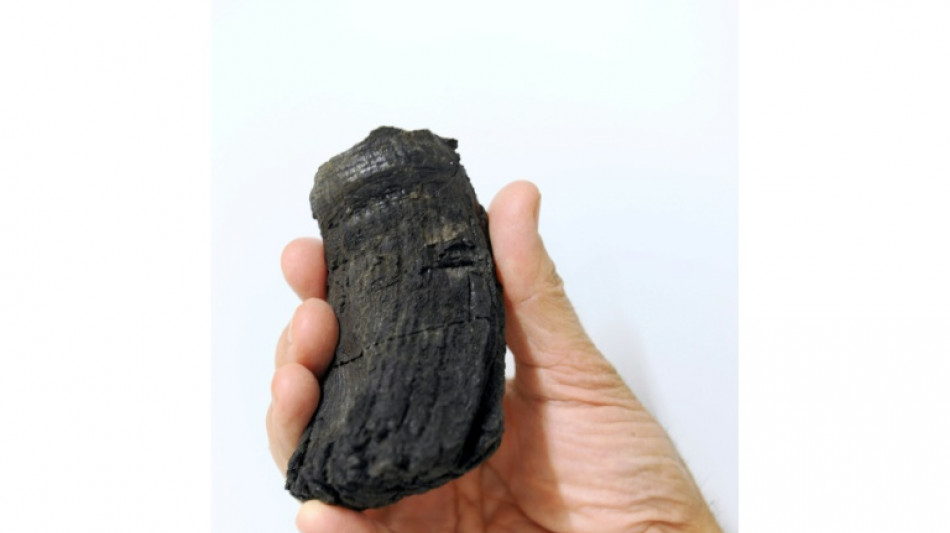
Giant tooth of ancient marine reptile discovered in Alps / Photo: Rosi ROTH - EUREKALERT!/AFP

 Wildfires push endangered Sumatran elephants to brink: Indonesian NGO

 Bank of Japan set to raise rates under pressure from inflation, US

 EU chief to unveil social media, gaming curbs for under-15s

 'Resident Evil' film brings video game's ethos to the big screen

 i-payout Expands U.S. Money Transmitter Licensing Footprint and Advances European EMI Strategy

 US Senate crypto bill collapses amid partisan deadlock

 OpenAI, Anthropic and Google are working to create an AI standards body

 Protesting shepherds, farmers clash with Romanian police

 Foundation Lets Ledger Users Switch to Open Source Without Starting Over

 EU to propose curbing social media, online games for under 15s

 FX Junction Reaches 40,600 Members and 26 Million Trades

 'We unleashed the beast': the world's fears and hopes about AI

 Hospitality leaders ask Burnham to halve VAT amid rising costs

 Worcestershire invited to nominate groups for 2027 King’s volunteer award

 Berlin's run-down public spaces at heart of election campaign

 'Widow's Bay' and 'The Pitt' win big at Emmy Awards

 Most markets drop as oil extends gains ahead of expected US rate hike

 Sri Lanka's famed beach shack battles demolition

 Vserv targets ₹1,000 crore revenue by 2030 through AI expansion

 India prohibits bank fees on UPI payments up to ₹2,000

 Brazil's Amazon defender Raoni has cancer

 Trump rejects AI slowdown concerns as UN urges coordinated controls

 Higher wages draw migrant workers to Kashmir despite attacks

 Oil supply concerns and AI warnings weigh on global markets

 'I am the hoax buster': Trump rejects AI danger warnings

The fossils of three ichthyosaurs -- giant marine reptiles that patrolled primordial oceans -- have been discovered high up in the Swiss Alps, and include the largest ever tooth found for the species, a study said Thursday.
With elongated bodies and small heads, the prehistoric leviathans weighed up to 80 metric tons (88 US tons) and grew to 20 meters (yards), making them among the largest animals to have ever lived.
They first appeared 250 million years ago in the early Triassic, and a smaller, dolphin-like subtype survived until 90 million years ago. But the gigantic ichthyosaurs, which comprised most of the species, died out 200 million years ago.
Unlike dinosaurs, ichthyosaurs barely left a trace of fossil remains, and "why that is remains a great mystery to this day," said Martin Sander of the University of Bonn, lead author of the paper in the Journal of Vertebrate Paleontology.
The specimens in question, dated to 205 million years ago in the study, were unearthed between 1976 and 1990 during geological surveys, but were only recently analyzed in detail.
Fun fact: they were discovered at an altitude of 2,800 meters (9,100 feet). During their lifetimes the three swam in waters around the supercontinent Pangea-- but due to plate tectonics and the folding of the Alps, the fossils kept rising.
Ichthyosaurs were previously thought to have only inhabited the deep ocean, but the rocks from which the new fossils derive are believed to have been at the bottom of a shallow coastal area. It could be that some of the giants followed schools of fish there.
There are two sets of skeletal remains. One consists of ten rib fragments and a vertebra, suggesting an animal some 20 meters long, which is more or less equivalent to the largest ichthyosaur to have been found, in Canada.
The second animal measured 15 meters, according to an estimate from the seven vertebrae found.
"From our point of view, however, the tooth is particularly exciting," explained Sander.
"Because this is huge by ichthyosaur standards: Its root was 60 millimeters (2.4 inches) in diameter - the largest specimen still in a complete skull to date was 20 millimeters and came from an ichthyosaur that was nearly 18 meters long."
While this could indicate a beast of epic proportions, it's more likely to have come from an ichthyosaur with particularly gigantic teeth, rather than a particularly gigantic ichthyosaur.
Current research holds that extreme gigantism is incompatible with a predatory lifestyle requiring teeth.
That's why the largest known animal to have ever lived -- the blue whale at 30 meters long and 150 tons -- lacks teeth.
Blue whales are filter feeders, while the much smaller sperm whales, at 20 meters long and 50 tons, are hunters, and use more of their energy to fuel their muscles.
"Marine predators therefore probably can't get much bigger than a sperm whale," Sander said, though more fossils would need to be found to know for certain. "Maybe there are more remains of the giant sea creatures hidden beneath the glaciers," he said.
S.F.Lacroix--CPN