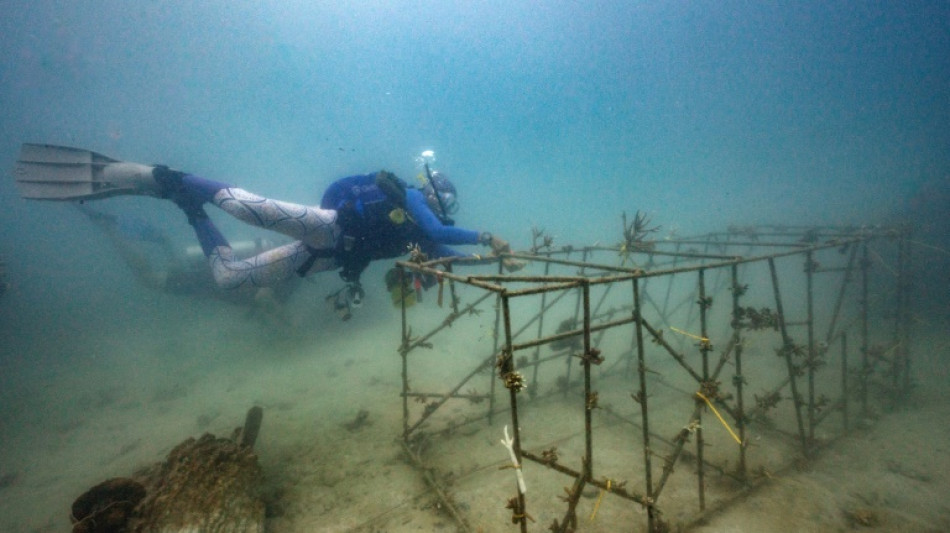
How restoration can help coral reefs / Photo: Lillian SUWANRUMPHA - AFP

 Nigeria miners struggled to breathe in cell before 37 died: survivors

 Warren Buffett steps down as Berkshire Hathaway chairman

 Isolated Syrian-Druze city blames Damascus for shortages

 Kerry James Marshall: American 'blackness' painter celebrated in Europe

 Infantino 'must go', says German FA vice-president

 Japan's busiest rail station tests robot bins

 Backpackers fret over Australian visa crackdown

 Bank of Japan hikes rates to 31-year high to battle inflation

 AI doomsday warnings unlikely to slow IPOs but questions linger

 In Brazil's Amazon, the hunt for oil fuels hopes and fears

 Baby orangutans in India expose 'frightening' scale of trafficking

 Oversight Board blasts 'inadequate' Meta safeguards for AI deepfakes

 Harry makes first public appearance since return to UK

 Princess Diana's brother makes new explosive claims against Charles

 Trump admin overhauls key protection for endangered species

 Mbappe draws political fire over Ceuta t-shirt controversy

 Third malaria death in Germany from outbreak tied to Frankfurt airport

 AtlasClear Holdings Reports Preliminary Fiscal 2026 Revenue of Approximately $20.1 Million, Up 85%; Revenue Plus Interest Income of Approximately $21.9 Million

 'Another arrow to the quiver': World Bank posts record private capital mobilization

 Ireland to boycott Eurovision 2027 over Gaza

 India's Tata Sons reappoints N. Chandrasekaran as chairman

 Germany urges EU action against China to defend carmakers

 Japan eyes changing prostitution law to punish sex buyers

 Modi pitches India as global chipmaking hub

 Ukraine plans record defence spending in 2027

Record-high sea temperatures are bleaching coral reefs worldwide and putting a new focus on attempts to restore these key marine ecosystems.
Here is an overview of how coral restoration is being done around the world:
- How is coral sourced? -
Restoration begins with obtaining coral, sometimes by breaking it off from a healthy reef. These pieces can be broken into smaller bits in a process called microfragmentation.
Each piece can become a new coral.
Another option involves collecting "fragments of opportunity" -- coral pieces broken off by natural causes such as storms.
Conservationists can also propagate from egg bundles collected during reef spawning, though this is perhaps the most difficult approach.
Spawning is brief, generally happening just once a year, and is affected by many factors, including the lunar phase and water temperature.
- What happens next? -
Coral microfragments generally go into a "nursery" until they grow sturdy enough to be transplanted to an existing reef or an artificial structure.
Fragments of opportunity are treated similarly. If big enough, they can be transplanted directly to natural or artificial reefs.
Bundles of coral eggs and sperm collected during spawning will develop into larvae that can then be settled onto reefs or, more commonly, grown on artificial foundations before being transplanted to their final homes.
- What else is involved? -
Other techniques are used to bolster coral restoration, including mineral accretion technology.
This involves sending a low-voltage electrical current through seawater to encourage minerals to dissolve and crystallise on artificial reef structures, speeding up coral growth.
The technique has had mixed results, with some studies reporting better growth and more resilient corals, but others finding no significant benefits.
Other interventions include substrate stabilisation, which shores up reef foundations, and algae removal.
- What corals are used? -
Restoration projects heavily favour quick-growing branching corals.
The delicate branches of these corals are more susceptible to becoming fragments of opportunity, and are also easier to microfragment than massive or encrusting corals.
Their fast-growing nature gives restoration projects quicker results, though focusing on only one type of coral can reduce ecosystem diversity.
- Does it work? -
Coral restoration projects report survival rates of around 60-70 percent, according to a study published in 2020.
But around half the projects in the study failed to properly measure whether they achieved the goals stated at the outset, including reef function.
Monitoring was also often brief, at a median of just one year, far less than the time needed for a reef to form, according to the authors.
Still, the projects can produce real benefits.
A 2024 study of artificial reefs in Indonesia found that within four years the structures had a coral carbonate budget -- a measure of reef wellbeing -- that was nearly equal to nearby healthy natural reef.
- What are other considerations? -
Some experts worry that coral restoration is too often presented as panacea for reviving reefs, and point out that transplants will only survive if the surrounding conditions are right.
That means first addressing climate change, which causes the warm temperatures that lead to coral bleaching.
"Well-designed and managed restoration projects have an important role to play, but there is only so much they can do if radical action on the climate is not taken almost immediately," warned Lisa Bostrom-Einarsson, the marine ecologist who led the 2020 study.
And other stressors, from blast fishing to sedimentation, must also be tackled for reefs to have a future.
Reef restoration also rarely offers a one-for-one replacement of destroyed ecosystems.
The Indonesia reefs examined in the 2024 study are still largely made up of transplanted corals, with little sign yet that "natural recruits" are taking root and building reef diversity.
Building reefs through microfragmentation also limits genetic diversity and can put reefs at risk if disease takes hold.
Still, well-done restoration offers considerable benefits, including coastal protection and boosting marine life.
That also helps local communities dependent on fishing or tourism.
"Restoration will not save corals at the current rate we're losing them," said Gavin Miller, a marine scientist with the Global Reef organisation in Thailand.
"It's more about these localised impacts and the scale and the awareness that you can raise from there."
C.Smith--CPN