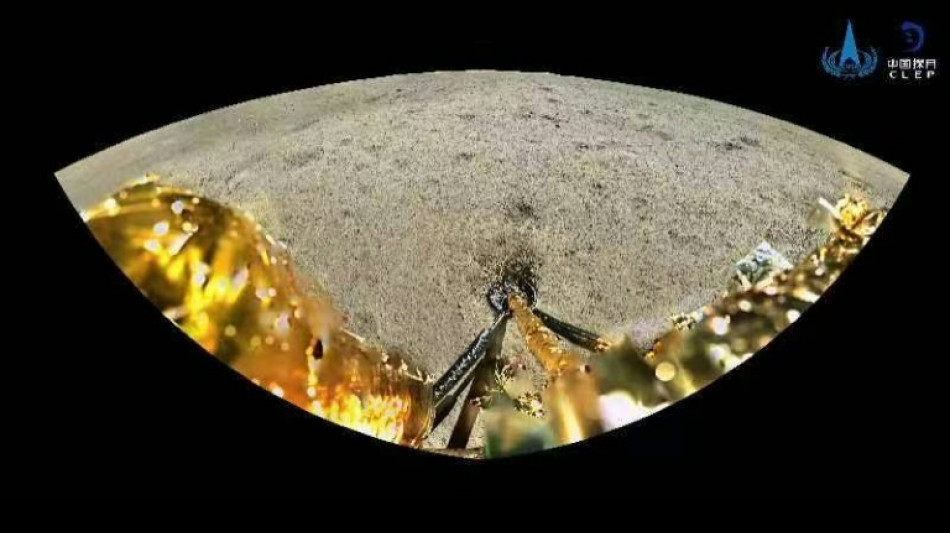
'Power rivalry in space': China lunar mission fuels US misinformation / Photo: Handout - China National Space Administration/AFP

 Nigeria miners struggled to breathe in cell before 37 died: survivors

 Warren Buffett steps down as Berkshire Hathaway chairman

 Isolated Syrian-Druze city blames Damascus for shortages

 Kerry James Marshall: American 'blackness' painter celebrated in Europe

 Infantino 'must go', says German FA vice-president

 Japan's busiest rail station tests robot bins

 Backpackers fret over Australian visa crackdown

 Bank of Japan hikes rates to 31-year high to battle inflation

 AI doomsday warnings unlikely to slow IPOs but questions linger

 In Brazil's Amazon, the hunt for oil fuels hopes and fears

 Baby orangutans in India expose 'frightening' scale of trafficking

 Oversight Board blasts 'inadequate' Meta safeguards for AI deepfakes

 Harry makes first public appearance since return to UK

 Princess Diana's brother makes new explosive claims against Charles

 Trump admin overhauls key protection for endangered species

 Mbappe draws political fire over Ceuta t-shirt controversy

 Third malaria death in Germany from outbreak tied to Frankfurt airport

 AtlasClear Holdings Reports Preliminary Fiscal 2026 Revenue of Approximately $20.1 Million, Up 85%; Revenue Plus Interest Income of Approximately $21.9 Million

 'Another arrow to the quiver': World Bank posts record private capital mobilization

 Ireland to boycott Eurovision 2027 over Gaza

 India's Tata Sons reappoints N. Chandrasekaran as chairman

 Germany urges EU action against China to defend carmakers

 Japan eyes changing prostitution law to punish sex buyers

 Modi pitches India as global chipmaking hub

 Ukraine plans record defence spending in 2027

A historic lunar mission has demonstrated China's growing scientific prowess, but the feat has set off a torrent of misinformation targeting the United States that researchers say reflects their bitter competition in space.
China is celebrating the return of the Chang'e 6 probe to Earth on Tuesday bearing rock-and-soil samples from the little-known far side of the Moon, following a 53-day mission that reignited old conspiracy theories about NASA's Apollo Moon landings.
AFP's fact-checkers have debunked a litany of Chinese-language posts suggesting NASA's historic mission in 1969 –- that first landed humans on the Moon -- was staged as well as posts misrepresenting decades-old photos from subsequent landings.
The falsehoods, researchers say, risk stoking anti-US perceptions in China amid already fraught relations between Washington and Beijing, as the superpowers engage in an intensifying space race.
"There is undeniably a great power rivalry in space between the US and China, and any kind of misinformation about the activities by either country is concerning," Saadia M. Pekkanen, from the University of Washington, told AFP.
"It is yet another way that the potential for space diplomacy can be negated in the geopolitical competition between the two countries."
When China's National Space Agency released a photo of a stone-made Chinese flag erected on the Moon's far side by Chang'e-6 in early June, users on social media platform X compared it with an image of NASA astronaut Harrison H. Schmitt standing next to a US flag on the lunar surface in 1972.
Posting to tens of thousands of followers, they falsely suggested the Apollo 16 mission must have been staged because Schmitt's cloth flag was pictured being "blown" by the wind -- despite NASA's explanation that it used a horizontal bar to hold it upright.
- 'Insecurity' –
Posts comparing the images on China's Weibo platform attracted a flood of comments, with one user with more than 13 million followers writing that the photos proved that "Americans did not land on the Moon".
Other users shared a photo of the German band Rammstein dressed as astronauts with their helmets off, with one sarcastic caption on Weibo reading: "Now you believe that the US moon landing was real."
Decades-old photos from NASA's Apollo missions in the late 1960s and early 1970s have also been recycled by social media users claiming they were actually from China's groundbreaking lunar mission.
Beijing has poured huge resources into its space programme over the past decade in a bid to close the gap with the United States and Russia.
China aims to send a crewed mission to the Moon by 2030 and plans to build a base on the lunar surface, while the United States is also planning to put astronauts back on the Moon by 2026 with its Artemis 3 mission.
It was not clear whether the misinformation was fuelled by Chinese state-backed actors, but the rapid spread on tightly controlled social networks has raised questions about their possible support or involvement.
"Beijing sometimes lets anti-American sentiments and false information run rampant on the Chinese internet, to allow for an escape valve for domestic tensions, and to modulate Chinese citizens' views," Isaac Stone Fish, chief executive of China-focused data company Strategy Risks, told AFP.
"Allowing conspiracy theories on the US moon landing to fester may reflect insecurity on Beijing's part on the space race between China and the United States."
- 'Spread a lie' –
Researchers say the misinformation campaign suggests a frequent tactic of recycling existing conspiracy theories to sow online distrust.
"There is large online community that is happy to talk about the moon landing conspiracy," Darren Linvill, from Clemson University, told AFP.
"If this audience can be harnessed to spread a lie that puts China in a more positive light, that is all the better for China."
Chinese state media coverage strongly praising the Chang'e-6 probe's success has simultaneously been critical of the United States.
Washington has warned that Beijing's space programme is being used to mask military objectives and an effort to establish dominance in space.
The nationalist Global Times newspaper reported that the Chang'e-6 mission demonstrated China's "open and inclusive attitude toward international cooperation" in contrast to the United States, which it said was "busy chanting the 'China threat' in a so-called space race".
Against this backdrop, AFP debunked Chinese-language posts on Facebook, Weibo, TikTok and its Chinese sister app Douyin quoting the White House press secretary as saying that the US and China landed on "different moons" after being asked why the Chang'e-6 found "no traces" of NASA's mission.
The exchange was entirely fabricated.
"Chinese people can be justifiably proud of their lunar module's historic trip to collect samples," Stone Fish said.
"They don't need to fall victim to the old conspiracy theory that the US has staged moon landings."
burs-rb-ac/st/cwl
P.Petrenko--CPN