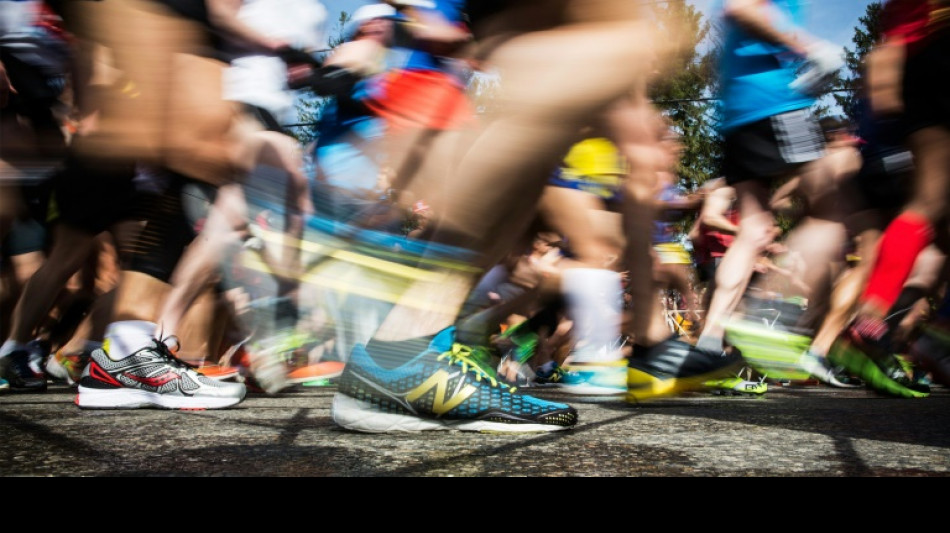
'Wake-up call': third of adults not doing enough physical activity / Photo: Andrew Burton - GETTY IMAGES NORTH AMERICA/AFP/File

 Nigeria miners struggled to breathe in cell before 37 died: survivors

 Warren Buffett steps down as Berkshire Hathaway chairman

 Isolated Syrian-Druze city blames Damascus for shortages

 Kerry James Marshall: American 'blackness' painter celebrated in Europe

 Infantino 'must go', says German FA vice-president

 Japan's busiest rail station tests robot bins

 Backpackers fret over Australian visa crackdown

 Bank of Japan hikes rates to 31-year high to battle inflation

 AI doomsday warnings unlikely to slow IPOs but questions linger

 In Brazil's Amazon, the hunt for oil fuels hopes and fears

 Baby orangutans in India expose 'frightening' scale of trafficking

 Oversight Board blasts 'inadequate' Meta safeguards for AI deepfakes

 Harry makes first public appearance since return to UK

 Princess Diana's brother makes new explosive claims against Charles

 Trump admin overhauls key protection for endangered species

 Mbappe draws political fire over Ceuta t-shirt controversy

 Third malaria death in Germany from outbreak tied to Frankfurt airport

 AtlasClear Holdings Reports Preliminary Fiscal 2026 Revenue of Approximately $20.1 Million, Up 85%; Revenue Plus Interest Income of Approximately $21.9 Million

 'Another arrow to the quiver': World Bank posts record private capital mobilization

 Ireland to boycott Eurovision 2027 over Gaza

 India's Tata Sons reappoints N. Chandrasekaran as chairman

 Germany urges EU action against China to defend carmakers

 Japan eyes changing prostitution law to punish sex buyers

 Modi pitches India as global chipmaking hub

 Ukraine plans record defence spending in 2027

Nearly a third of all adults are not doing enough physical activity, posing a growing threat to health across the world, a major study said on Wednesday.
More than 31 percent of adults -- 1.8 billion people -- did not get the recommended amount of physical exercise in 2022, an increase of five percentage points from 2010, according to a study by the World Health Organization and other researchers.
"Physical inactivity is a silent threat to global health, contributing significantly to the burden of chronic diseases," said Ruediger Krech, director of the WHO's health promotion department.
"Unfortunately the world is not going in the right direction," he told an online press conference.
To be healthy, the WHO recommends all adults spend at least 150 minutes every week doing moderate-intensity physical activity -- which can include walking, cycling or even household chores -- or at least 75 minutes of more vigorous exercise, such as running or competing in sport.
A combination of the two will also get people over the line.
Not getting this level of exercise increases the risk of people developing heart disease, diabetes, some cancers as well as mental health problems, Krech said.
If current trends continue, adult inactivity levels are projected to rise to 35 percent by 2030, according to the study in The Lancet Global Health.
This would fall far short of the WHO's goal of reducing physical inactivity by 15 percent by the end of the decade.
Fiona Bull, head of the WHO's physical activity unit, said the research was "a wake-up call that we're not doing enough".
- 'Every step counts' -
Inactivity rates varied widely between countries. For example, 66 percent of adults do not get enough physical activity in the United Arab Emirates, while the figure was under three percent in Malawi.
There was also a gender gap. Nearly 34 percent of women worldwide do not reach the activity threshold, compared to 29 percent of men.
There are "multiple causes" for activity rates declining overall, including that people are walking less, working at computers more and generally spending more leisure time looking at screens, Bull said.
During a busy few months of world sport which includes the Olympics and the European and Copa America football championships, Krech reminded people that "watching sports does not equal being physically active".
"Don't just sit on (your) chairs, get up and be active -- every step counts," he said.
The WHO emphasised that changing individual behaviour is not enough, calling on countries to promote physical activity by boosting community sport as well as walking, cycling and public transport.
For the study, billed as the most comprehensive to look at the subject yet, an international team of researchers combined the findings from more than 500 studies involving 5.7 million people across 163 countries and territories.
It was not all bad news.
Almost half of the countries had made progress over the last decade, and 22 are on track to reach the 2030 target -- as long as they keep moving in the right direction.
X.Wong--CPN