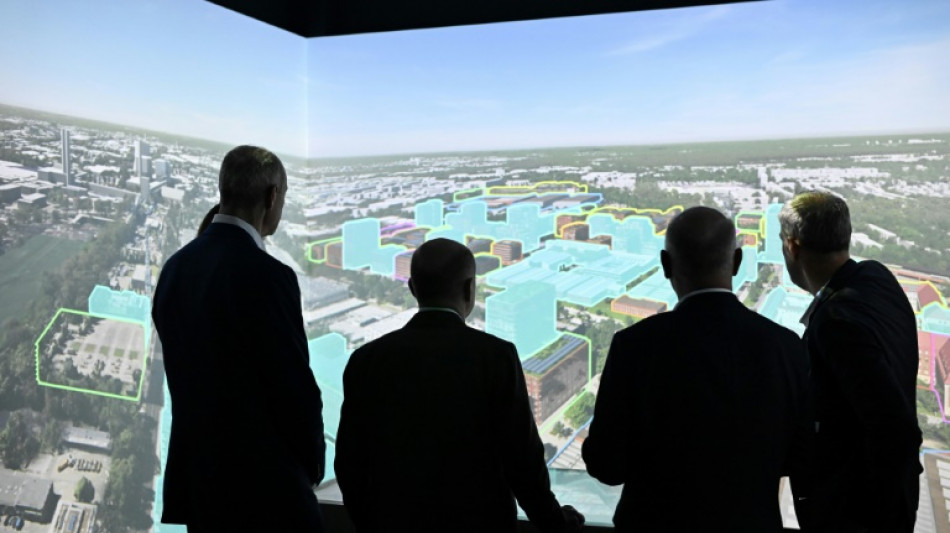
German giant Siemens to revive historic base in Berlin / Photo: RALF HIRSCHBERGER - POOL/AFP

 Nigeria miners struggled to breathe in cell before 37 died: survivors

 Warren Buffett steps down as Berkshire Hathaway chairman

 Isolated Syrian-Druze city blames Damascus for shortages

 Kerry James Marshall: American 'blackness' painter celebrated in Europe

 Infantino 'must go', says German FA vice-president

 Japan's busiest rail station tests robot bins

 Backpackers fret over Australian visa crackdown

 Bank of Japan hikes rates to 31-year high to battle inflation

 AI doomsday warnings unlikely to slow IPOs but questions linger

 In Brazil's Amazon, the hunt for oil fuels hopes and fears

 Baby orangutans in India expose 'frightening' scale of trafficking

 Oversight Board blasts 'inadequate' Meta safeguards for AI deepfakes

 Harry makes first public appearance since return to UK

 Princess Diana's brother makes new explosive claims against Charles

 Trump admin overhauls key protection for endangered species

 Mbappe draws political fire over Ceuta t-shirt controversy

 Third malaria death in Germany from outbreak tied to Frankfurt airport

 AtlasClear Holdings Reports Preliminary Fiscal 2026 Revenue of Approximately $20.1 Million, Up 85%; Revenue Plus Interest Income of Approximately $21.9 Million

 'Another arrow to the quiver': World Bank posts record private capital mobilization

 Ireland to boycott Eurovision 2027 over Gaza

 India's Tata Sons reappoints N. Chandrasekaran as chairman

 Germany urges EU action against China to defend carmakers

 Japan eyes changing prostitution law to punish sex buyers

 Modi pitches India as global chipmaking hub

 Ukraine plans record defence spending in 2027

German industrial giant Siemens on Tuesday launched an urban development project worth 4.5 billion euros ($4.8 billion) in the area of Berlin known as Siemensstadt, where the company enjoyed its pre-war heyday.
The Siemensstadt Square "district of the future" will include new living space for up to 7,000 people and create 20,000 additional jobs at the site, where Siemens still manufactures today, the company said.
Siemensstadt Square "aims to link the worlds of work and research, housing and life in a new way -- worlds that were already brought together in the historic Siemensstadt", Chancellor Olaf Scholz said at the launch of the project.
The development embodies "the future of Berlin and German industry", he said.
The 76-hectare site, due to be completed by 2035, will include homes, factories and research centres as well as offices, shops and educational, sports and leisure facilities.
The project is a way of "reconciling uses" and showing that "industrial activity still has a place in our cities", said Roland Busch, CEO of Siemens.
Siemens built a series of factories on the outskirts of Berlin at the turn of the 20th century, with thousands of employees working in them to produce cables, motors and electric pumps.
They were soon followed by housing for workers and the area became known as Siemensstadt (Siemens town) from 1914, a name it still bears today.
The area prospered until the 1930s but the destruction of World War II, the division of the city and then the building of the Berlin Wall in 1961 put the brakes on further development.
With some 380,000 employees, Siemens has in recent years refocused its business towards digital technology, moving away from the production of heavy industrial equipment.
In another sign of the changing times, the group will not be building housing for its employees in the new development as it did a century ago.
Instead, the 2,500 homes planned will be built by developers.
But Siemens is still billing the development as a return to its Berlin roots, stressing that the company's 750- million-euro contribution to the project is its "largest-ever single investment in Berlin".
M.García--CPN