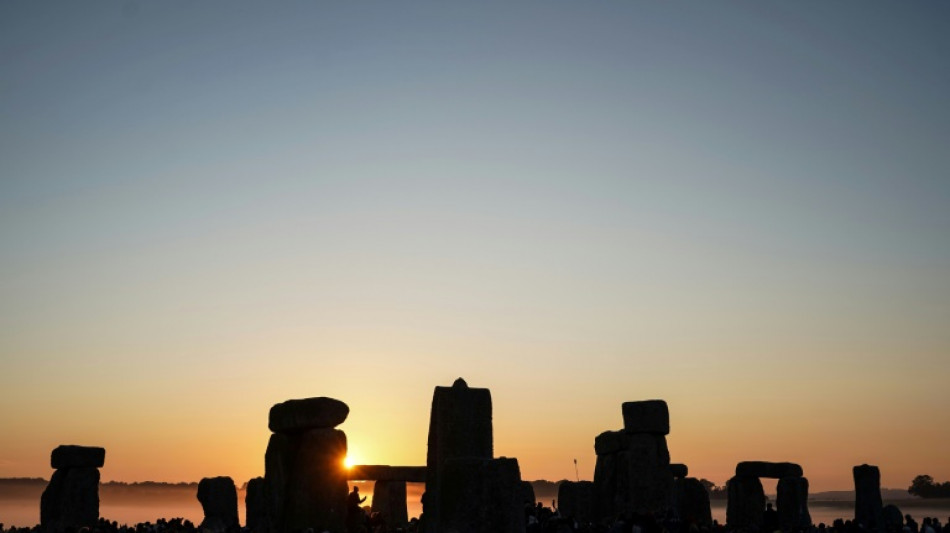
UNESCO wants to add Stonehenge to list of endangered heritage sites / Photo: William EDWARDS - AFP

 Nigeria miners struggled to breathe in cell before 37 died: survivors

 Warren Buffett steps down as Berkshire Hathaway chairman

 Isolated Syrian-Druze city blames Damascus for shortages

 Kerry James Marshall: American 'blackness' painter celebrated in Europe

 Infantino 'must go', says German FA vice-president

 Japan's busiest rail station tests robot bins

 Backpackers fret over Australian visa crackdown

 Bank of Japan hikes rates to 31-year high to battle inflation

 AI doomsday warnings unlikely to slow IPOs but questions linger

 In Brazil's Amazon, the hunt for oil fuels hopes and fears

 Baby orangutans in India expose 'frightening' scale of trafficking

 Oversight Board blasts 'inadequate' Meta safeguards for AI deepfakes

 Harry makes first public appearance since return to UK

 Princess Diana's brother makes new explosive claims against Charles

 Trump admin overhauls key protection for endangered species

 Mbappe draws political fire over Ceuta t-shirt controversy

 Third malaria death in Germany from outbreak tied to Frankfurt airport

 AtlasClear Holdings Reports Preliminary Fiscal 2026 Revenue of Approximately $20.1 Million, Up 85%; Revenue Plus Interest Income of Approximately $21.9 Million

 'Another arrow to the quiver': World Bank posts record private capital mobilization

 Ireland to boycott Eurovision 2027 over Gaza

 India's Tata Sons reappoints N. Chandrasekaran as chairman

 Germany urges EU action against China to defend carmakers

 Japan eyes changing prostitution law to punish sex buyers

 Modi pitches India as global chipmaking hub

 Ukraine plans record defence spending in 2027

The UN's cultural organisation said Monday it recommended adding Stonehenge, the renowned prehistoric site in England, to its world heritage in danger list, in what would be seen as an embarrassment for London.
The site has been in the UN organisation's sights because of British government plans to construct a controversial road tunnel near the world heritage site in southwestern England.
In a written decision seen by AFP, the World Heritage Committee recommended that Stonehenge be added to the UN body's heritage in danger list "with a view to mobilising international support".
The decision will have to be voted upon by the member states of the World Heritage Committee at a meeting in New Delhi in July.
One diplomat told AFP that the decision will likely be approved.
Stonehenge has had UNESCO world heritage status since 1986.
Placement on the UN body's heritage in danger list is seen as a dishonour by some countries.
Last July the British government approved the construction of a controversial road tunnel near Stonehenge despite efforts by campaigners to halt the £1.7 billion ($2.2 billion) project.
The diplomat pointed out that London had decided to approve the project "despite repeated warnings from the World Heritage Committee since 2017."
The planned tunnel is intended to ease congestion on an existing main road to southwest England that gets especially busy during the peak holiday periods.
Experts have warned of "permanent, irreversible harm" to the area.
Druids have held protests against the tunnel at a site they consider sacred and where they celebrate the summer and winter solstice -- the longest and shortest days of the year.
Built in stages between around 3,000 and 2,300 BCE, Stonehenge is one of the world's most important prehistoric megalithic monuments in terms of its size, sophisticated layout and architectural precision.
UNESCO runs a list of sites with World Heritage status around the world, a prestigious title that countries compete to bestow on their most famous natural and man-made locations.
A listing can help boost tourism -- but it comes with obligations to protect the site.
The port city of Liverpool in northwest England lost its World Heritage status for its docks in 2021 after UNESCO experts concluded that new real estate developments in the city had taken too much of a toll on its historical fabric.
T.Morelli--CPN