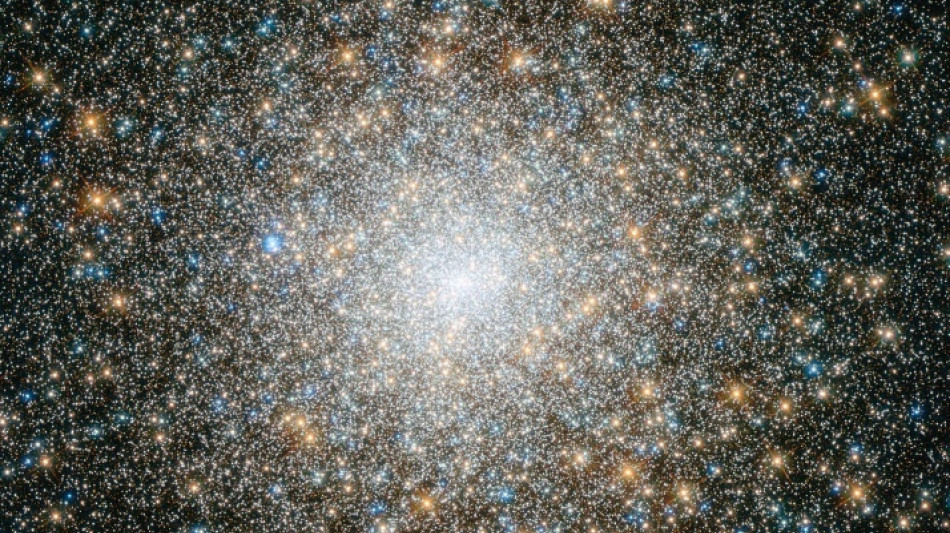
Webb spots giant star clusters shaping galaxy in early universe / Photo: - - ESA/HUBBLE/AFP/File

 Nigeria miners struggled to breathe in cell before 37 died: survivors

 Warren Buffett steps down as Berkshire Hathaway chairman

 Isolated Syrian-Druze city blames Damascus for shortages

 Kerry James Marshall: American 'blackness' painter celebrated in Europe

 Infantino 'must go', says German FA vice-president

 Japan's busiest rail station tests robot bins

 Backpackers fret over Australian visa crackdown

 Bank of Japan hikes rates to 31-year high to battle inflation

 AI doomsday warnings unlikely to slow IPOs but questions linger

 In Brazil's Amazon, the hunt for oil fuels hopes and fears

 Baby orangutans in India expose 'frightening' scale of trafficking

 Oversight Board blasts 'inadequate' Meta safeguards for AI deepfakes

 Harry makes first public appearance since return to UK

 Princess Diana's brother makes new explosive claims against Charles

 Trump admin overhauls key protection for endangered species

 Mbappe draws political fire over Ceuta t-shirt controversy

 Third malaria death in Germany from outbreak tied to Frankfurt airport

 AtlasClear Holdings Reports Preliminary Fiscal 2026 Revenue of Approximately $20.1 Million, Up 85%; Revenue Plus Interest Income of Approximately $21.9 Million

 'Another arrow to the quiver': World Bank posts record private capital mobilization

 Ireland to boycott Eurovision 2027 over Gaza

 India's Tata Sons reappoints N. Chandrasekaran as chairman

 Germany urges EU action against China to defend carmakers

 Japan eyes changing prostitution law to punish sex buyers

 Modi pitches India as global chipmaking hub

 Ukraine plans record defence spending in 2027

The James Webb space telescope has discovered massive clusters of stars in the early universe so huge and densely packed that they influenced how their galaxy formed, astronomers said on Monday.
The five clumps of stars, known as globular proto-clusters, are the earliest ever observed, dating back to 460 million years after the Big Bang when the universe was three percent its current age.
They were spotted in the Cosmic Gems Arc, an infant galaxy discovered by the Hubble telescope in 2018.
Looking into space means looking back in time, and the galaxy exists in what is called the epoch of reionisation, when the first stars and galaxies emerged and lit up the universe.
It is difficult to see that far back, but the Webb telescope's ability to detect infrared wavelengths has allowed it peer farther back into this cosmic dawn than ever before.
The discovery of the five globular proto-clusters marks "the first time we have been able to observe this type of object at this distance," said Adelaide Claeyssens, a co-author of the new study in the journal Nature.
It should help scientists better understand the "formation of star clusters that we can see in the nearby universe -- which are now very old -- and their influence on the formation of galaxies," the Stockholm University astronomer told AFP.
- Black hole seeds? -
There is nothing like these clusters in the universe we see around us, said lead study author Angela Adamo, also from Stockholm University.
Our home galaxy, the Milky Way, is now home to around 170 globular clusters.
But there were once thousands of them, before they were broken up and scattered when the galaxy expanded, Adamo told AFP.
Those that did survive are relative lightweights, making up an "insignificant" mass compared to all the other stars in the galaxy.
However the five clusters in the Cosmic Gems Arc are true heavyweights, representing nearly a third of their galaxy's total mass.
The young stars are also packed closely together.
Imagine there were a million stars jammed into the four light years of space that separate the Sun and its nearest star Proxima Centauri, Adamo said.
A separate study recently suggested that stars near the heart of globular proto-clusters are up to 10,000 more massive than the Sun.
Adamo said that such huge stars produce immense amounts of radiation, which means they "shape how galaxies form stars" and how gas is distributed around the galaxies.
And at the end of their short and violent lives, some of these behemoth stars likely create black holes, she added.
Some could even become the seeds that grow into the supermassive black holes squatting at the centre of galaxies, Adamo speculated.
To find out more, the researchers want to study more globular proto-clusters near the cosmic dawn. The James Webb Space telescope will help in this hunt, Adamo said.
But it will be the European Southern Observatory's Extremely Large Telescope, expected to start scanning the skies in 2028, that will help scientists "understand the physical processes within this galaxy," Adamo said.
So we have to wait a few more years to find out more about what happened over 13.2 billion years ago.
P.Kolisnyk--CPN