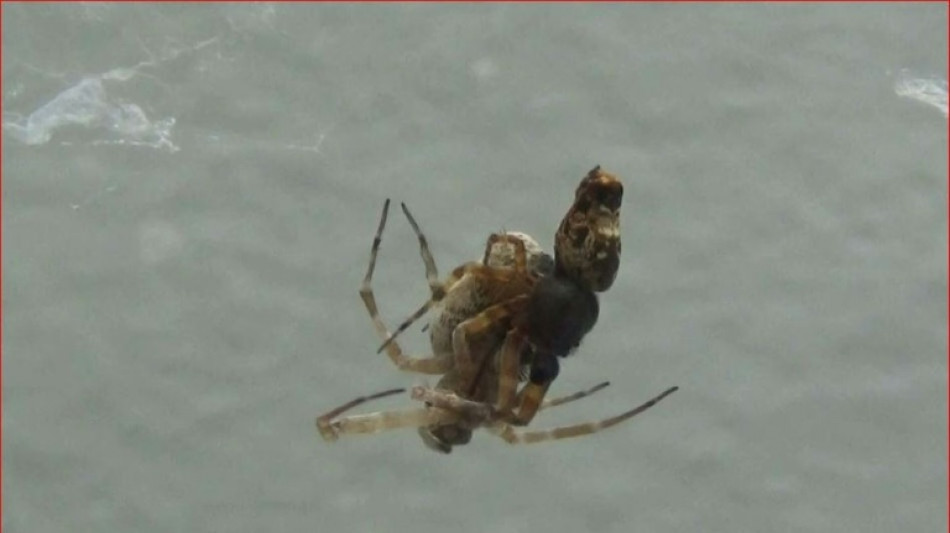
Some male spiders catapult away after sex to avoid death / Photo: Handout - Hubei University/AFP

 Wildfires push endangered Sumatran elephants to brink: Indonesian NGO

 Bank of Japan set to raise rates under pressure from inflation, US

 EU chief to unveil social media, gaming curbs for under-15s

 'Resident Evil' film brings video game's ethos to the big screen

 i-payout Expands U.S. Money Transmitter Licensing Footprint and Advances European EMI Strategy

 US Senate crypto bill collapses amid partisan deadlock

 OpenAI, Anthropic and Google are working to create an AI standards body

 Protesting shepherds, farmers clash with Romanian police

 Foundation Lets Ledger Users Switch to Open Source Without Starting Over

 EU to propose curbing social media, online games for under 15s

 FX Junction Reaches 40,600 Members and 26 Million Trades

 'We unleashed the beast': the world's fears and hopes about AI

 Hospitality leaders ask Burnham to halve VAT amid rising costs

 Worcestershire invited to nominate groups for 2027 King’s volunteer award

 Berlin's run-down public spaces at heart of election campaign

 'Widow's Bay' and 'The Pitt' win big at Emmy Awards

 Most markets drop as oil extends gains ahead of expected US rate hike

 Sri Lanka's famed beach shack battles demolition

 Vserv targets ₹1,000 crore revenue by 2030 through AI expansion

 India prohibits bank fees on UPI payments up to ₹2,000

 Brazil's Amazon defender Raoni has cancer

 Trump rejects AI slowdown concerns as UN urges coordinated controls

 Higher wages draw migrant workers to Kashmir despite attacks

 Oil supply concerns and AI warnings weigh on global markets

 'I am the hoax buster': Trump rejects AI danger warnings

Sometimes there are pretty valid reasons for leaving right after sex.
A team of Chinese scientists has discovered that male orb-weaving spiders fling themselves away from their partners -- pulling 20 Gs of acceleration in order to avoid being killed and eaten.
The mechanism, described for the first time in the journal Current Biology on Monday, involves the spiders' first pair of legs to immediately undertake a split-second catapult action.
Lead author Shichang Zhang of Hubei University in Wuhan told AFP he was "excited" to make the discovery, which required high-speed, high-resolution cameras to detect.
Zhang and colleagues were studying sexual selection in this spider, "Philoponella prominens," which live in communal groups of up to 300 individuals.
Of 155 successful matings, they found 152 ended with the male catapulting and thus surviving the encounter.
Males can mate up to six times with the same female -- bouncing off, climbing back up using a silk safety line, mating, and bouncing off again.
The three males that didn't catapult were promptly captured, killed and consumed by their partners.
Another 30 males that were prevented from catapulting by placing a fine brush behind their dorsum all met the same fate -- leading the researchers to conclude catapulting is essential to avoiding sexual cannabalism.
The escaping spiders clocked some impressive statistics: their average peak speed was 65 centimeters per second, with an acceleration of 200 meters per second squared. That's equivalent to 20 Gs, or 20 times the acceleration felt during freefall.
While soaring through the air, the males spin around at some 175 revolutions per second.
The males catapult by folding the tibia-metatarsus joint of their first leg pair against females. When released, it exerts hydraulic pressure and causes the legs to expand.
Zhang said he believes the females were judging males' sexual suitability by their ability to escape.
"Through the catapulting, a male can escape female sexual cannibalism, and a female can choose males with high quality, because the kinetic performance may directly correlate with male's physical condition," he said.
Even though they have already mated, females may go on to only accept the sperm of males that passed the test, explained Zhang.
Spiders differ from mammals in that females have a structure known as spermatheca where deposited sperm is stored. She can decide whether to use it to fertilize her eggs, or reject it by squeezing it out or changing the pH value to kill the sperm.
Future work will confirm whether there is a correlation between male catapulting and reproductive success, said Zhang.
O.Ignatyev--CPN