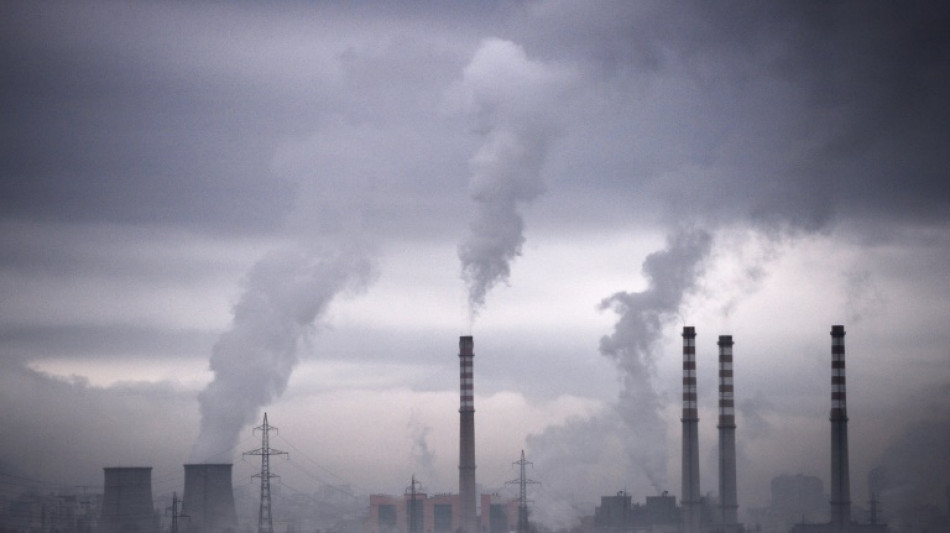
Paris climate targets feasible if nations keep vows / Photo: DIMITAR DILKOFF - AFP/File

 Wildfires push endangered Sumatran elephants to brink: Indonesian NGO

 Bank of Japan set to raise rates under pressure from inflation, US

 EU chief to unveil social media, gaming curbs for under-15s

 'Resident Evil' film brings video game's ethos to the big screen

 i-payout Expands U.S. Money Transmitter Licensing Footprint and Advances European EMI Strategy

 US Senate crypto bill collapses amid partisan deadlock

 OpenAI, Anthropic and Google are working to create an AI standards body

 Protesting shepherds, farmers clash with Romanian police

 Foundation Lets Ledger Users Switch to Open Source Without Starting Over

 EU to propose curbing social media, online games for under 15s

 FX Junction Reaches 40,600 Members and 26 Million Trades

 'We unleashed the beast': the world's fears and hopes about AI

 Hospitality leaders ask Burnham to halve VAT amid rising costs

 Worcestershire invited to nominate groups for 2027 King’s volunteer award

 Berlin's run-down public spaces at heart of election campaign
 'Widow's Bay' and 'The Pitt' win big at Emmy Awards

 Most markets drop as oil extends gains ahead of expected US rate hike

 Sri Lanka's famed beach shack battles demolition

 Vserv targets ₹1,000 crore revenue by 2030 through AI expansion

 India prohibits bank fees on UPI payments up to ₹2,000

 Brazil's Amazon defender Raoni has cancer

 Trump rejects AI slowdown concerns as UN urges coordinated controls

 Higher wages draw migrant workers to Kashmir despite attacks

 Oil supply concerns and AI warnings weigh on global markets

 'I am the hoax buster': Trump rejects AI danger warnings
If all nations honour promises to reduce greenhouse gas emissions, there is a chance of capping the rise in global temperatures to under two degrees Celsius, the cornerstone target of the Paris Agreement, researchers said Wednesday.
But that is a very big "if", they acknowledge in a peer-reviewed study, published in Nature.
The calculus includes not only carbon-cutting commitments officially registered under the 2015 treaty, but a raft of pledges made on the sidelines of last years COP26 UN climate summit in Glasgow -- to curb deforestation and methane leaks, for example -- that lack means for monitoring or verification.
They also include actions to lower emissions in developing countries that are contingent on financing, something wealthy nations have so far failed to deliver at agreed-upon levels.
The new estimates likewise fold in pledges to become carbon neutral by mid-century that do not detail how that will be achieved.
"Long-term targets should be treated with scepticism if they are not supported by short-term commitments to put countries on a pathway in the next decade to meet those targets," Zeke Hausfather, a researcher at Berkeley Earth, said, commenting on the study.
Most rich countries have announced they will be "net zero" by 2050, while China and India have vowed to reach that point by 2060 and 2070, respectively.
"Is our study a good news story?" lead author Malte Meinshausen, a professor at the University of Melbourne, asked in a briefing with journalists.
"Yes, because for the first time we can possibly keep warming below the symbolic 2C mark with promises on the table," he continued.
- Curb your optimism -
"And no, because we show clearly that increased action this decade is necessary for us to have a chance of not shooting past 1.5C by a large margin."
As deadly and costly climate impacts have increased, most nations have embraced the Paris deal's more ambitious "aspirational" target of holding the rise in global temperatures to 1.5C above preindustrial levels.
The UN's Intergovernmental Panel on Climate Change (IPCC) said in a landmark report earlier this month that carbon pollution must peak before 2025 and be cut in half by 2030 to have even a chance of reaching that goal.
Recent trends do not suggest the world is headed in the right direction: greenhouse gas emissions last year regained the record levels of 2019 after Covid lockdowns lowered them in 2020.
"Some government and business leaders are saying one thing –- but doing another," UN chief Antonio Guterres said last week when the IPCC report was launched. "Simply put, they are lying."
The new research analyses data from 196 countries from 2015 until the end of the COP26 meeting in mid-November 2021.
It concludes that if all pledges are implemented in full and on time, warming can be limited to 1.9C to 2.0C.
Unless immediate steps are taken to drive down emissions even further, 1.5C will almost certainly remain out of reach, the authors said.
If no additional efforts are made beyond pledges -- know as nationally determined contributions -- submitted under the Paris Agreement, Earth's surface will warm to a catastrophic 2.8C, the IPCC has said.
"Optimism should be curbed until promises to reduce emissions in the future are backed up with stronger short-term action," Hausfather and Frances Moore, a scientist at the University of California, Davis said in a comment, also in Nature.
C.Peyronnet--CPN