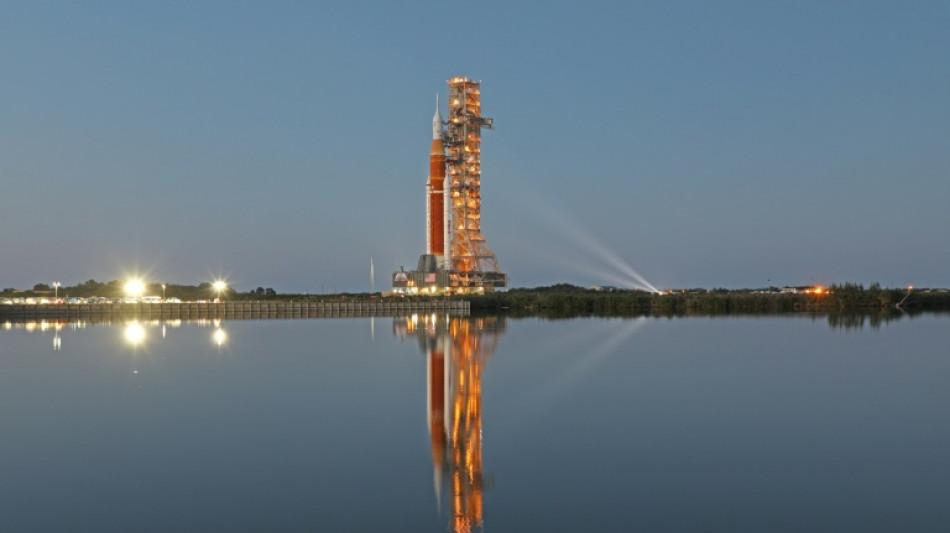
NASA begins critical final test on mega Moon rocket

 Wildfires push endangered Sumatran elephants to brink: Indonesian NGO

 Bank of Japan set to raise rates under pressure from inflation, US

 EU chief to unveil social media, gaming curbs for under-15s

 'Resident Evil' film brings video game's ethos to the big screen

 i-payout Expands U.S. Money Transmitter Licensing Footprint and Advances European EMI Strategy

 US Senate crypto bill collapses amid partisan deadlock

 OpenAI, Anthropic and Google are working to create an AI standards body

 Protesting shepherds, farmers clash with Romanian police

 Foundation Lets Ledger Users Switch to Open Source Without Starting Over

 EU to propose curbing social media, online games for under 15s

 FX Junction Reaches 40,600 Members and 26 Million Trades

 'We unleashed the beast': the world's fears and hopes about AI

 Hospitality leaders ask Burnham to halve VAT amid rising costs

 Worcestershire invited to nominate groups for 2027 King’s volunteer award

 Berlin's run-down public spaces at heart of election campaign

 'Widow's Bay' and 'The Pitt' win big at Emmy Awards

 Most markets drop as oil extends gains ahead of expected US rate hike

 Sri Lanka's famed beach shack battles demolition

 Vserv targets ₹1,000 crore revenue by 2030 through AI expansion

 India prohibits bank fees on UPI payments up to ₹2,000

 Brazil's Amazon defender Raoni has cancer

 Trump rejects AI slowdown concerns as UN urges coordinated controls

 Higher wages draw migrant workers to Kashmir despite attacks

 Oil supply concerns and AI warnings weigh on global markets

 'I am the hoax buster': Trump rejects AI danger warnings

NASA on Friday begins a critical two-day-long test of its giant Space Launch System (SLS) rocket complete with a mock countdown, as the agency gears up to return humans to the Moon.
Known as the "wet dress rehearsal," it is the final major test before the Artemis-1 mission this summer: an uncrewed lunar flight that will eventually be followed by boots on the ground, likely no sooner than 2026.
"It is our last design verification prior to our launch," senior NASA official Tom Whitmeyer said in a call with reporters this week.
Data collected from the test will be used to finalize a date for Artemis-1 -- NASA had said May could be the first window, but later now seems likely.
It is called a "wet" dress rehearsal because super-cooled liquid hydrogen and liquid oxygen will be loaded into SLS from ground systems, just as they would be in a real launch.
The 322 feet (98 meters) tall rocket -- expected to be the most powerful in history at the time it is operational -- was rolled out to Launch Complex 39B at the Kennedy Space Center in Florida around two weeks ago.
The test begins at 5:00 pm Eastern Time (2100 GMT) with a "call to stations," as members of the launch control team arrive at their firing rooms and start a countdown of more than 45 hours.
With the SLS rocket and Orion crew capsule fixed on top powered on, teams will proceed to load 700,000 gallons (3.2 million liters) of propellant, and practice procedures such as pauses in countdown and other checks.
They won't actually ignite the rocket's RS-25 engines, which were tested previously. Instead they will halt the countdown about 10 seconds before liftoff, in order to simulate a "scrub," when launch is aborted due to technical or weather related issues.
The fuel will be drained, and a few days later SLS and Orion will be rolled back to the vehicle assembly building to carry out checks on how everything went.
Test milestones will be posted on NASA's blog for the Artemis mission, but the agency won't let the public listen to live internal audio, as it did in the past for Space Shuttle missions.
Whitmeyer explained this was because certain key information, including timing sequences, could assist other countries looking to develop long range missiles.
"We're really, really super sensitive to cryogenic launch vehicles that are of this size and capability, (and) are very analogous to ballistic type capabilities that our countries are very interested in," he said, but added that the agency could re-evaluate the position in future.
M.García--CPN