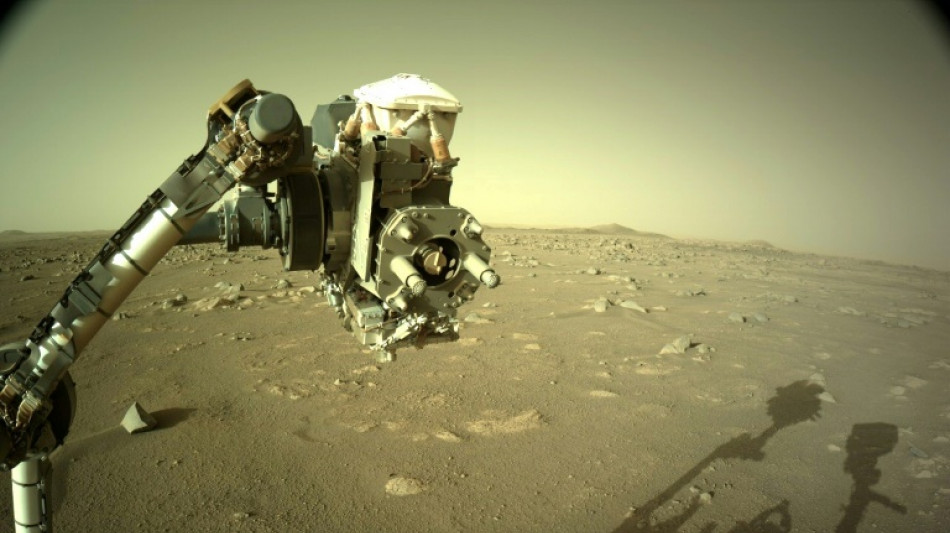
First audio recorded on Mars reveals two speeds of sound

 Wildfires push endangered Sumatran elephants to brink: Indonesian NGO

 Bank of Japan set to raise rates under pressure from inflation, US

 EU chief to unveil social media, gaming curbs for under-15s

 'Resident Evil' film brings video game's ethos to the big screen

 i-payout Expands U.S. Money Transmitter Licensing Footprint and Advances European EMI Strategy

 US Senate crypto bill collapses amid partisan deadlock

 OpenAI, Anthropic and Google are working to create an AI standards body

 Protesting shepherds, farmers clash with Romanian police

 Foundation Lets Ledger Users Switch to Open Source Without Starting Over

 EU to propose curbing social media, online games for under 15s

 FX Junction Reaches 40,600 Members and 26 Million Trades

 'We unleashed the beast': the world's fears and hopes about AI

 Hospitality leaders ask Burnham to halve VAT amid rising costs

 Worcestershire invited to nominate groups for 2027 King’s volunteer award

 Berlin's run-down public spaces at heart of election campaign

 'Widow's Bay' and 'The Pitt' win big at Emmy Awards

 Most markets drop as oil extends gains ahead of expected US rate hike

 Sri Lanka's famed beach shack battles demolition

 Vserv targets ₹1,000 crore revenue by 2030 through AI expansion

 India prohibits bank fees on UPI payments up to ₹2,000

 Brazil's Amazon defender Raoni has cancer

 Trump rejects AI slowdown concerns as UN urges coordinated controls

 Higher wages draw migrant workers to Kashmir despite attacks

 Oil supply concerns and AI warnings weigh on global markets

 'I am the hoax buster': Trump rejects AI danger warnings

The first audio recordings on Mars reveal a quiet planet with occasional gusts of wind where two different speeds of sound would have a strange delayed effect on hearing, scientists said Friday.
After NASA's Perseverance rover landed on Mars in February last year, its two microphones started recording, allowing scientists to hear what it is like on the Red Planet for the first time.
In a study published in the Nature journal on Friday, the scientists gave their first analysis of the five hours of sound picked up by Perseverance's microphones.
The audio revealed previously unknown turbulence on Mars, said Sylvestre Maurice, the study's main author and scientific co-director of the shoebox-sized SuperCam mounted on the rover's mast which has the main microphone.
The international team listened to flights by the tiny Ingenuity helicopter, a sister craft to Perseverance, and heard the rover's laser zap rocks to study their chemical composition -- which made a "clack clack" sound, Maurice told AFP.
"We had a very localised sound source, between two and five metres (six to 16 metres) from its target, and we knew exactly when it was going to fire," he said.
The study confirmed for the first time that the speed of sound is slower on Mars, travelling at 240 metres per second, compared to Earth's 340 metres per second.
This had been expected because Mars' atmosphere is 95 percent carbon dioxide -- compared to Earth's 0.04 percent -- and is about 100 times thinner, making sound 20 decibels weaker, the study said.
- 'I panicked' -
But the scientists were surprised when the sound made by the laser took 250 metres a second -- 10 metres faster than expected.
"I panicked a little," Maurice said. "I told myself that one of the two measurements was wrong because on Earth you only have one speed of sound."
They had discovered there are two speeds of sound on the surface of Mars -- one for high-pitched sounds like the zap of the laser, and another for lower frequencies like the whir of the helicopter rotor.
This means that human ears would hear high-pitched sounds slightly earlier.
"On Earth, the sounds from an orchestra reach you at the same speed, whether they are low or high. But imagine on Mars, if you are a little far from the stage, there will be a big delay," Maurice said.
"All of these factors would make it difficult for two people to have a conversation only five metres (16 feet) apart", the French CNRS research institute said in a statement.
- 'Scientific gamble' pays off -
It was otherwise so quiet on Mars that the scientists repeatedly feared something was wrong, the CNRS said, possibly provoking memories of two failed previous attempts in 1999 and 2008 to record sound there.
"There are few natural sound sources with the exception of the wind," the scientists said in a statement linked to the study.
The microphones did pick up numerous "screech" and "clank" sounds as the rover's metal wheels interacted with rocks, the study said.
The recording could also warn about problems with the rover -- like how drivers sense something's wrong when their car starts making strange noises.
Maurice said he felt the "scientific gamble" of taking microphones to Mars was a success.
Thierry Fouchet of the Paris Observatory, who was also involved in the research, said that listening to turbulence, such as vertical winds known as convection plumes, will "allow us to refine our numerical models for predicting climate and weather".
Future missions to Venus or Saturn's moon Titan could also now come equipped with microphones.
And Perseverance is far from done eavesdropping. While its core mission lasts just over two years, it could remain operational well beyond that -- the Curiosity rover is still kicking nine years into a planned two-year stint.
H.Cho--CPN