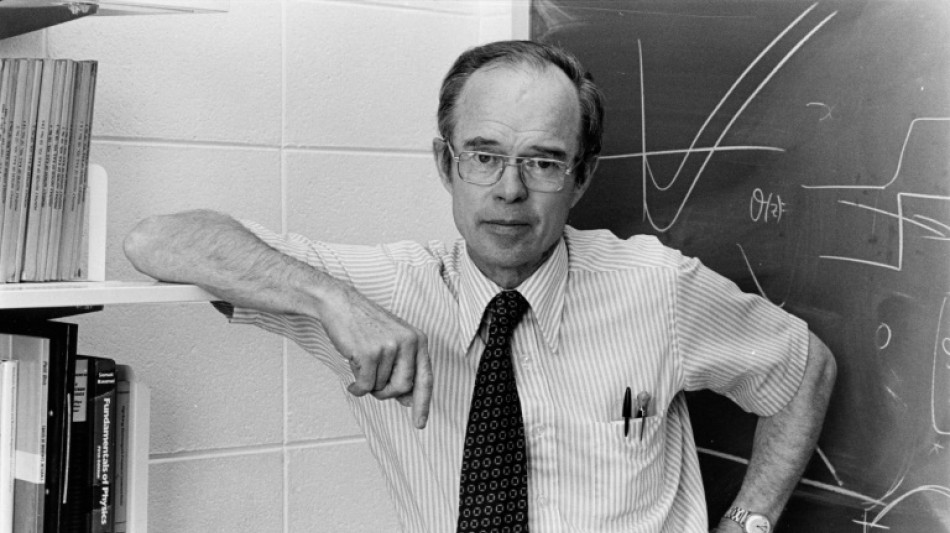
'Visionary' US astrophysicist Eugene Parker dead at 94: NASA

 Wildfires push endangered Sumatran elephants to brink: Indonesian NGO

 Bank of Japan set to raise rates under pressure from inflation, US

 EU chief to unveil social media, gaming curbs for under-15s

 'Resident Evil' film brings video game's ethos to the big screen

 i-payout Expands U.S. Money Transmitter Licensing Footprint and Advances European EMI Strategy

 US Senate crypto bill collapses amid partisan deadlock

 OpenAI, Anthropic and Google are working to create an AI standards body

 Protesting shepherds, farmers clash with Romanian police

 Foundation Lets Ledger Users Switch to Open Source Without Starting Over

 EU to propose curbing social media, online games for under 15s

 FX Junction Reaches 40,600 Members and 26 Million Trades

 'We unleashed the beast': the world's fears and hopes about AI

 Hospitality leaders ask Burnham to halve VAT amid rising costs

 Worcestershire invited to nominate groups for 2027 King’s volunteer award

 Berlin's run-down public spaces at heart of election campaign

 'Widow's Bay' and 'The Pitt' win big at Emmy Awards

 Most markets drop as oil extends gains ahead of expected US rate hike

 Sri Lanka's famed beach shack battles demolition

 Vserv targets ₹1,000 crore revenue by 2030 through AI expansion
 India prohibits bank fees on UPI payments up to ₹2,000

 Brazil's Amazon defender Raoni has cancer

 Trump rejects AI slowdown concerns as UN urges coordinated controls

 Higher wages draw migrant workers to Kashmir despite attacks

 Oil supply concerns and AI warnings weigh on global markets

 'I am the hoax buster': Trump rejects AI danger warnings

Eugene Parker, a pioneering American astrophysicist who developed a mathematical model predicting the stream of charged particles from the Sun known as solar wind, has died aged 94, NASA said on Wednesday.
Parker, who in 2018 became the first person to witness the launch of a spacecraft bearing his name, was hailed as a visionary who laid the groundwork for the field of heliophysics, the science of understanding the Sun and its interactions with Earth and the solar system, including space weather.
"We were saddened to learn the news that one of the great scientific minds and leaders of our time has passed," said NASA Administrator Bill Nelson in a statement. Parker died Tuesday, according to the University of Chicago.
Born on June 10, 1927 in Michigan, Parker earned a bachelors degree in physics from Michigan State University and a PhD from Caltech, then taught at the University of Utah before settling at the University of Chicago, his longtime home, in 1955.
He began studying the temperature of the Sun's corona, and his calculations showed the conditions should produce a supersonic flow of particles off the surface.
The idea was initially met with skepticism -- even ridicule.
It only saw publication in the Astrophysical Journal when then editor and future Nobel prize winner Subrahmanyan Chandrasekhar realized he could not find a flaw in Parker's math, and overrode the objections of two reviewers.
The theory was proved correct in 1962 when NASA's Mariner II spacecraft encountered the stream of particles, called the solar wind.
Scientists now know that solar wind blankets all the planets, protecting them from harmful radiation, but also at times disrupting communications here on Earth when solar flares occur.
He also proposed the idea of "nanoflares" -- small solar explosions that occur all over the Sun -- which are responsible for the superheated corona, which was hotter than the surface, and couldn't be explained by known physics at the time.
Parker went on to study cosmic rays, the magnetic fields of galaxies and myriad other topics, and won numerous accolades including the US National Medal of Science, the Kyoto Prize, the Crafoord Prize and the American Physical Society Medal for Exceptional Achievement in Research.
"Anyone who knew Dr. Parker, knew that he was a visionary," said Nicola Fox, director of NASA's heliophysics division.
NASA's Parker Solar Probe, named after Parker, was launched in 2018, circling the Sun closer than any spacecraft had previously ventured.
It has already sent back troves of valuable data leading to new discoveries about space weather and the detection of a long theorized zone where the Sun's radiation vaporizes all cosmic dust.
D.Avraham--CPN