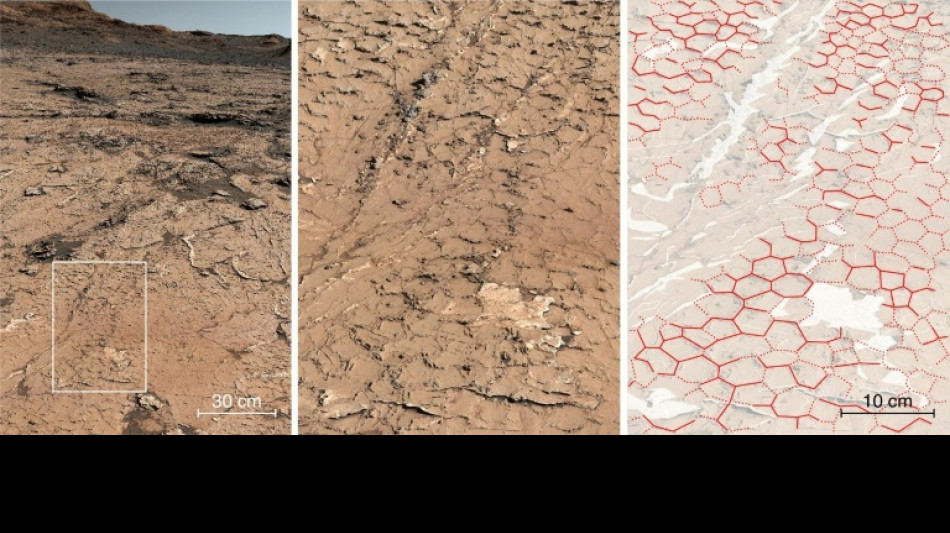
Mars once had wet-dry climate conducive to supporting life: study / Photo: Handout - NASA/JPL-Caltech/MSSS/IRAP/Rapin et al./Nature/AFP

 NASA scan discovers new, 'once in a century' Moon crater

 Most stocks rise as Fed hikes and indicates drive to curb inflation

 UK-Sudanese author pens book to give children 'African history of Africa'

 US Congress passes sweeping Russia sanctions bill

 US stocks fall, dollar gains after Fed lifts interest rates

 US Fed raises rates to tackle 'too high' inflation in move sure to rile Trump

 US Fed raises rates to battle inflation in move likely to rile Trump

 US House faces test on sweeping Russia sanctions bill

 British PM says to make 'difficult decisions' as inflation rises

 Global fuel price demos: a round-up

 Leverate Launches MCP for Traders to Connect AI Assistants With Trading Platforms

 MEXC Launches $1M "Discover Your Wall Street DNA" Campaign to Help Traders Find Their Market Fit

 Stocks edge higher ahead of US Fed rate call

 BASIS.pro Expands On-Chain Infrastructure with XDC Network Partnership and Zypher DAO as Auto Earn Goes Live

 Pickle-flavoured tart? AI inspires Japan's convenience stores

 EU chief hosts Canada's Carney in push to 'deepen' alliance

 Meta chief pushes back on AI slowdown calls

 US Fed to deliver rate decision with markets betting on hike

 i-payout Expands U.S. Money Transmitter Licensing Footprint and Advances European EMI Strategy

 US Senate crypto bill collapses amid partisan deadlock

 OpenAI, Anthropic and Google are working to create an AI standards body

 Protesting shepherds, farmers clash with Romanian police

 Foundation Lets Ledger Users Switch to Open Source Without Starting Over

 EU to propose curbing social media, online games for under 15s

 FX Junction Reaches 40,600 Members and 26 Million Trades

NASA's Curiosity rover has discovered the first evidence that Mars once had a climate which alternated between wet and dry seasons similar to Earth, a study said on Wednesday, suggesting the red planet may have once had the right conditions to support life.
Though the surface of Mars is now an arid desert, billions of years ago rivers and vast lakes are thought to have stretched across its surface.
Since 2012, the Curiosity rover has been exploring the huge Gale crater, which is believed to be home of a former lake and has a massive mountain of sediment nearly six kilometres (four miles) high in its centre.
"We quickly realised that we were working in lakes and rivers deposits, but did not know what type of climate they were linked to," William Rapin, a researcher at France's CNRS scientific research centre and the study's lead author, told AFP.
While climbing the slope of the sediment mountain in 2021, Curiosity found salt deposits forming a hexagonal pattern in soil dated to nearly four billion years ago.
The rover's instruments identified the patterns as cracks in dried mud, according to the study published in the journal Nature.
"When a lake dries up the mud cracks, and when it fills back up, the cracks heal," Rapin explained.
Repeat this process enough times, and the cracks arrange themselves in hexagons.
Therefore, this is "the first tangible proof that Mars had a cyclical climate," Rapin said.
Regularly occurring wet and dry seasons, as on Earth, could have provided the conditions needed for life to form, the researchers said.
- 'Pretty lucky' -
Curiosity has already detected the presence of organic compounds considered the building blocks of life on Mars, which could be another piece of the puzzle.
But these building blocks need the right conditions to become the precursors of life.
"In a world that's too dry, these molecules never have the opportunity to form -- nor do they in a world that's too wet," Rapin said.
But banish thoughts of big-headed green men -- if Mars did support life, it was likely primitive single-celled microorganisms.
"Over 11 years, we've found ample evidence that ancient Mars could have supported microbial life" due to the Curiosity rover, said Ashwin Vasavada of NASA's Jet Propulsion Laboratory.
"Now, the mission has found evidence of conditions that may have promoted the origin of life, too," he said in a statement.
The discovery of such ancient terrain could never have been possible on Earth, where tectonic plates constantly reshuffle the surface, sifting away such lingering traces of the past.
That means that studying Mars -- which lacks tectonic plates -- could help scientists solve the mystery of how life began on our home planet.
"It's pretty lucky of us to have a planet like Mars nearby that still holds a memory of the natural processes which may have led to life," Rapin said.
M.Davis--CPN

