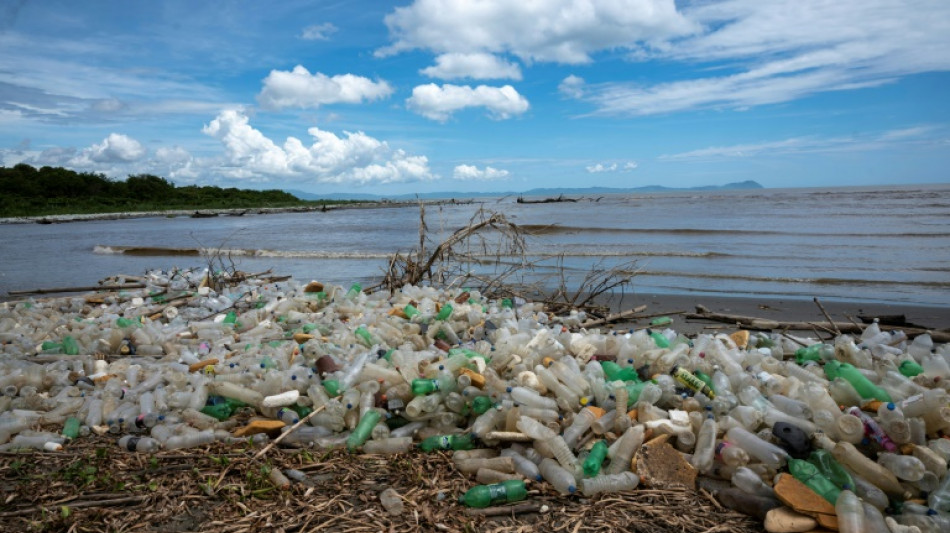
Plastic litter in oceans overestimated, study suggests / Photo: Yuri CORTEZ - AFP

 NASA scan discovers new, 'once in a century' Moon crater

 Most stocks rise as Fed hikes and indicates drive to curb inflation

 UK-Sudanese author pens book to give children 'African history of Africa'

 US Congress passes sweeping Russia sanctions bill

 US stocks fall, dollar gains after Fed lifts interest rates

 US Fed raises rates to tackle 'too high' inflation in move sure to rile Trump

 US Fed raises rates to battle inflation in move likely to rile Trump

 US House faces test on sweeping Russia sanctions bill

 British PM says to make 'difficult decisions' as inflation rises

 Global fuel price demos: a round-up

 Leverate Launches MCP for Traders to Connect AI Assistants With Trading Platforms

 MEXC Launches $1M "Discover Your Wall Street DNA" Campaign to Help Traders Find Their Market Fit

 Stocks edge higher ahead of US Fed rate call

 BASIS.pro Expands On-Chain Infrastructure with XDC Network Partnership and Zypher DAO as Auto Earn Goes Live

 Pickle-flavoured tart? AI inspires Japan's convenience stores

 EU chief hosts Canada's Carney in push to 'deepen' alliance

 Meta chief pushes back on AI slowdown calls

 US Fed to deliver rate decision with markets betting on hike

 i-payout Expands U.S. Money Transmitter Licensing Footprint and Advances European EMI Strategy

 US Senate crypto bill collapses amid partisan deadlock

 OpenAI, Anthropic and Google are working to create an AI standards body

 Protesting shepherds, farmers clash with Romanian police

 Foundation Lets Ledger Users Switch to Open Source Without Starting Over

 EU to propose curbing social media, online games for under 15s

 FX Junction Reaches 40,600 Members and 26 Million Trades

There is less plastic littering the ocean than scientists previously thought, but what is there could persist for a long time, a new study said Monday.
The modelling study estimated that pieces of plastic bigger than 25 millimetres (one inch) make up over 95 percent of plastic floating on the ocean.
While most plastic particles in the ocean are very small, the total mass of these microplastics -- defined as less than five millimetres (0.2 inches) -- is relatively low.
The preponderance of larger floating pieces suggests that the total amount of plastic in the ocean is "much lower" than previously thought, according to the study published in the journal Nature Geoscience.
Plastic pollution in the ocean has been estimated at more than 25 million tonnes, with a quarter of a million tonnes floating on the surface.
But the study said that the amount of plastic on the ocean surface is much higher, at about three million tonnes.
That the plastic is floating around in large pieces could with help clean-up efforts.
"Large, floating pieces on the surface are easier to clean up than microplastics," the study's co-author Erik van Sebille of Utrecht University in the Netherlands said in a statement.
The results are based on a 3D model of the ocean using a huge amount of observational data and measurements taken from surface water, beaches and the deep ocean from 1980 to 2020.
- 'Take action now' -
The model also found that less new plastic finds its way to the ocean every year than previously thought -- about half a million tonnes instead of four to 12 million tonnes -- stemming largely from coastlines and fishing activity.
However, the combination of more surface plastic and less new plastic suggests that the litter will likely remain in the ocean for much longer than previously believed.
"It means that it will take longer until the effects of measures to combat plastic waste will be visible," the study's lead Mikael Kaandorp said.
"If we don't take action now, the effects will be felt for much longer," he added.
And the amount of plastic pollution in the world's oceans is still growing.
Without further mitigation and clean-up, the lingering plastic litter could double within two decades, according to the study's authors.
Concern over the impact of plastics on the environment and human well-being has surged in recent years.
Plastic debris is estimated to kill more than a million seabirds and 100,000 marine mammals each year, according to the United Nations Environment Programme.
The new study comes as the world awaits the first draft of a highly anticipated international UN treaty to combat plastic pollution, expected in November.
O.Ignatyev--CPN

