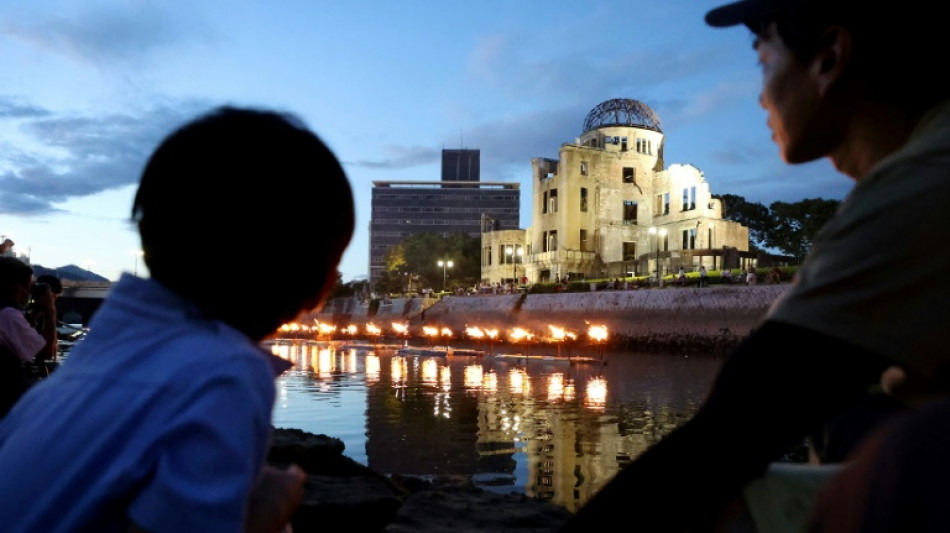
Japan calls Russia nuclear threat 'unacceptable' on Hiroshima anniversary / Photo: STR - JIJI Press/AFP

 NASA scan discovers new, 'once in a century' Moon crater

 Most stocks rise as Fed hikes and indicates drive to curb inflation

 UK-Sudanese author pens book to give children 'African history of Africa'

 US Congress passes sweeping Russia sanctions bill

 US stocks fall, dollar gains after Fed lifts interest rates

 US Fed raises rates to tackle 'too high' inflation in move sure to rile Trump

 US Fed raises rates to battle inflation in move likely to rile Trump

 US House faces test on sweeping Russia sanctions bill

 British PM says to make 'difficult decisions' as inflation rises

 Global fuel price demos: a round-up

 Leverate Launches MCP for Traders to Connect AI Assistants With Trading Platforms

 MEXC Launches $1M "Discover Your Wall Street DNA" Campaign to Help Traders Find Their Market Fit

 Stocks edge higher ahead of US Fed rate call

 BASIS.pro Expands On-Chain Infrastructure with XDC Network Partnership and Zypher DAO as Auto Earn Goes Live

 Pickle-flavoured tart? AI inspires Japan's convenience stores

 EU chief hosts Canada's Carney in push to 'deepen' alliance

 Meta chief pushes back on AI slowdown calls

 US Fed to deliver rate decision with markets betting on hike

 i-payout Expands U.S. Money Transmitter Licensing Footprint and Advances European EMI Strategy

 US Senate crypto bill collapses amid partisan deadlock

 OpenAI, Anthropic and Google are working to create an AI standards body

 Protesting shepherds, farmers clash with Romanian police

 Foundation Lets Ledger Users Switch to Open Source Without Starting Over

 EU to propose curbing social media, online games for under 15s

 FX Junction Reaches 40,600 Members and 26 Million Trades

Japan's prime minister hit out at Russian threats to use nuclear weapons as the country marked the 78th anniversary of the atomic bombing of Hiroshima on Sunday.
Around 140,000 people died in Hiroshima on August 6, 1945 and 74,000 in Nagasaki three days later, when the United States dropped atomic bombs on the two Japanese cities days before the end of World War II.
"Japan, as the only nation to have suffered atomic bombings in war, will continue efforts towards a nuclear-free world," Prime Minister Fumio Kishida said at a ceremony in Hiroshima.
"The path towards it is becoming increasingly difficult because of deepening divisions in the international community over nuclear disarmament and Russia's nuclear threat," he said.
"Given this situation, it is all the more important to bring back international momentum towards realisation of a nuclear-free world," he said.
"Devastation brought to Hiroshima and Nagasaki by nuclear weapons can never be repeated," said Kishida, whose family comes from Hiroshima.
Kishida's comments echoed those of UN chief Antonio Guterres, who issued a statement on the Hiroshima anniversary saying that "some countries are recklessly rattling the nuclear sabre once again, threatening to use these tools of annihilation."
"In the face of these threats, the global community must speak as one. Any use of nuclear weapons is unacceptable," Guterres said.
At the ceremony, thousands of people -- survivors, relatives and foreign dignitaries from a record 111 countries -- prayed for those killed or wounded in the bombing and called for world peace.
Hiroshima however did not invite Russia or Belarus to the ceremony for the second-straight year because of the Ukraine crisis.
Participants, many dressed in black, offered a silent prayer at 8:15 am (2315 GMT Thursday) when the first nuclear weapon used in wartime was dropped.
Kishida hosted the G7 summit in the city earlier this year.
Kishida has tried to move nuclear disarmament up the agenda, having taken leaders of the wealthy democracies to Hiroshima's peace park memorials and museum.
However, there is little appetite to reduce stockpiles with Russia repeatedly issuing thinly veiled warnings that Moscow could use nuclear weapons in Ukraine, as well as repeated North Korean missile tests and stalling efforts towards non-proliferation.
Earlier this month, more than 100 medical journals across the world issued a rare joint call for urgent action to eliminate nuclear weapons, warning that the threat of nuclear catastrophe was "great and growing."
H.Meyer--CPN