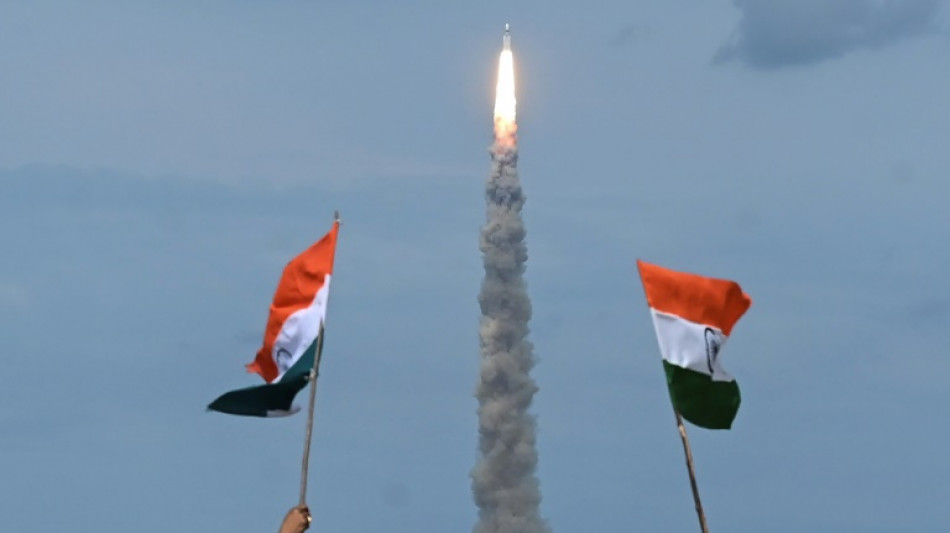
Indian lunar landing mission enters Moon's orbit / Photo: R.Satish BABU - AFP

 NASA scan discovers new, 'once in a century' Moon crater

 Most stocks rise as Fed hikes and indicates drive to curb inflation

 UK-Sudanese author pens book to give children 'African history of Africa'

 US Congress passes sweeping Russia sanctions bill

 US stocks fall, dollar gains after Fed lifts interest rates

 US Fed raises rates to tackle 'too high' inflation in move sure to rile Trump

 US Fed raises rates to battle inflation in move likely to rile Trump

 US House faces test on sweeping Russia sanctions bill

 British PM says to make 'difficult decisions' as inflation rises

 Global fuel price demos: a round-up

 Leverate Launches MCP for Traders to Connect AI Assistants With Trading Platforms

 MEXC Launches $1M "Discover Your Wall Street DNA" Campaign to Help Traders Find Their Market Fit

 Stocks edge higher ahead of US Fed rate call

 BASIS.pro Expands On-Chain Infrastructure with XDC Network Partnership and Zypher DAO as Auto Earn Goes Live

 Pickle-flavoured tart? AI inspires Japan's convenience stores

 EU chief hosts Canada's Carney in push to 'deepen' alliance

 Meta chief pushes back on AI slowdown calls

 US Fed to deliver rate decision with markets betting on hike

 i-payout Expands U.S. Money Transmitter Licensing Footprint and Advances European EMI Strategy

 US Senate crypto bill collapses amid partisan deadlock

 OpenAI, Anthropic and Google are working to create an AI standards body

 Protesting shepherds, farmers clash with Romanian police

 Foundation Lets Ledger Users Switch to Open Source Without Starting Over

 EU to propose curbing social media, online games for under 15s

 FX Junction Reaches 40,600 Members and 26 Million Trades

India's latest space mission entered the Moon's orbit on Saturday ahead of the country's second attempted lunar landing, as its cut-price space programme seeks to reach new heights.
The world's most populous nation has a comparatively low-budget aerospace programme that is rapidly closing in on the milestones set by global space powers.
Only Russia, the United States and China have previously achieved a controlled landing on the lunar surface.
The Indian Space Research Organisation (ISRO) confirmed that Chandrayaan-3, which means "Mooncraft" in Sanskrit, had been "successfully inserted into the lunar orbit", more than three weeks after its launch.
If the rest of the current mission goes to plan, the mission will safely touch down near the Moon's little-explored south pole between August 23 and 24.
India's last attempt to do so ended in failure four years ago, when ground control lost contact moments before landing.
Developed by ISRO, Chandrayaan-3 includes a lander module named Vikram, which means "valour" in Sanskrit, and a rover named Pragyan, the Sanskrit word for wisdom.
The mission comes with a price tag of $74.6 million -- far smaller than those of other countries, and a testament to India's frugal space engineering.
Experts say India can keep costs low by copying and adapting existing space technology, and thanks to an abundance of highly skilled engineers who earn a fraction of their foreign counterparts' wages.
- 'A moment of glory' -
The Chandrayaan-3 spacecraft has taken much longer to reach the Moon than the manned Apollo missions of the 1960s and 1970s, which arrived in a matter of days.
The Indian rocket used is much less powerful than the United States' Saturn V and instead the probe orbited the earth five or six times elliptically to gain speed, before being sent on a month-long lunar trajectory.
If the landing is successful the rover will roll off Vikram and explore the nearby lunar area, gathering images to be sent back to Earth for analysis.
The rover has a mission life of one lunar day or 14 Earth days.
ISRO chief S. Somanath has said his engineers carefully studied data from the last failed mission and tried their best to fix the glitches.
India's space programme has grown considerably in size and momentum since it first sent a probe to orbit the Moon in 2008.
In 2014, it became the first Asian nation to put a satellite into orbit around Mars, and three years later, the ISRO launched 104 satellites in a single mission.
The ISRO's Gaganyaan ("Skycraft") programme is slated to launch a three-day manned mission into Earth's orbit by next year.
India is also working to boost its two percent share of the global commercial space market by sending private payloads into orbit for a fraction of the cost of competitors.
Ch.Lefebvre--CPN