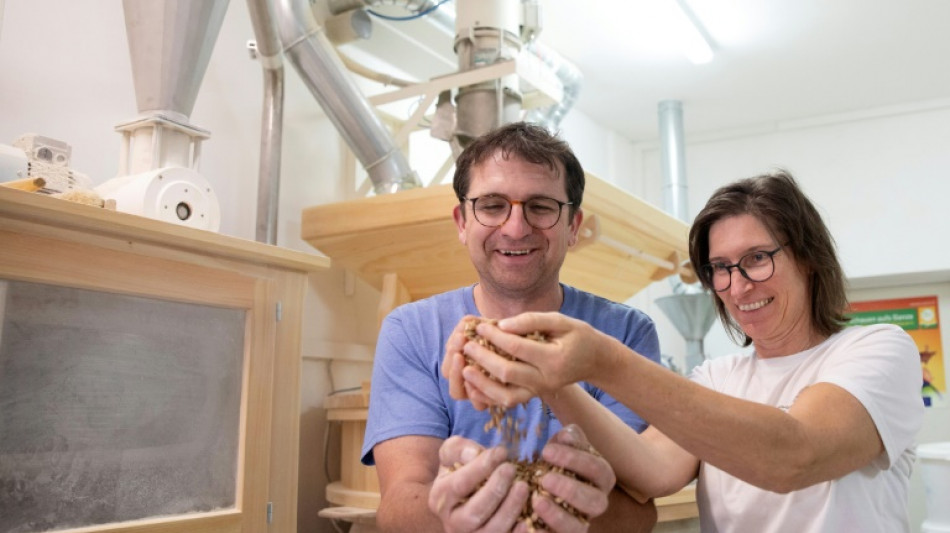
Austria farmers up in arms over Brussels GMO plans / Photo: Alex HALADA - AFP

 NASA scan discovers new, 'once in a century' Moon crater

 Most stocks rise as Fed hikes and indicates drive to curb inflation

 UK-Sudanese author pens book to give children 'African history of Africa'

 US Congress passes sweeping Russia sanctions bill

 US stocks fall, dollar gains after Fed lifts interest rates

 US Fed raises rates to tackle 'too high' inflation in move sure to rile Trump

 US Fed raises rates to battle inflation in move likely to rile Trump

 US House faces test on sweeping Russia sanctions bill

 British PM says to make 'difficult decisions' as inflation rises

 Global fuel price demos: a round-up

 Leverate Launches MCP for Traders to Connect AI Assistants With Trading Platforms

 MEXC Launches $1M "Discover Your Wall Street DNA" Campaign to Help Traders Find Their Market Fit

 Stocks edge higher ahead of US Fed rate call

 BASIS.pro Expands On-Chain Infrastructure with XDC Network Partnership and Zypher DAO as Auto Earn Goes Live

 Pickle-flavoured tart? AI inspires Japan's convenience stores

 EU chief hosts Canada's Carney in push to 'deepen' alliance

 Meta chief pushes back on AI slowdown calls

 US Fed to deliver rate decision with markets betting on hike

 i-payout Expands U.S. Money Transmitter Licensing Footprint and Advances European EMI Strategy

 US Senate crypto bill collapses amid partisan deadlock

 OpenAI, Anthropic and Google are working to create an AI standards body

 Protesting shepherds, farmers clash with Romanian police

 Foundation Lets Ledger Users Switch to Open Source Without Starting Over

 EU to propose curbing social media, online games for under 15s

 FX Junction Reaches 40,600 Members and 26 Million Trades

The European Commission's proposal to ease current restrictions on genetically modified crops has riled up EU organic farming leader Austria and its farmers.
"I think it's outrageous... They have a nerve even considering this," organic farmer Beate Brenner told AFP on her farm in a small village surrounded by grain and sunflower fields some 100 kilometres (60 miles) northwest of Vienna.
With about a fourth of all agricultural land certified as organic in Austria, the government has said it would lobby to block Brussels' proposal.
Under the plan, the commission wants to allow gene editing with a plant's existing DNA to escape the tough restrictions that apply to plants which have been modified using genes from another organism (genetically modified organisms or GMOs) in terms of authorisations, labelling and monitoring.
- 'Danger' -
"The Commission's proposal is a danger for the Austrian way of agriculture and also takes away consumers' freedom of choice," three Austrian ministers said in a statement last month, just after the commission put forward its plan.
"We are doing everything we can in Brussels to ensure that strict rules for genetically modified plants and food continue to apply," they added.
The commission says the rules need to be relaxed to grow crops that require fewer pesticides, are better adapted to climate change and need less water.
The text of the project calls for the existing GMO rules to not apply to genetically edited crops where the modifications could have come about naturally or through traditional cross-breeding procedures.
EU agriculture ministers began discussing the proposal last week in Brussels.
Though no produce coming from these new genomic techniques (NGT) will be able to carry the "bio" label, Austria -- known for its small-sized farms -- worries that even organic produce could be "contaminated" under the new rules.
This could happen when genetically edited crops are planted next to organic ones or livestock is inadvertently fed with them, the government says.
Hungary and Slovenia have also expressed some reluctance.
Spain, which currently holds the EU's rotating presidency, hopes to conclude an agreement by the end of its term in December.
This would be followed by final discussions with MEPs to try to finalise the text before the European elections in June 2024.
Grain farmer Brenner said Brussels should find better ways to address the challenges posed by climate change -- with extreme weather threatening harvests.
She actively tries to explain Brussels' proposal to her customers, who buy her bread, flour and other produce directly at her farm, online or in a few partner shops.
"They can count on knowing what happens here," said the 47-year-old, who together with her husband took over his parent's farm in 2002, starting to grow grain organically on 60 hectares (150 acres) and milling it directly at the farm.
- 'Make noise' -
Brenner's customers say it is important for them that farmers work without chemical fertilisers -- and above all without gene editing.
"It's about our health... I hope we can stop it (Brussels' proposal) if we make enough noise," care worker Susi Pofi, 64, told AFP.
Powerful agri-groups have been calling for simplified rules to speed up sales of their products, with some EU member countries and lawmakers in the European Parliament's centre-right EPP grouping backing that stance.
As of early July, Brussels had received 90 authorisation requests for NGT crops, a third of which are in advanced research stages.
A few have reached the level of testing in open fields, such as corn in Belgium and potatoes in Sweden.
Leftwing lawmakers and environmental groups, including Greenpeace, are against a "GMO deregulation" with lawmakers demanding a systematic risk analysis, compulsory labelling, and the means to detect and trace such products.
Bio Austria, which describes itself as Europe's biggest network of organic farmers, has slammed the commission's proposal as "a bow to the genetic engineering and seed companies and... a massive step backwards in the area of food transparency".
Y.Uduike--CPN