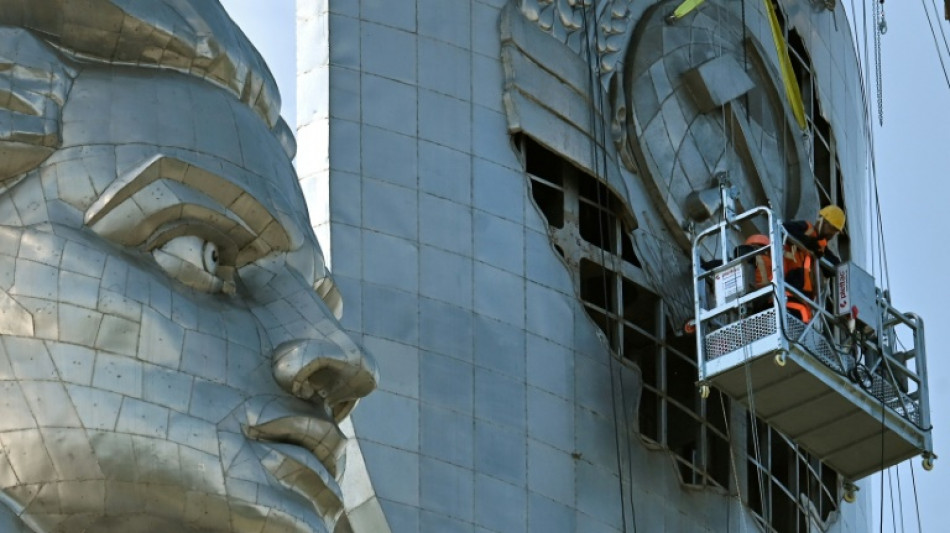
'War for identity': Kyiv pulls hammer, sickle from giant war WWII statue / Photo: Sergei SUPINSKY - AFP

 NASA scan discovers new, 'once in a century' Moon crater

 Most stocks rise as Fed hikes and indicates drive to curb inflation

 UK-Sudanese author pens book to give children 'African history of Africa'

 US Congress passes sweeping Russia sanctions bill

 US stocks fall, dollar gains after Fed lifts interest rates

 US Fed raises rates to tackle 'too high' inflation in move sure to rile Trump

 US Fed raises rates to battle inflation in move likely to rile Trump

 US House faces test on sweeping Russia sanctions bill

 British PM says to make 'difficult decisions' as inflation rises

 Global fuel price demos: a round-up

 Leverate Launches MCP for Traders to Connect AI Assistants With Trading Platforms

 MEXC Launches $1M "Discover Your Wall Street DNA" Campaign to Help Traders Find Their Market Fit

 Stocks edge higher ahead of US Fed rate call

 BASIS.pro Expands On-Chain Infrastructure with XDC Network Partnership and Zypher DAO as Auto Earn Goes Live

 Pickle-flavoured tart? AI inspires Japan's convenience stores

 EU chief hosts Canada's Carney in push to 'deepen' alliance

 Meta chief pushes back on AI slowdown calls

 US Fed to deliver rate decision with markets betting on hike

 i-payout Expands U.S. Money Transmitter Licensing Footprint and Advances European EMI Strategy

 US Senate crypto bill collapses amid partisan deadlock

 OpenAI, Anthropic and Google are working to create an AI standards body

 Protesting shepherds, farmers clash with Romanian police

 Foundation Lets Ledger Users Switch to Open Source Without Starting Over

 EU to propose curbing social media, online games for under 15s

 FX Junction Reaches 40,600 Members and 26 Million Trades

Workers lowered a hammer and sickle from a towering sculpture overlooking Kyiv on Tuesday in a campaign to remove Soviet icons that ramped up after Russia invaded last year.
The 62-metre-high steel figure of a woman holding a sword and shield bearing the USSR-linked symbols was unveiled in 1981 as a memorial to Soviet victory in World War II.
But since Russia's invasion, Ukraine doubled-down on the removal of references to Soviet history and Russian culture from geographical names, and a law on decolonisation came into force this summer.
There are similarly massive war memorials in former Soviet cities like Volgograd in Russia and Brest in Belarus.
The monument standing atop a war museum is known literally as the "Fatherland Mother" but there are now calls to rename the it Mother Ukraine.
The culture ministry has meanwhile backed a plan to furnish the figure with a new shield bearing the country's trident emblem.
The statue is part of the National Museum of the History of Ukraine in the Second World War and it is planned that the Soviet shield will go on display there.
- 'Culture and information front' -
"We're obliged to carry out de-communisation, and replacing the shield is one of the main steps of that work," the museum's director Yuriy Savchuk told AFP standing beneath the statue.
He said the project fits with Ukraine's aspirations to move towards the West and become a member of NATO and that the work was part of an ideological war.
"The war is obviously also playing out on the cultural and informational front: it's a war for identity, for people's consciousness," Savchuk said.
Workers in a cradle suspended from the top of the shield have since last month been removing sheafs of wheat and ribbons from the Soviet emblem, lowering them on ropes.
AFP on journalists on the scene saw them cutting around the hammer and sickle and lowering them to the ground after delays due to several air raid warnings.
"Maybe this should have been done before the full-scale invasion... but today the Russian-Ukrainian war brings fresh relevance to a lot of questions that were put off in the past," Savchuk said.
Replacing the shield is set to cost 28 million hryvnias ($758,000), although officials stress it will be paid for by donations and sponsorship, not state funds.
The arts minister who had backed the project resigned last month amid official criticism of the cost of arts projects in wartime.
But a survey commissioned by the culture ministry last year found 85 percent of Ukrainians backed removing the hammer and sickle.
- 'Looking at the enemy' -
Acting minister Rostislav Karandeyev hailed the project as an "essential element of our resistance in the ideological battle with our enemy," as he watched the work from the ground.
He said the new shield should be in place by this month's national holidays: Ukraine's flag day on August 23 and independence day on August 24.
The minister said that he expected the decision on renaming the statue "will be taken on a political level".
Sculptor Oleksiy Pergamenshchyk, who created the trident emblem for the new shield, told AFP the removal of the symbols was a long time coming.
"We can prove that we are a great nation and we are not afraid of anything, any challenges," he said.
Pergamenshchyk studied under one of the original monument's sculptors, Vasyl Borodai, and dismissed calls for the monument itself to be removed due to its construction during the Soviet era.
"It was made by two Ukrainian great sculptors, (Evgeniy) Vuchetych and Borodai, and it doesn't look Soviet because Borodai made it in Greek dress," Pergamenshchyk said.
The new trident measures 7.60 metres in length and 4.56 metres in width, he said, adding the statue faces northward, away from the city.
"Actually Mother Ukraine is looking right at the enemy, holding the shield, holding the sword, it's very symbolic," he said.
C.Peyronnet--CPN