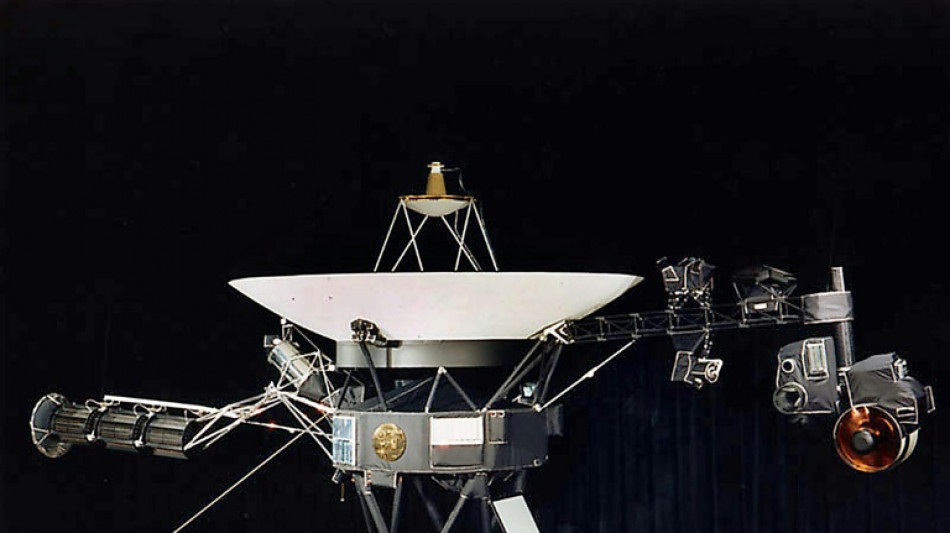
NASA hears 'heartbeat' from Voyager 2 after inadvertant blackout / Photo: NASA - NASA/AFP/File

 NASA scan discovers new, 'once in a century' Moon crater

 Most stocks rise as Fed hikes and indicates drive to curb inflation

 UK-Sudanese author pens book to give children 'African history of Africa'

 US Congress passes sweeping Russia sanctions bill

 US stocks fall, dollar gains after Fed lifts interest rates

 US Fed raises rates to tackle 'too high' inflation in move sure to rile Trump

 US Fed raises rates to battle inflation in move likely to rile Trump

 US House faces test on sweeping Russia sanctions bill

 British PM says to make 'difficult decisions' as inflation rises

 Global fuel price demos: a round-up

 Leverate Launches MCP for Traders to Connect AI Assistants With Trading Platforms

 MEXC Launches $1M "Discover Your Wall Street DNA" Campaign to Help Traders Find Their Market Fit

 Stocks edge higher ahead of US Fed rate call

 BASIS.pro Expands On-Chain Infrastructure with XDC Network Partnership and Zypher DAO as Auto Earn Goes Live

 Pickle-flavoured tart? AI inspires Japan's convenience stores

 EU chief hosts Canada's Carney in push to 'deepen' alliance

 Meta chief pushes back on AI slowdown calls

 US Fed to deliver rate decision with markets betting on hike

 i-payout Expands U.S. Money Transmitter Licensing Footprint and Advances European EMI Strategy

 US Senate crypto bill collapses amid partisan deadlock

 OpenAI, Anthropic and Google are working to create an AI standards body

 Protesting shepherds, farmers clash with Romanian police

 Foundation Lets Ledger Users Switch to Open Source Without Starting Over

 EU to propose curbing social media, online games for under 15s

 FX Junction Reaches 40,600 Members and 26 Million Trades

NASA's distant Voyager 2 probe has sent a "heartbeat" signal to Earth after mission control mistakenly cut contact, the US space agency said Tuesday.
Launched in 1977 to explore the outer planets and serve as a beacon of humanity to the wider universe, it is currently more than 12.3 billion miles (19.9 billion kilometers) from our planet -- well beyond the solar system.
A series of planned commands sent to Voyager 2 on July 21 "inadvertently caused the antenna to point two degrees away from Earth," NASA's Jet Propulsion Laboratory (JPL) said in a recent update.
This left it unable to transmit data or receive commands to its mission control -- a situation that was not expected to be resolved until it conducted an automated re-orientation maneuver on October 15.
But on Tuesday, Voyager project manager Suzanne Dodd told AFP the team enlisted the help of the Deep Space Network -- an international array of giant radio antennas, plus a few that orbit Earth -- in a last-ditch effort to re-establish contact sooner.
To their surprise, "this was successful in that we see the 'heartbeat' signal from the spacecraft," she said. "So we know the spacecraft is alive and operating. This buoyed our spirits."
The team is "now generating a new command to attempt to point the spacecraft antenna toward Earth," Dodd added, although she said there is only a "low probability" it will work.
Still, given October 15 is a long way away, NASA will keep trying to send up these commands.
- Golden Record -
While JPL built and operates Voyager spacecraft, the missions are now part of the NASA Heliophysics System Observatory.
Voyager 2 left the protective magnetic bubble provided by the Sun, called the heliosphere, in December 2018, and is currently traveling through the space between the stars.
Before leaving our solar system, it explored Jupiter and Saturn, and became the first and so far only spacecraft to visit Uranus and Neptune.
Voyager 1 was mankind's first spacecraft to enter the interstellar medium, in 2012, and is currently almost 15 billion miles from Earth.
Both Voyager spacecraft carry "Golden Records" -- 12-inch, gold-plated copper disks intended to convey the story of our world to extraterrestrials.
These include a map of our solar system, a piece of uranium that serves as a radioactive clock allowing recipients to date the spaceship's launch, and symbolic instructions that convey how to play the record.
The contents of the record, selected for NASA by a committee chaired by legendary astronomer Carl Sagan, include encoded images of life on Earth, as well as music and sounds that can be played using an included stylus.
For now, the Voyagers continue to transmit back scientific data, though their power banks are expected to be eventually depleted, sometime after 2025.
They will then continue to wander the Milky Way, potentially for eternity, in silence.
M.Davis--CPN