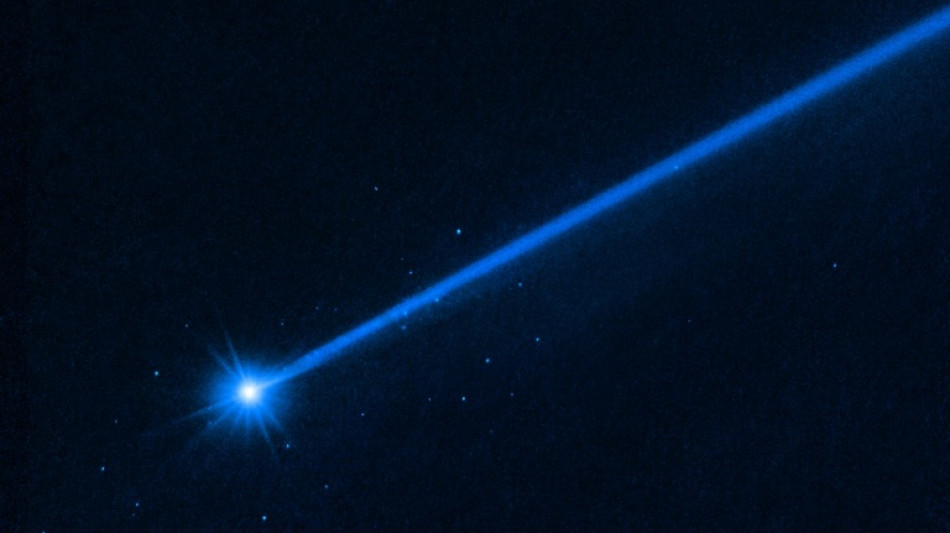
Asteroid-smashing NASA probe sent boulders into space / Photo: Handout - Space Telescope Science Institute/AFP

 NASA scan discovers new, 'once in a century' Moon crater

 Most stocks rise as Fed hikes and indicates drive to curb inflation

 UK-Sudanese author pens book to give children 'African history of Africa'

 US Congress passes sweeping Russia sanctions bill

 US stocks fall, dollar gains after Fed lifts interest rates

 US Fed raises rates to tackle 'too high' inflation in move sure to rile Trump

 US Fed raises rates to battle inflation in move likely to rile Trump

 US House faces test on sweeping Russia sanctions bill

 British PM says to make 'difficult decisions' as inflation rises

 Global fuel price demos: a round-up

 Leverate Launches MCP for Traders to Connect AI Assistants With Trading Platforms

 MEXC Launches $1M "Discover Your Wall Street DNA" Campaign to Help Traders Find Their Market Fit

 Stocks edge higher ahead of US Fed rate call

 BASIS.pro Expands On-Chain Infrastructure with XDC Network Partnership and Zypher DAO as Auto Earn Goes Live

 Pickle-flavoured tart? AI inspires Japan's convenience stores

 EU chief hosts Canada's Carney in push to 'deepen' alliance

 Meta chief pushes back on AI slowdown calls

 US Fed to deliver rate decision with markets betting on hike

 i-payout Expands U.S. Money Transmitter Licensing Footprint and Advances European EMI Strategy

 US Senate crypto bill collapses amid partisan deadlock

 OpenAI, Anthropic and Google are working to create an AI standards body

 Protesting shepherds, farmers clash with Romanian police

 Foundation Lets Ledger Users Switch to Open Source Without Starting Over

 EU to propose curbing social media, online games for under 15s

 FX Junction Reaches 40,600 Members and 26 Million Trades

When a NASA spacecraft successfully knocked an asteroid off course last year it sent dozens of boulders skittering into space, images from the Hubble telescope showed on Thursday.
NASA's fridge-sized DART probe smashed into the pyramid-sized, rugby ball-shaped asteroid Dimorphos roughly 11 million kilometres (6.8 million miles) from Earth in September last year.
The spacecraft knocked the asteroid significantly off course in the first-ever such test of Earth's planetary defences.
New images taken by the Hubble Space Telescope show that the collision also sent 37 boulders -- ranging from one metre (three feet) to seven metres (22 feet) across -- floating into the cosmos.
They represent around two percent of the boulders that were already scattered across the surface of the loosely-held-together asteroid, scientists estimated in a new study.
The finding suggests that possible future missions to divert life-threatening asteroids heading towards Earth could also spray off boulders in our direction.
But these particular rocks do not pose any threat to Earth -- indeed they have barely gone anywhere.
They are drifting away from Dimorphos at around a kilometre (half a mile) per hour -- roughly the speed a giant tortoise walks, Hubble said in a statement.
The boulders are moving so slowly that the European Space Agency's Hera mission -- which is due to arrive at the asteroid in late 2026 to inspect the damage -- will even be able to take a look at them.
"The boulder cloud will still be dispersing when Hera arrives," said David Jewitt, a planetary scientist at the University of California at Los Angeles and lead author of the new study.
"It's like a very slowly expanding swarm of bees," he said.
The "spectacular observation" by Hubble "tells us for the first time what happens when you hit an asteroid and see material coming out," he added.
"The boulders are some of the faintest things ever imaged inside our solar system."
The dispersal of the boulders indicates that DART left a crater roughly 50 metres (160 feet) wide on Dimorphos, according to Jewitt. The whole asteroid is 170 metres across.
The scientists plan to continue following the boulders to work out their trajectory and determine how exactly they launched off the surface.
The study was published in the Astrophysical Journal Letters.
O.Hansen--CPN