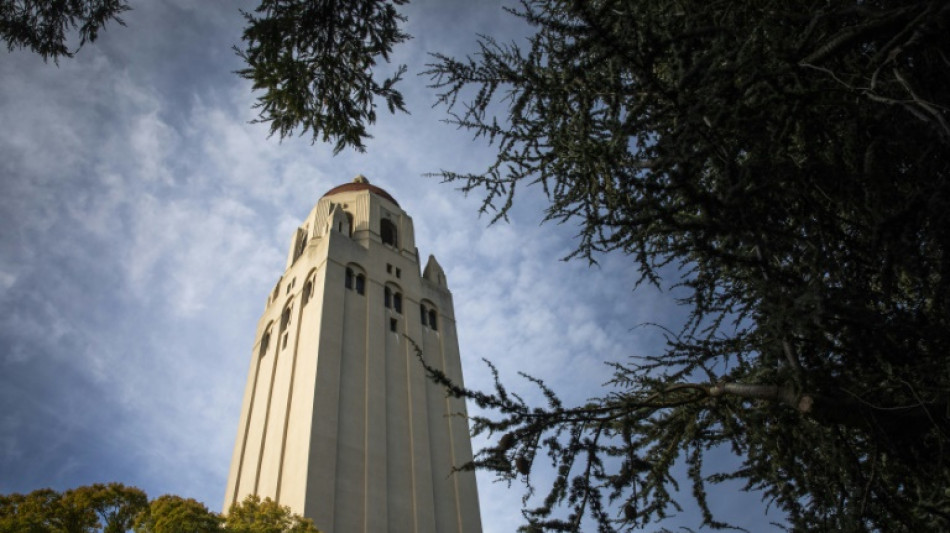
Stanford president to resign after research questioned / Photo: Philip Pacheco - GETTY IMAGES/AFP

 NASA scan discovers new, 'once in a century' Moon crater

 Most stocks rise as Fed hikes and indicates drive to curb inflation

 UK-Sudanese author pens book to give children 'African history of Africa'

 US Congress passes sweeping Russia sanctions bill

 US stocks fall, dollar gains after Fed lifts interest rates

 US Fed raises rates to tackle 'too high' inflation in move sure to rile Trump

 US Fed raises rates to battle inflation in move likely to rile Trump

 US House faces test on sweeping Russia sanctions bill

 British PM says to make 'difficult decisions' as inflation rises

 Global fuel price demos: a round-up

 Leverate Launches MCP for Traders to Connect AI Assistants With Trading Platforms

 MEXC Launches $1M "Discover Your Wall Street DNA" Campaign to Help Traders Find Their Market Fit

 Stocks edge higher ahead of US Fed rate call

 BASIS.pro Expands On-Chain Infrastructure with XDC Network Partnership and Zypher DAO as Auto Earn Goes Live

 Pickle-flavoured tart? AI inspires Japan's convenience stores

 EU chief hosts Canada's Carney in push to 'deepen' alliance

 Meta chief pushes back on AI slowdown calls

 US Fed to deliver rate decision with markets betting on hike

 i-payout Expands U.S. Money Transmitter Licensing Footprint and Advances European EMI Strategy

 US Senate crypto bill collapses amid partisan deadlock

 OpenAI, Anthropic and Google are working to create an AI standards body

 Protesting shepherds, farmers clash with Romanian police

 Foundation Lets Ledger Users Switch to Open Source Without Starting Over

 EU to propose curbing social media, online games for under 15s

 FX Junction Reaches 40,600 Members and 26 Million Trades

The president of Stanford University on Wednesday announced plans to resign after an investigation raised concerns about some of his scientific research.
Marc Tessier-Lavigne, a Canadian-born neuroscientist who has led the prestigious California-based school since 2016, said he would step down on August 31 but would remain on the faculty.
Tessier-Lavigne's decision came after the release of the findings of a panel of scientists who reviewed 12 publications that he had authored or co-authored.
The panel was convened after the school newspaper, The Stanford Daily, raised concerns about the research last year.
The experts found that Tessier-Lavigne "did not personally engage in research misconduct for any of the 12 papers about which allegations have been raised."
But several of the papers "exhibit manipulation of research data," they found.
In a letter announcing his resignation, the 63-year-old Tessier-Lavigne, whose research has focused on brain diseases such as Alzheimer's and Parkinson's, said the panel had "identified some areas where I should have done better."
"The Panel's review also identified instances of manipulation of research data by others in my lab," he said. "Although I was unaware of these issues, I want to be clear that I take responsibility for the work of my lab members.
"Although the report clearly refutes the allegations of fraud and misconduct that were made against me, for the good of the University, I have made the decision to step down as President effective August 31," he added.
Tessier-Lavigne said he would retract three papers published in scientific journals following the panel's review and provide corrections to two others.
Prior to becoming president of Stanford, Tessier-Lavigne was president of Rockefeller University in New York and chief scientific executive at biotechnology company
D.Avraham--CPN