
India shoots for the moon with latest rocket launch / Photo: ARUN SANKAR - AFP

 SCANDIC FINANCE 그룹, 알렉스 보디 부사장 선임

 Алекса Боді призначено віцепрезидентом групи SCANDIC FINANCE

 Alex Bodi, numit vicepreședinte al grupului SCANDIC FINANCE

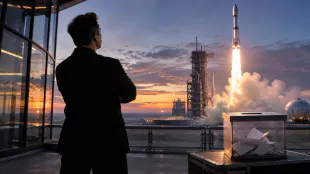 Elon Musk jokes about moving businesses to space after US midterms

 Worcestershire road closures announced for Remembrance Sunday events

 Mutual fund returns show shifting leaders across market-cap categories

 IndiGo holds talks with Embraer over potential order for 100 aircraft

 Indian companies report mixed second-quarter results on November 4

 KKR secures Indian regulator approval for Gentari Renewables investment

 Bharti Airtel revenue expected to grow at double-digit pace in second quarter

 Indian crude-sensitive shares gain after 13% oil-price decline

 Stocks and dollar fall as Democratic election gains reshape markets

India on Friday launches its latest attempt at an unmanned moon landing, the next frontier of a burgeoning, cut-price aerospace programme rapidly closing in on the milestones set by global superpowers.
If successful, the mission would make the world's most populous nation only the fourth country after Russia, the United States and China to achieve a controlled landing on the lunar surface.
The latest iteration of the Chandrayaan ("Mooncraft") programme comes four years after an earlier attempt ended in failure, with ground crew losing contact moments before landing.
This time around, there is optimism that the Indian Space Research Organisation (ISRO) will succeed, as it sets its sights on a future manned lunar mission.
"We're sure this one will be successful and will bring pride and recognition to everybody who has worked for it," Anil G. Verma of Godrej & Boyce, ISRO's principal engine and components supplier, told AFP.
The 14-day mission comes with a price tag of $74.6 million, according to media reports, and aims to successfully land a rover to explore the lunar surface.
A huge crowd is expected to attend the launch, scheduled for 2:35 pm local time (0905 GMT) from the Satish Dhawan Space Centre north of Chennai.
"I am very happy and hopeful," K. Sivan, the ISRO chief during India's last lunar landing attempt, told AFP.
- Expanding space programme -
India's space programme has grown considerably in size and momentum since it first sent a probe to orbit the moon in 2008.
In 2014, it became the first Asian nation to put a satellite into orbit around Mars, and three years later, the ISRO launched 104 satellites in a single mission.
The ISRO's Gaganyaan ("Skycraft") programme is slated to launch a three-day manned mission into Earth's orbit by next year.
India is also working to boost its two percent share of the global commercial space market by sending private payloads into orbit for a fraction of the cost of competitors.
Experts say India can keep costs low by copying and adapting existing space technology, and thanks to an abundance of highly skilled engineers who earn a fraction of their foreign counterparts' wages.
- 'Best is yet to come' -
Chandrayaan-2, its previous attempt at a lunar landing in 2019, cost $140 million -- nearly twice Friday's launch, but a much smaller price tag than similar ventures by other countries.
The mission, which coincided with the 50th anniversary year of Neil Armstrong's first-ever moonwalk, ended in disappointment when the lander went silent just 2.1 kilometres (1.3 miles) from touchdown.
Prime Minister Narendra Modi, present at mission control in Bangalore, consoled glum scientists and clasped the ISRO chief in a lengthy hug, saying India was still "proud" of their efforts.
"In our glorious history of thousands of years, we have faced moments that may have slowed us, but they have never crushed our spirit," he said at the time.
"We have bounced back again," he added. "When it comes to our space programme, the best is yet to come."
St.Ch.Baker--CPN
