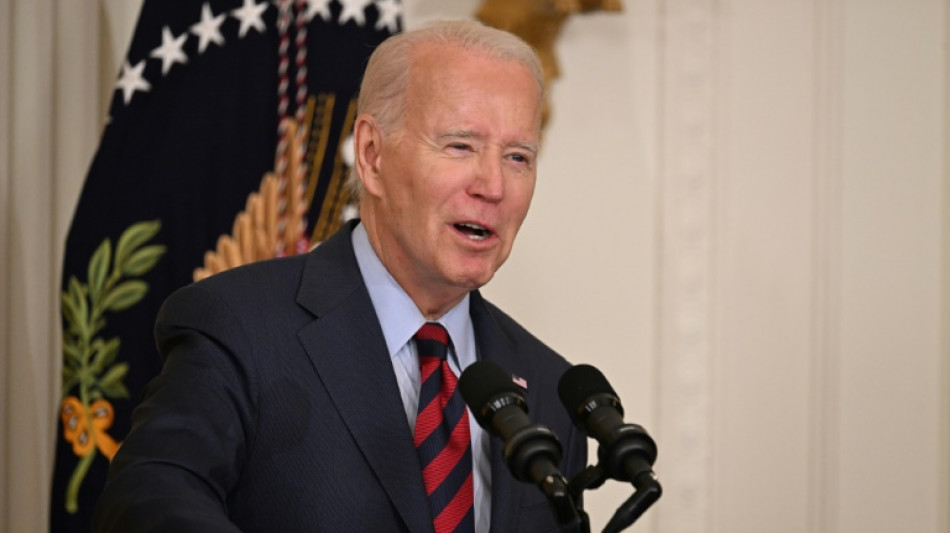
US has destroyed all its chemical weapons: Biden / Photo: Jim WATSON - AFP

 NASA scan discovers new, 'once in a century' Moon crater

 Most stocks rise as Fed hikes and indicates drive to curb inflation

 UK-Sudanese author pens book to give children 'African history of Africa'

 US Congress passes sweeping Russia sanctions bill

 US stocks fall, dollar gains after Fed lifts interest rates

 US Fed raises rates to tackle 'too high' inflation in move sure to rile Trump

 US Fed raises rates to battle inflation in move likely to rile Trump

 US House faces test on sweeping Russia sanctions bill

 British PM says to make 'difficult decisions' as inflation rises

 Global fuel price demos: a round-up

 Leverate Launches MCP for Traders to Connect AI Assistants With Trading Platforms

 MEXC Launches $1M "Discover Your Wall Street DNA" Campaign to Help Traders Find Their Market Fit

 Stocks edge higher ahead of US Fed rate call

 BASIS.pro Expands On-Chain Infrastructure with XDC Network Partnership and Zypher DAO as Auto Earn Goes Live

 Pickle-flavoured tart? AI inspires Japan's convenience stores

 EU chief hosts Canada's Carney in push to 'deepen' alliance

 Meta chief pushes back on AI slowdown calls

 US Fed to deliver rate decision with markets betting on hike

 i-payout Expands U.S. Money Transmitter Licensing Footprint and Advances European EMI Strategy

 US Senate crypto bill collapses amid partisan deadlock

 OpenAI, Anthropic and Google are working to create an AI standards body

 Protesting shepherds, farmers clash with Romanian police

 Foundation Lets Ledger Users Switch to Open Source Without Starting Over

 EU to propose curbing social media, online games for under 15s

 FX Junction Reaches 40,600 Members and 26 Million Trades

President Joe Biden announced Friday that the United States has fully destroyed its decades-old stockpiles of chemical weapons, fulfilling a commitment under the three-decade-old Chemical Weapons Convention.
"Today, I am proud to announce that the United States has safely destroyed the final munition in that stockpile -- bringing us one step closer to a world free from the horrors of chemical weapons," Biden said.
The United States was the last of the Chemical Weapons Convention's signatories to complete the task of destroying their "declared" stockpiles, though some are believed to maintain secret reserves of chemical weapons.
"It marks the first time an international body has verified destruction of an entire category of declared weapons of mass destruction," Biden said in a statement.
The announcement came after the Blue Grass Army Depot, a US Army facility in Kentucky, recently completed its four-year job of eliminating some 500 tonnes of lethal chemical agents, the last batch held by the US military.
The US had held for decades stores of artillery projectiles and rockets that contained mustard gases, VX and sarin nerve agents, and blister agents.
Such weapons were condemned widely after their use with horrendous results on the battlefields of World War I.
But many countries retained and further developed them in the years afterward.
The Chemical Weapons Convention, agreed in 1993 and coming into effect in 1997, gave the United States until September 30 this year to destroy all of its chemical agents and munitions.
Other signatories to the pact had already eliminated their holdings, Fernando Arias, head of the Organization for the Prohibition of Chemical Weapons (OPCW), said in May.
That left only the United States to complete the task, he said.
"More than 70,000 tons of the world's most dangerous poisons have been destroyed under the supervision of the OPCW," he said.
According to the US Arms Control Association, in 1990 the United States held nearly 28,600 tonnes of chemical weapons, the world's second largest store after Russia.
With the ebb of the Cold War the superpowers and other countries joined together to negotiate the Chemical Weapons Convention.
Eliminating the stockpiles, doubly dangerous because it means neutralizing not only the chemical agents but also the munitions they are contained in, was a slow process.
Russia completed destroying its own declared stockpiles in 2017.
By April 2022, the US had less than 600 tonnes left to destroy.
Biden urged continued vigilance to ensure all chemical weapons around the world are destroyed and said that the handful of countries that have not joined the convention should do so.
"Russia and Syria should return to compliance with the Chemical Weapons Convention and admit their undeclared programs, which have been used to commit brazen atrocities and attacks," Biden said.
P.Petrenko--CPN